
Will Chinese AI Leap Ahead or Follow the Global Race? Insights from Chinese AI Leaders
back to All
Intro
On Saturday, some of China’s leading AI figures shared highly insightful perspectives on LLM divergence, next-generation paradigms, and agentic systems, offering a rare window into the country’s evolving role in the global AI race.
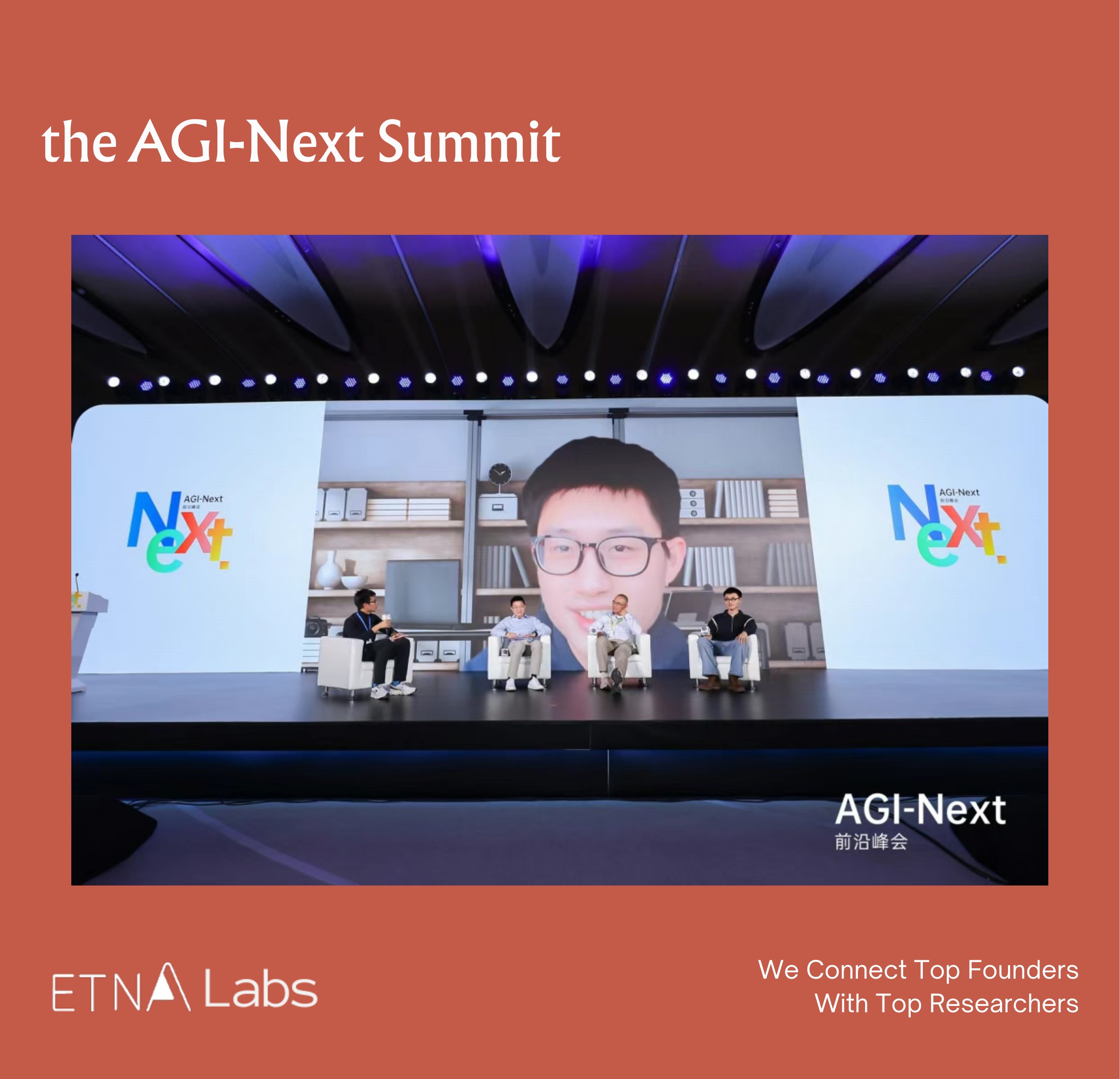
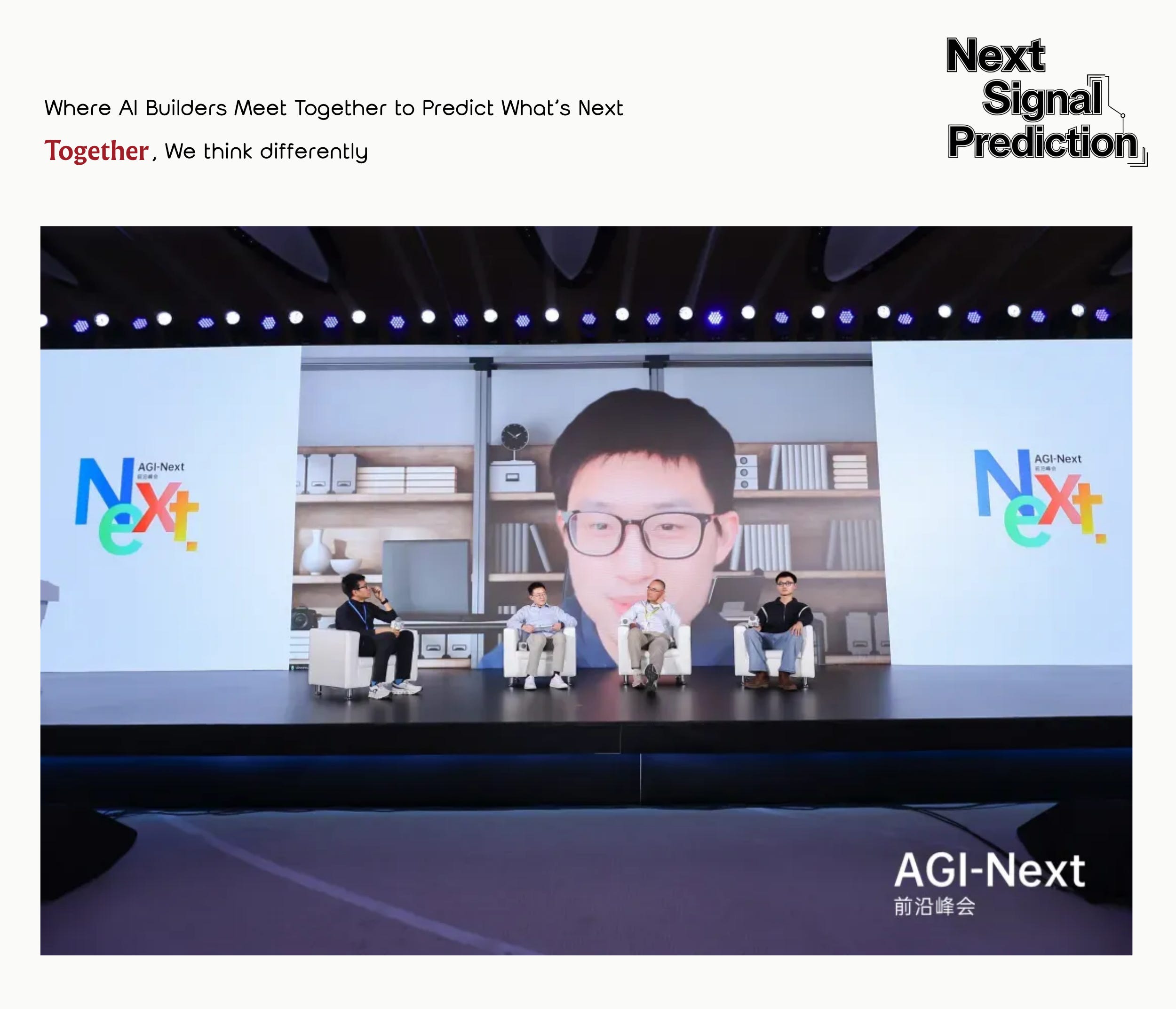
The discussions took place at the AGI‑Next Summit, an event also covered by Bloomberg, bringing together Junyang Lin of Qwen, Shunyu Yao, formerly of OpenAI and now at Tencent, Jie Tang of Zhipu, and Qiang Yang, Fellow of the Canadian Academy of Engineering.
Coinciding with these discussions, DeepSeek released its latest research recently, Conditional Memory via Scalable Lookup: A New Axis of Sparsity for Large Language Models, and open-sourced its core module Engram on GitHub, drawing renewed attention from the global AI community.
We obtained the roundtable meeting minutes from the summit and translated them into English. What follows is a curated, near-verbatim transcript of the discussion, preserving the participants’ original remarks while highlighting the strategic considerations, technical challenges, and future directions that Chinese AI leaders are weighing as they navigate domestic priorities alongside the global AI landscape.
Thanks for reading! Subscribe for free to receive new posts and support our work.
Topic 1: How Will LLMs Diverge?
Host
After listening to the previous talks from the floor, I’d like to share a few reflections.
First, Jie Tang has a rare ability to bring people together. The strength of the Tsinghua network is hard to miss, not just in China, but worldwide. Its presence, including many alumni working abroad, is unusually strong.
Second, based on the presentations we’ve just seen from several Chinese AI companies, my impression is that they are not simply following trends or focusing narrowly on open source. Instead, they are actively exploring the next paradigm, going beyond coding capabilities to experiment with new product forms.
The timing matters. 2025 is becoming a breakout year for Chinese open-source models. Over the past year, coding capabilities have grown by 10 to 20 times. Globally, there’s also renewed debate about the limits of scaling and whether new paradigms are beginning to take shape.
That’s why this conversation, and this panel on what comes next, matters right now.
Let’s start with the first topic, which I think is particularly interesting. If you look at Silicon Valley right now, you can already see clear signs of divergence among the major players. That makes “differentiation” a good place to begin.
Anthropic, in particular, offers an important reference point for Chinese AI model companies. Competition in Silicon Valley is intense, but Anthropic didn’t try to do everything. Instead, it made deliberate choices, focusing on enterprise use cases, on coding, and on agentic systems.
That raises a broader question for China: as the market matures, how will Chinese foundation model companies choose to differentiate? Which directions will they commit to? I think that’s a compelling lens for this discussion.
Why don’t we start with you, Shunyu, tell us a bit about what you’ve been working on recently, and how you’re thinking about this question.
Shunyu Yao
Hi everyone. Am I basically a giant face on the screen right now? Sorry I couldn’t be in Beijing in person today, but I’m really glad to be part of this. Lately I’ve just been heads down building models and products. Honestly, that’s a pretty normal state of life if you’re working in AI. Being back in China feels great too, the food is definitely better.
Host
Could you expand a bit on how you think about this idea of model differentiation? We’re seeing it clearly in Silicon Valley, Anthropic leaning hard into coding, many Chinese models focusing on open source, rapid gains in coding capabilities over the past year. Even Google Gemini didn’t try to do everything at once; it really nailed multimodality first. OpenAI has been very focused on consumer products. Given that you’ve worked across both the US and China, I’d love to hear your perspective. Whether it’s your own work or the broader industry, how are you thinking about where this kind of differentiation goes next?
Shunyu Yao
I have two big takeaways.
First, there’s a clear split emerging between consumer-facing AI and enterprise-focused AI. Second, we’re also seeing divergence between two architectural paths: one centered on vertical integration, and the other on a more modular stack where models and applications are layered separately.
Let me start with the first. When people talk about AI “super apps” today, two products usually come up: ChatGPT and Claude Code. You can think of them as archetypes: ChatGPT on the consumer side, and Claude Code on the enterprise side. What’s interesting is that for most users, most of the time, ChatGPT today doesn’t feel dramatically different from a year ago. The improvements are real, but they’re subtle in everyday use.
Claude Code tells a very different story. A year ago, the coding shift hadn’t really begun. Over the past year, it has started to fundamentally change how work gets done across the software industry. People aren’t really writing code in the traditional sense anymore, they’re increasingly describing what they want in plain English and letting the system do the rest.
At the heart of this is a simple reality: on the consumer side, most people don’t actually need that level of intelligence most of the time. ChatGPT may now be far better at things like abstract algebra or Galois theory than it was a year ago, but that’s not something most users ever notice. For many people, especially in China, it still functions more like a supercharged search engine. And often, users don’t quite know how to interact with it in a way that truly brings out its full capabilities.
On the enterprise side, one clear point stands out: higher intelligence usually translates directly into higher productivity, and in turn, more revenue. Everything is interconnected. Another obvious observation is that businesses are often willing to pay for the best model. For example, one model might cost $200 a month, while a slightly weaker alternative is $50 or $20. What we see, at least in the U.S., is that many users are happy to pay the premium for the top-tier model.
Here’s why: imagine someone earning $200,000 a year who has 10 tasks to complete each day. A strong model like Opus 4.5 might get eight or nine of those tasks right, while a weaker model only gets five or six correct. The problem is, you don’t know in advance which five or six the weaker model will get right, so you end up spending a lot of extra time monitoring and correcting it. In enterprise settings, that gap makes the difference between models increasingly significant.
The second point is about the difference between vertical integration and a layered approach separating models from applications. A good example is ChatGPT with Agent functionality versus using Claude or Gemini with an application layer like Manus. Traditionally, people assumed that vertical integration would always lead to better results. But today, that’s not necessarily true. The skills needed for the model layer and the application layer are quite different. For enterprise and productivity use cases, large-scale pre-training is still critical, but it’s something product-focused companies struggle to do well. At the same time, to fully leverage a strong model, so it delivers real value, you also need significant work on the application side, or in the environment where it’s deployed.
What this means is that for consumer-facing applications, vertical integration still works. ChatGPT or Doubao, for instance, iterate closely between model and product, and the coupling is very tight. But for enterprise applications, the trend seems to be moving the other way: models are getting stronger, but there’s also more space for application-layer innovation, where different tools can take advantage of those models to improve productivity across multiple workflows.
Host
Let me follow up with one more question for you. With your new role at Tencent and your perspective on the Chinese market, what are the key bets or priorities you’re focusing on? Are there any standout themes or keywords you can share with us?
Shunyu Yao
Right. Tencent still has a strong consumer focus, so we’re thinking a lot about how the current wave of LLMs and AI development can deliver real value to users. But one core insight we’ve had is this: often, the bottleneck on the consumer side isn’t simply having a bigger model, better reinforcement learning, or a stronger reward model. More often, it’s about providing richer context and a better environment.
A recent example I often use illustrates this well. Suppose I ask, “What should I eat today?” Whether you ask ChatGPT today, last year, or tomorrow, the experience is often underwhelming. Improving it isn’t about a bigger model or stronger pre-training. The real bottleneck is usually additional input—more context.
For example, if the model knew, “It’s really cold today, I want something warm,” or “I’ll be in this part of the city,” or even “My wife is somewhere else, what might she want to eat?” it could give a much more useful answer. In other words, the bottleneck isn’t intelligence, it’s context. If we could feed a model our chat history from WeChat, or otherwise provide richer inputs, we could deliver far more value to users. This is how we think about the consumer side.
Enterprise AI in China is much harder. The productivity revolution, and the work many Chinese companies are doing building coding agents, often involves entering overseas markets. One key consideration is how to serve our own needs first. The difference between startups and large companies working on coding solutions is that big companies already have many real-world applications where productivity improvements are crucial. If our models perform better in these scenarios, they gain a real advantage and, importantly, capture more diverse real-world data.
Take Anthropic as an example. As a startup building coding agents, they rely on data vendors to label code data. Those vendors depend on engineers to decide what to label. The bottleneck is clear: there are only so many vendors and people, so diversity is limited. A company with 100,000 employees, however, can experiment differently, leveraging real-world data directly rather than relying solely on external labeling or distillation.
Host
Thanks, Shunyu. Let’s ask Junyang next. How do you see the future ecosystem or differentiation bets for Qwen? You’ve emphasized multimodality, and previously Alibaba Cloud was strong on the enterprise side. Now it seems your multimodal focus may lean more toward consumer applications. What are you thinking about this?
Junyang Lin
I can’t comment on company strategy. But I don’t think it’s just about a company’s DNA. Often, the people in each generation shape the company over time.
I’d like to share a bit of our own thinking about AGI. Whether it’s enterprise or consumer, at the end of the day, we’re serving real humans. So the question we ask is: how can we make the human world better? Even if you focus on consumer products, there will still be differentiation. Take OpenAI—it’s increasingly a platform—but if you’re building for consumers, who are the real users you’re ultimately serving?
A lot of AI today naturally gravitates toward specific domains, medical, legal, and so on. I believe Anthropic didn’t necessarily set out thinking, “Coding is hot, let’s bet on it.” They engage deeply with customers, and opportunities emerge organically. That’s something we ourselves still need to improve, even with our advantages. The Chinese SaaS market is different from the U.S.—companies there interact with clients constantly, which makes it easier to spot opportunities.
For example, when I talked with U.S. API providers, many hadn’t expected coding to consume so many tokens. In China, that’s not as pronounced, at least from what I see. In the U.S., coding dominates usage. That’s not something everyone would have predicted. Today, Anthropic is exploring more finance-related applications, again, based on insights from client interactions.
So I see differentiation as largely organic. I tend to believe AGI should focus on doing what AGI is meant to do, and let the rest follow naturally.
Host
Thanks, Junyang. Qiang Yang, how do you view the issue of differentiation?
Qiang Yang
When it comes to differentiation, I actually want to focus on the split between industry and academia. This is something we can observe across both the U.S. and China. Traditionally, academia has been more of an observer, while industry has been charging ahead. Now, many academics are starting to work on industrial-scale problems. Jie Tang is a good example. I see this as a positive development. It’s similar to the early days of astrophysics: initially, the focus was on observation, Galileo’s telescope, and only later came Newton.
In the next phase, once we have a stable set of LLMs and the field reaches a steady state, academia should catch up. What should we focus on? Problems that industry hasn’t had time to fully solve yet. One key question I’ve been thinking about is: what is the upper limit of intelligence? Given certain resources, computational or energy, how far can we push performance?
We can get even more specific. How do we allocate resources between training and inference? Early in my career, in the 1990s, I ran a small experiment: if we dedicate a certain amount of resources to memory, how much does that memory help reasoning? Could it backfire too much memory, including noise, actually interfering with inference? Is there an optimal balance? These are still fundamental questions today.
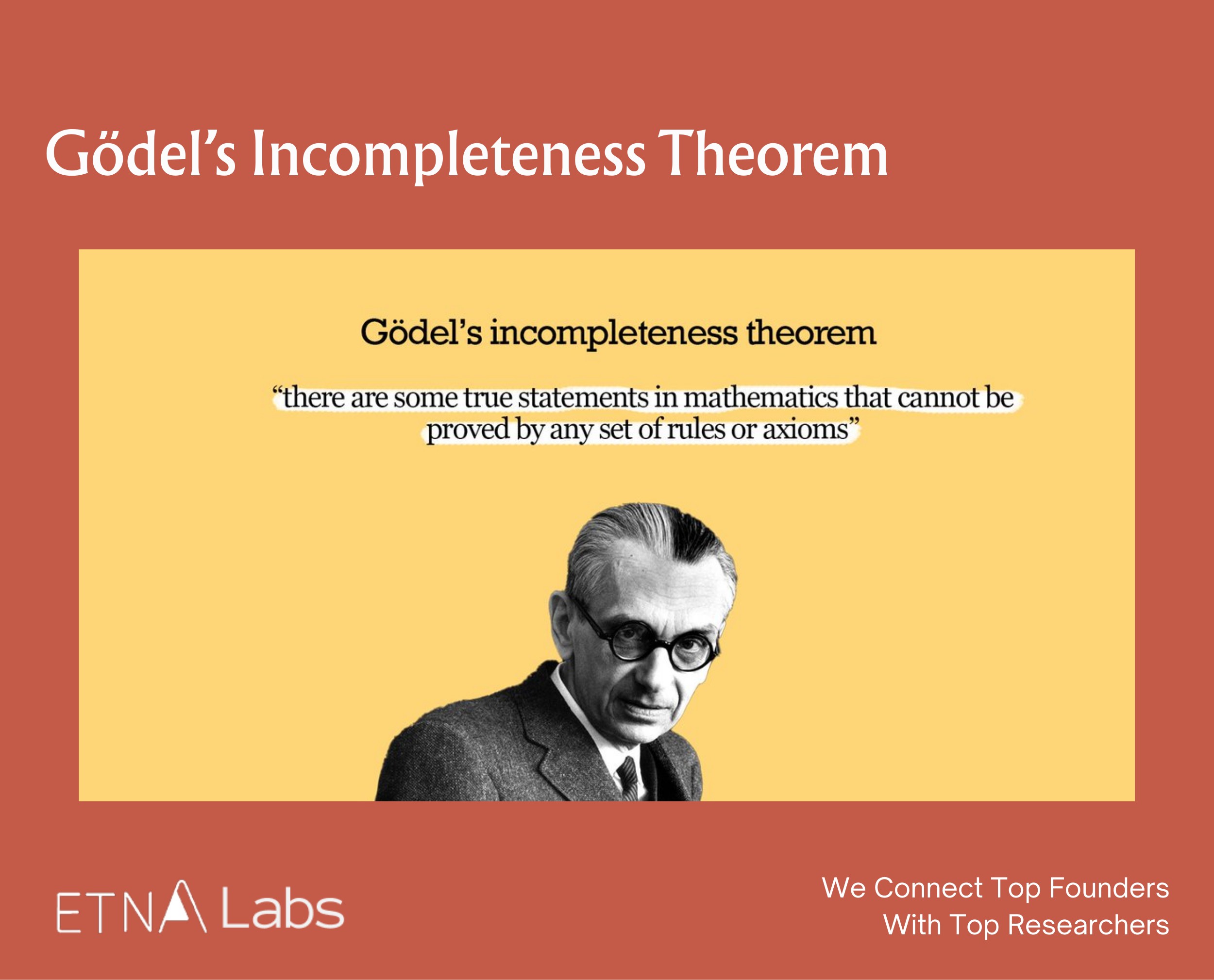
Lately, I’ve been thinking about another question. Anyone who’s studied computer science has taken theory courses, and one important theorem is Gödel’s incompleteness theorem. In simple terms, it says that a system, like a large model, cannot fully prove its own correctness. There will always be some hallucinations that cannot be completely eliminated. Sure, giving more resources may reduce them, but that raises a scientific question: how much resource investment is needed to reduce hallucinations by a certain amount? It’s a trade-off, very much like the risk-reward balance in economics. That’s why we sometimes call it the “no free lunch theorem.” These questions are perfect for collaboration between mathematics, algorithms, and industry, and they could lead to major breakthroughs.

Jie Tang also mentioned continual learning, which I think is a particularly interesting problem. It introduces the concept of time. In continual learning, if you chain multiple agents together, and each agent is not perfect, then after N agents, the overall performance tends to decline exponentially.
How can we prevent that decline? Humans provide a useful example. On day one, we learn; on day two, we build on the previous day’s knowledge, including its noise. This mirrors LLMs, where performance can degrade over time. Humans, however, have a method to counteract this: sleep.
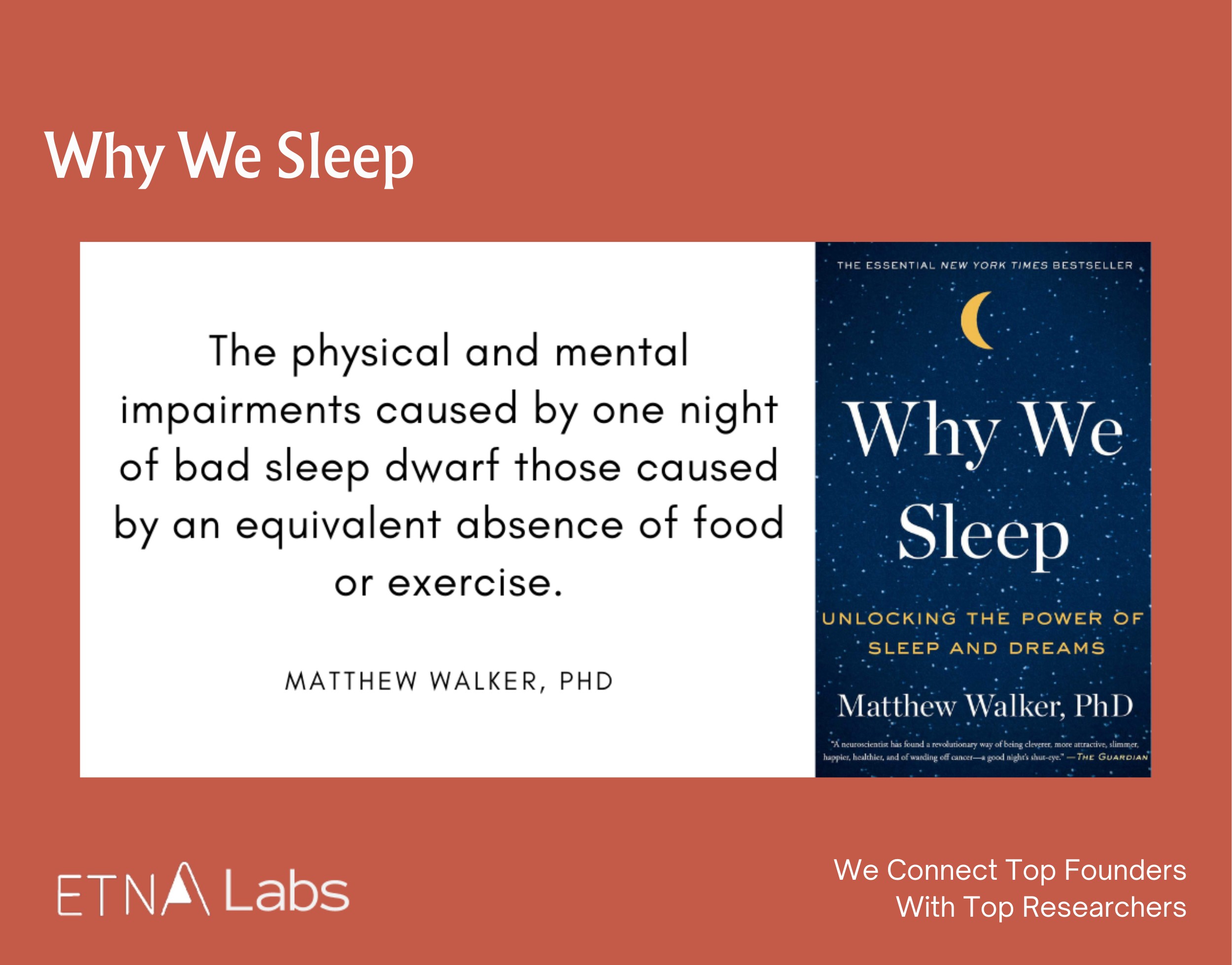
I recommend a book called Why We Sleep. It explains that sleep serves to clear out noise, so the next day your accuracy can improve instead of accumulating errors. These kinds of theoretical studies are paving the way for a new kind of computing paradigm. Today, most attention is on Transformers and Agentic Computing, but I believe it’s necessary to explore new approaches as well. This is how I see the convergence of industry and academia, closing the gap and tackling fundamental questions together.
Host
Thank you, Qiang Yang. Jie Tang, from the outside, Zhipu today looks like it’s taken a path similar to Anthropic’s, very strong in coding, ranking high on the benchmarks, and with the long-horizon agent work you just mentioned. What do you think about this question of differentiation?
Jie Tang
I tend to go back to the most fundamental question. In the early days, what really mattered was still the foundation model and the upper bound of intelligence. Back in 2023, we were the first to launch a chat-based model. At the time, the instinct was simple: get it online as fast as possible. Later, because of unified regulatory requirements, everyone ended up launching around August or September.
When that happened, my first reaction was that suddenly there were more than a dozen large models on the market, and none of them had that many users. Today, the differentiation is even more pronounced.
After thinking about this for a year, I’ve come to believe that this wasn’t really solving the core problem. My original assumption was that LLMs would replace search. And yes, today many people do use models as a substitute for search, but they haven’t replaced Google. If anything, Google reinvented search itself. From that perspective, I felt that particular battle was essentially over, especially after DeepSeek came out.
So once DeepSeek arrived, the real question became: what’s the next bet? What’s the next battle? I think the next phase has to be about AI actually doing things. What those things are is where you place your bet. Around that time, our team debated this for many late nights. You could call it luck, but it was also a deliberate decision, we chose to bet on coding. From that point on, we essentially put all of our focus there.
Topic 2: the Next Paradigm for AGI
Host
I think the idea of placing bets is fascinating. Over the past year, China hasn’t just made strong progress in open source, teams have also started to make clear, differentiated bets of their own. That leads naturally to a second question.
Pre-training has been the dominant approach for about three years now, and many people feel it’s delivered perhaps 70 to 80 percent of its potential gains. Reinforcement learning has also become a broad consensus, but may only be halfway there, with maybe 40 to 50 percent of the upside realized so far. In Silicon Valley, there’s active discussion about what comes next as a new paradigm. Jie Tang just mentioned ideas like self-learning or continual learning.
Note: At present, there is no unified definition of this new paradigm within the AI community. Concepts such as active learning, continual learning, and self-learning essentially reflect the same underlying expectation: enhancing a model’s capacity for autonomous learning, enabling it to continuously improve its intelligence without human intervention.
Why don’t we start with Shunyu? You spent time at OpenAI, which helped push the first two paradigms forward for the field. From your perspective, what should we think about a third paradigm? What insights can you share based on that experience?
Shunyu Yao
Self-learning is a hot topic in Silicon Valley right now. You hear people talking about it everywhere and there’s almost a sense of consensus around it. That said, from what I’ve seen, people often mean very different things when they talk about it. I’ll make two points.
First, I don’t think the main bottleneck is methodology. It’s data, or more precisely, tasks. When we talk about self-learning, we need to be clear about the setting and the reward function. Personalization in chat is one form of self-learning. An AI learning a company’s internal codebase while writing software is another. Exploring a new scientific field, starting from zero and gradually becoming an expert, like a PhD student, that’s also self-learning. Each of these scenarios comes with very different challenges and requires different approaches.
Second, and this may not be a consensus view,I think this is already happening. When ChatGPT uses user interactions to better match a person’s conversational style, isn’t that a form of self-learning? Today, Claude Code has reportedly written about 95 percent of the Claude Code project itself, actively helping improve the system that runs it. Isn’t that also self-learning?
Back in 2022 and 2023, when we were working on SWE-agent, I gave a talk at AGI House. On the very first introductory slide, we wrote that the most important ingredient for ASI was self-learning. At a fundamental level, today’s AI systems all have two parts: a neural network, and a codebase. The codebase determines how the model is used, whether for reasoning, for acting as an agent, or something else.
Take Claude Code as an example. It consists of Opus as the neural network, plus a large amount of surrounding code that defines how that network is used, from GPU kernels and deployment infrastructure to the frontend. If a software agent can eventually improve its own repository, on its own, wouldn’t that qualify as a form of AGI?
In fact, Claude Code is already doing this at scale today. People just don’t always notice it, or they see it as something limited to a narrow use case. My view is that this shift is already underway, and it looks more like a gradual transition than a sudden break.
Host
Let me follow up on that. Some people are quite optimistic about self-learning and think we’ll start seeing clear signals by 2026. In your view, what concrete breakthroughs are still needed? For example, things like long context or parallel sampling at the model level. From where you sit, what key conditions have to be in place before those signals really show up?
Shunyu Yao
A lot of people say we won’t see those signals until 2026, but I think we’re already seeing some in 2025. Take Cursor, for example. Their auto-complete models retrain on fresh user data every few hours. The newer Composer models are also being trained on data generated in real environments.


People might say these aren’t exactly earth-shattering yet, partly because those teams don’t have large-scale pre-training capabilities, so the results can’t match something like Opus. But I do think these are real signals.
To me, the biggest bottleneck right now is imagination. With reinforcement learning or reasoning, it’s easy to picture what progress looks like. You can say, for instance, that a model like o1 goes from scoring 10 to 80 on math problems. But if in 2026 or 2027 a new paradigm emerges and we claim that self-learning has truly been achieved, how do we validate it? What task do we use?
Is it that the system becomes a profitable trading agent, an extension of something like a trading benchmark? Or does it solve a meaningful scientific problem? We need to be able to imagine, ahead of time, what that announcement blog post would actually look like.
Host
OpenAI has led two major paradigm shifts already. If a new paradigm emerges in 2026 or 2027, which company do you think is most likely to lead it, on a global scale?
Shunyu Yao
OpenAI is still the most likely candidate. Even though commercialization and organizational changes may have diluted some of its original research-driven culture, I still think it remains the place with the highest probability of producing the next paradigm.
Host
Junyang, what’s your take on the next paradigm? How do you see things unfolding toward 2026?
Junyang Lin
From a more practical perspective, the paradigms we’ve been discussing are still very early. Reinforcement learning hasn’t really been scaled in terms of compute, so much of its potential hasn’t been realized yet. We’re also running into a range of infrastructure bottlenecks, and these are global issues, not something unique to any one region.
If we talk about the next generation of paradigms, self-learning is an obvious direction. Earlier, we touched on the idea that humans can’t simply make AI smarter through interaction alone. Repeated interaction often just leads to longer context windows and sometimes even worse performance. Whether test-time scaling truly works is still an open question. Can a model actually become stronger just by consuming more tokens at inference time? The O-series models suggest that this is possible, at least to some extent.
Anthropic has talked about models being able to “work for 30 hours” on a task. Can that really enable them to solve extremely hard problems? I think the current push toward AI scientist systems is meaningful in this regard. These efforts are testing whether test-time scaling can help tackle problems that are genuinely difficult, or even problems humans haven’t solved yet. From this angle, AI does need to evolve on its own. Whether that evolution requires updating model parameters, or can be achieved through other technical approaches, is still an open question, and different teams may choose different paths.
The second point is agency. Can AI become more proactive? Today, AI systems are largely passive: they only act when a human provides a prompt. But could the environment itself become the signal? Could an AI observe its surroundings, reason independently, and decide to take action?
This also raises a new issue: safety. My safety concerns aren't about AI speech, but AI action. For example, if it were to form its own ideas and decide to throw a bomb into a venue, that’s obviously something none of us would ever want to see. Just like raising a child, we need to give AI the right guidance and boundaries. At the same time, the ability to learn proactively may still be an important part of the next paradigm.
Host
Yes, Junyang also raised the idea of proactive agent, which could be a critical bet heading into 2026.
Let me follow up on that. If we do start to see signals of self-learning by 2026, where do you think they’ll show up first? What kinds of tasks? Will it be models training other models, where the strongest models can improve themselves? Or fully automated AI researchers? Where do you expect the earliest signs to appear?
Junyang Lin
I actually think fully automated AI researchers may not even require self-learning in the strict sense. “AI training AI” could happen fairly soon. When I watch what our engineers are doing day to day, it honestly feels like Claude Code could replace much of that work in the near future.
That said, I think a more interesting direction is sustained understanding of users. Personalization really matters here. In traditional recommendation systems, user signals flow in continuously, and that alone can make the system much stronger, even with relatively simple algorithms. In the AI era, the question becomes: can the system truly understand you better over time? Can ongoing user input become its strongest signal?
We often talk about copilots, but in reality, we don’t even have true copilots yet. The real question is whether AI can genuinely become my copilot.
So if self-learning shows up first, I expect it to emerge through human interaction, especially personalization. That said, it’s hard to define the right metrics. In the recommendation era, better personalization meant more clicks or more purchases. But when AI starts touching every aspect of human life, what does “good personalization” actually mean? We don’t really know yet.
From my perspective, one of the biggest technical challenges right now is evaluation. We don’t yet know how to properly measure these systems. That may be one of the most important problems for us to work on next.
Host
Junyang, since you mentioned proactive agent and personalization, do you think that if we really crack “memory”, we could see a major technical leap by 2026?
Junyang Lin
Personally, I think many so-called “breakthroughs” are really about perception. Technologically, progress is often linear; it’s just that the way humans experience it feels dramatic. Take ChatGPT, for example. For those of us working on large models, it wasn’t a sudden jump, it was a fairly steady, linear improvement.
Right now, everyone is working on memory. Are the technical approaches right or wrong? I don’t think it’s that clear-cut. Many of them aren’t fundamentally wrong. But in terms of results, let me use our own work as an example, our memory system might know what I’ve done in the past, but mostly it just recalls facts. It remembers things, calls me by my name every time, but that alone doesn’t make it feel particularly intelligent.
The real question is whether memory can reach a tipping point. A point where, by combining memory with interaction, the system starts to feel like a real person in everyday life. People often mention the movie Her. That sense of suddenly feeling understood, that moment is when users might feel something has really clicked.
I do think that kind of moment could take at least another year. Technology itself doesn’t usually move that fast. It just feels fast because competition is intense and there’s something new every day. In reality, progress is still linear. We may just be at a stage where small improvements, like incremental gains in coding ability, translate into outsized productivity gains, which makes it feel exponential.
Honestly, when I look at what we work on day to day, it’s still pretty rough. We’re fixing bugs that are frankly not very elegant. There’s nothing glamorous about it.
But if even with this kind of messy work we can already achieve meaningful results, then looking ahead, when algorithms and infrastructure come together more tightly, I think there’s still a lot of upside to come.
Host
Thank you. Qiang Yang?
Qiang Yang
My work has long focused on federated learning. The core idea is multiple centers collaborating together.
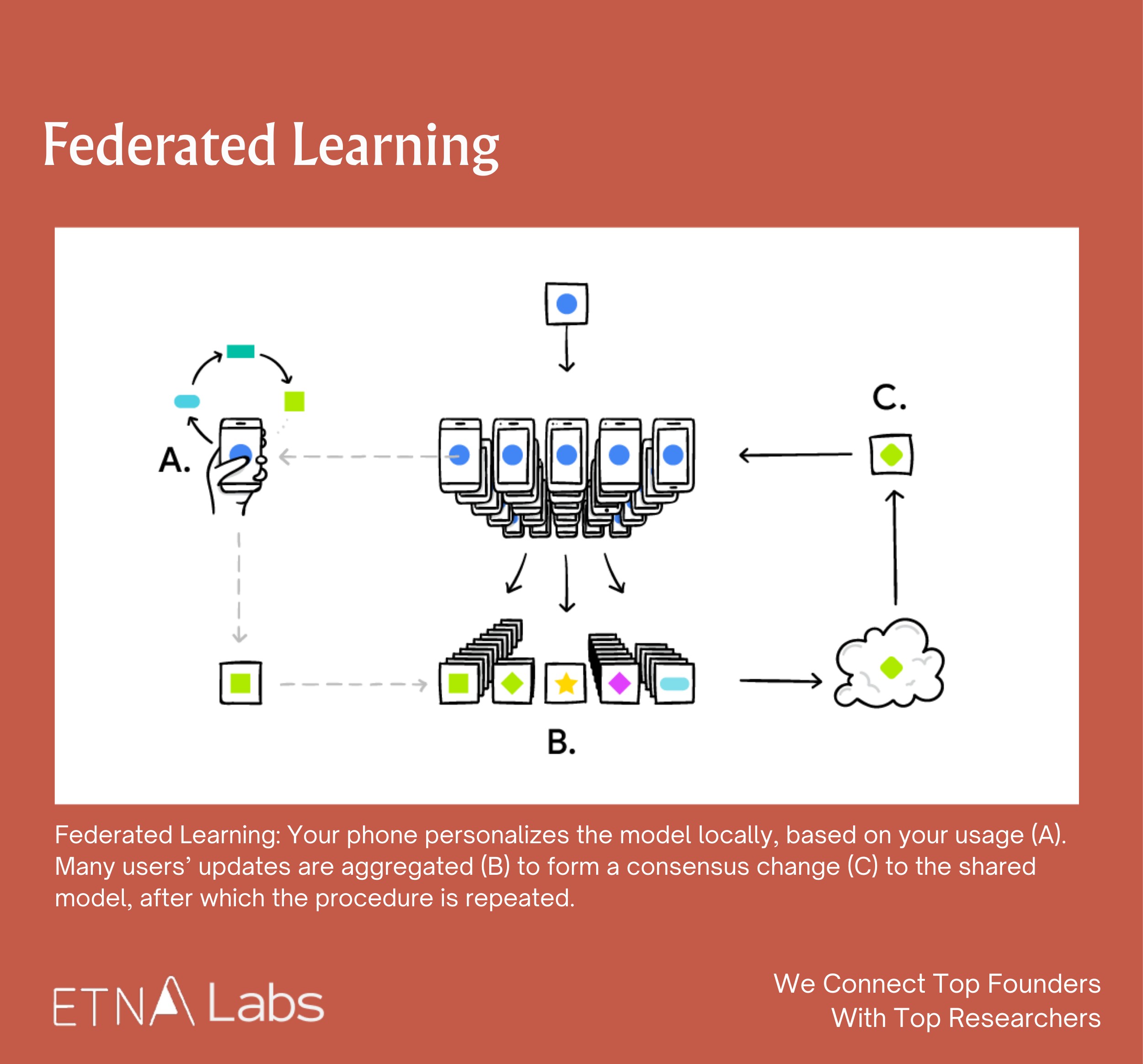
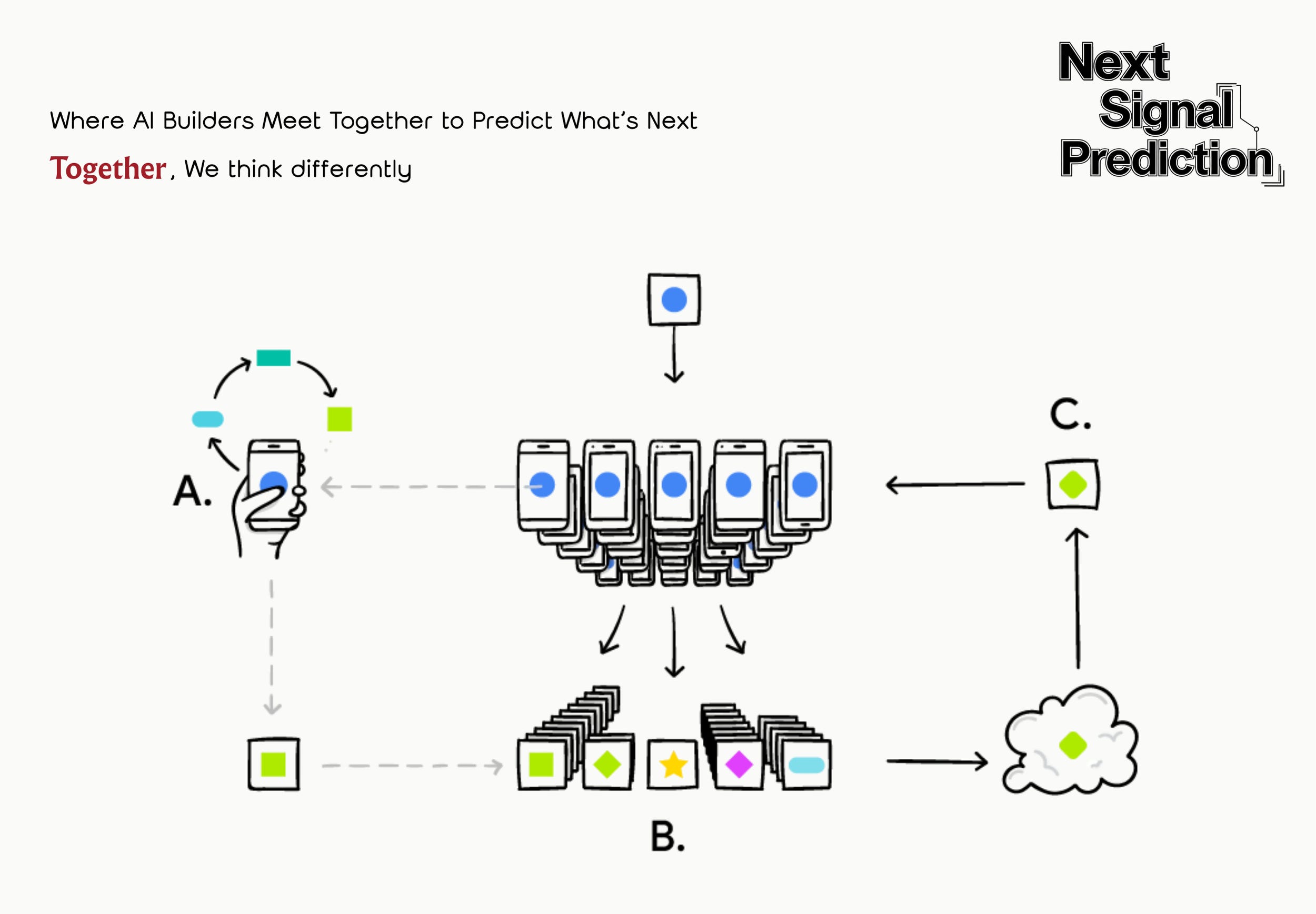
Federated Learning: Your phone personalizes the model locally, based on your usage (A). Many users’ updates are aggregated (B) to form a consensus change (C) to the shared model, after which the procedure is repeated.
Increasingly, I see situations where local resources are limited, but the data itself comes with strong privacy and security requirements. So we can start to imagine: as large, general-purpose models become more capable, how can they collaborate with smaller, specialized local models or models created by domain experts?
I think this kind of collaboration is becoming increasingly feasible. In the U.S., for example, Zoom has been working on what they call Federated AI. They built a large shared foundation that others can plug into. In a decentralized setup, it allows models to communicate and collaborate effectively while still protecting privacy.
I also see great value in open-source approaches, both in terms of knowledge and code. Especially in domains like healthcare and finance, I expect we’ll increasingly see this kind of collaborative, open ecosystem emerge.
Host
Thank you, Jie Tang?
Jie Tang
I’m actually quite positive that we’ll see a major paradigm shift this year. I won’t go into too much detail on specifics, because several areas could spark change, like continual learning, memory, model architectures, even multimodality. All of these have the potential to create a new paradigm.
But I want to highlight a broader trend and why I think a paradigm shift could happen. Historically, industry has been far ahead of academia. I remember a couple of years ago, when I went back to Tsinghua and spoke with professors about building large models, many had almost no GPUs. Industry had 10,000 while universities had one or zero. The gap was immense.
Now, that’s changing. Many universities have more GPUs, and professors have begun conducting serious research on large models, including model architectures and continual learning. Even in Silicon Valley, many academics are now engaging in research that was once dominated by industry. By late 2025 into early 2026, this imbalance isn’t nearly as extreme. There may still be a tenfold difference—1,000 GPUs here versus 10,000 there—but the seeds for innovation in academia are now present. That’s the first point.
The second point is about how innovation emerges. It usually happens when there’s massive investment, but efficiency becomes a bottleneck. Right now, the scale of investment in large models is huge, but efficiency isn’t high. Scaling up still delivers gains, of course. For example, maybe in early 2025 we had 10 terabytes of data; now we’re at 30 terabytes, and we could even scale to 100 terabytes. But at that scale, what’s the return on investment? And what about the computational cost? If you don’t innovate, you could spend hundreds of millions with only marginal gains but it may not be worth it.
Similarly, for new intelligence-driven innovations: if every time we need to retrain a foundation model and redo extensive reinforcement learning, the early gains are significant, but eventually, additional RL provides diminishing returns. It’s still beneficial, but not significant, the efficiency becomes the bottleneck.
Looking ahead, I think there are two levers. First, we need scaling, “the dumbest approach is still scaling,” as I said earlier. More data and compute will certainly increase the upper bound of intelligence. That’s the engineering approach. But second, we need to focus on what I’d call intelligence efficiency, how much incremental intelligence you gain per unit of input. If we can get the same intelligence boost with less investment, that’s when we hit a bottleneck, and bottlenecks are exactly where new paradigms emerge.
So I strongly believe a new paradigm will occur in 2026. Of course, we’re also placing our own bets and hoping it happens in our work, but it’s not guaranteed.
Topic 3: Agent Strategies
Host
I’m very optimistic, too. Every leading model company has been seeing roughly tenfold compound growth in compute each year. With more compute, more talent entering the field, and more experiments being run, it’s essentially a massive engineering effort, so breakthroughs could come from any point.
Jie Tang also mentioned the challenge of measuring intelligence. I think a third topic worth discussing is Agent strategies. I’ve spoken with many researchers recently, and there’s a lot of expectation for 2026. Today, agents can run reasoning tasks in the background for 3–5 hours, roughly matching what a human could do in a day or two. The hope is that by 2026, agents could handle the equivalent of a full human workweek or even two.
That’s a major shift. It moves beyond being just a tool, like a chat interface, as Jie Tang mentioned, to actually automating an entire day or week’s workflow. If this happens, 2026 could be a milestone year where agents start generating real economic value.
This ties into what Shunyu mentioned earlier about vertical integration: combining models with agent products. We also see a few companies in Silicon Valley building end-to-end solutions, from model to agent.
Shunyu, you’ve spent a lot of time researching agents. For 2026, do you really think long-horizon agents could automate a human’s one- or two-week workload? How does this shape the strategic thinking for agents, especially from the perspective of foundation model companies?
Shunyu Yao
I think, as I mentioned earlier, the picture is quite different for consumer-facing versus enterprise applications.
For enterprise, things are already on a steady upward trajectory, with no sign of slowing down. Take Anthropic, for example. They’re interesting because they aren’t chasing flashy innovations. Their approach is simple: scale up pre-training, do reinforcement learning properly, and keep training on real-world tasks. As long as pre-training grows and fine-tuning is grounded in real tasks, the models just get smarter and deliver more value over time.
What’s especially interesting about enterprise is that the objectives are highly aligned. The smarter your model, the more tasks it can solve; the more tasks it solves, the more revenue it generates. That makes things straightforward.
Consumer-facing applications are trickier. Daily active users or product metrics often don’t correlate directly with model intelligence, in some cases, they can even move in opposite directions. This is part of why Anthropic can focus so cleanly on improving the model: in enterprise, better models automatically translate into more value, so everything is aligned.
Right now, I think productivity agents are just getting started. Beyond the models themselves, there are two main bottlenecks: one is the environment, or deployment.
Before I joined OpenAI, I interned at a company called Sierra, which was a B2B customer service company. Working in a B2B setting taught me a lot. The biggest takeaway was this: even if model development completely stopped today, just deploying existing models across a variety of companies could easily deliver ten to a hundred times more value than we’re seeing now. In other words, the impact on GDP could be 5 to 10 percent, but at present, it’s nowhere near 1 percent.

The second bottleneck is education. I’ve noticed that the gap between people is widening, not because AI is replacing jobs, but because those who know how to use these tools will outperform those who don’t. It’s like when computers were first introduced: if you learned programming while others were still using slide rules or abacuses, the gap was enormous.
I think one of the most meaningful things we can do in China right now is focus on better education, teaching people how to effectively use products like Claude Code or ChatGPT. Of course, Claude Code might not be available in China, but we can use domestic models like Kimi or Zhipu instead.
Host
Thank you, Shunyu. Junyang, what are your thoughts on agents, especially considering Qwen’s ecosystem, where Qwen is building its own agents and supporting general-purpose agents within the ecosystem?
Junyang Lin
This touches on a product philosophy question. Manus has been very successful, but whether building wrapper products is the future is still an open discussion. At this stage, I tend to agree with your view: the model is the product.
When I talk with people at Thinking Machines Lab, they call it “research as a product”, and I really like that idea. Even at OpenAI, many researchers are essentially acting as product managers, taking something end-to-end from research to a real product. Within our own team, researchers are increasingly eager to work on real-world applications.
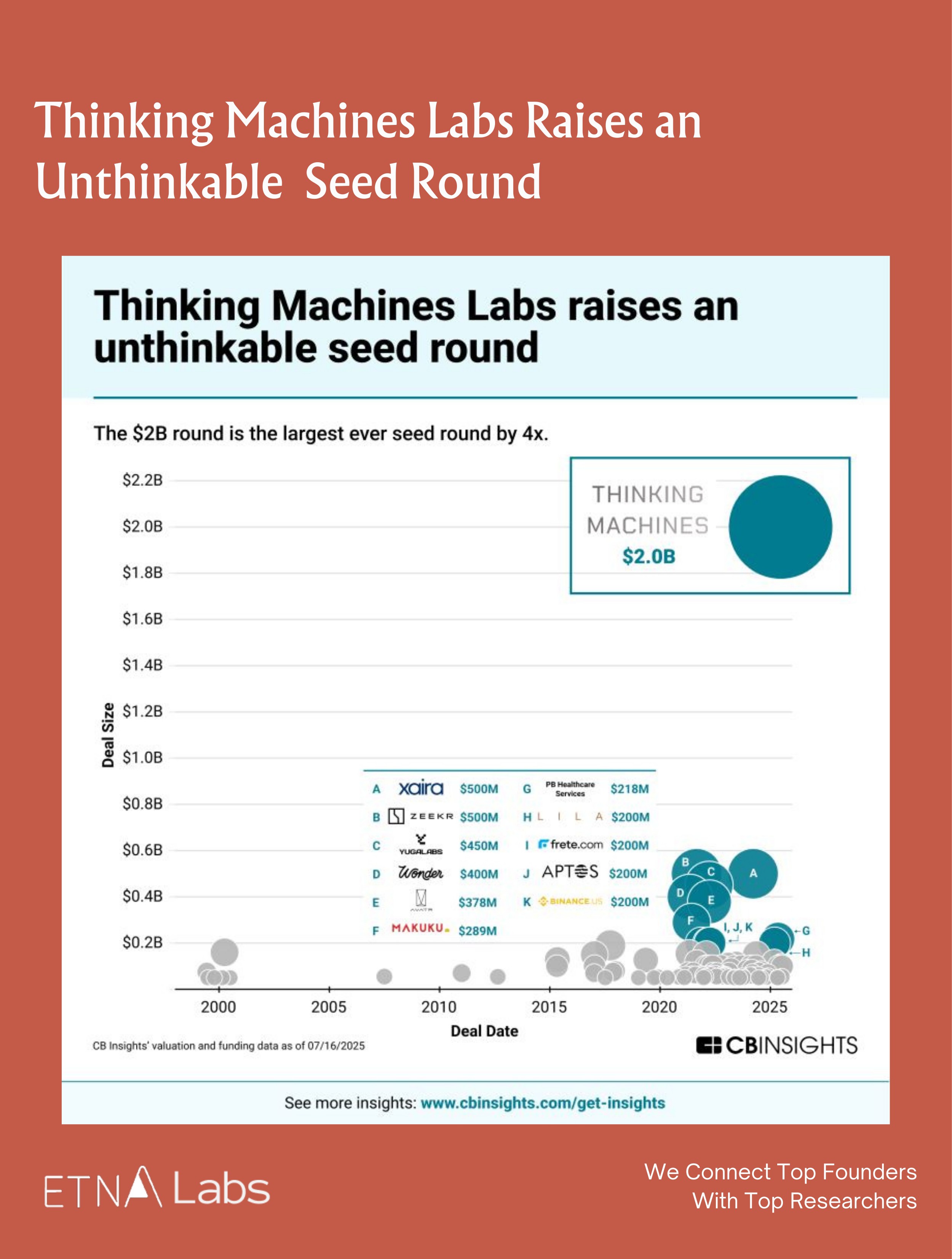
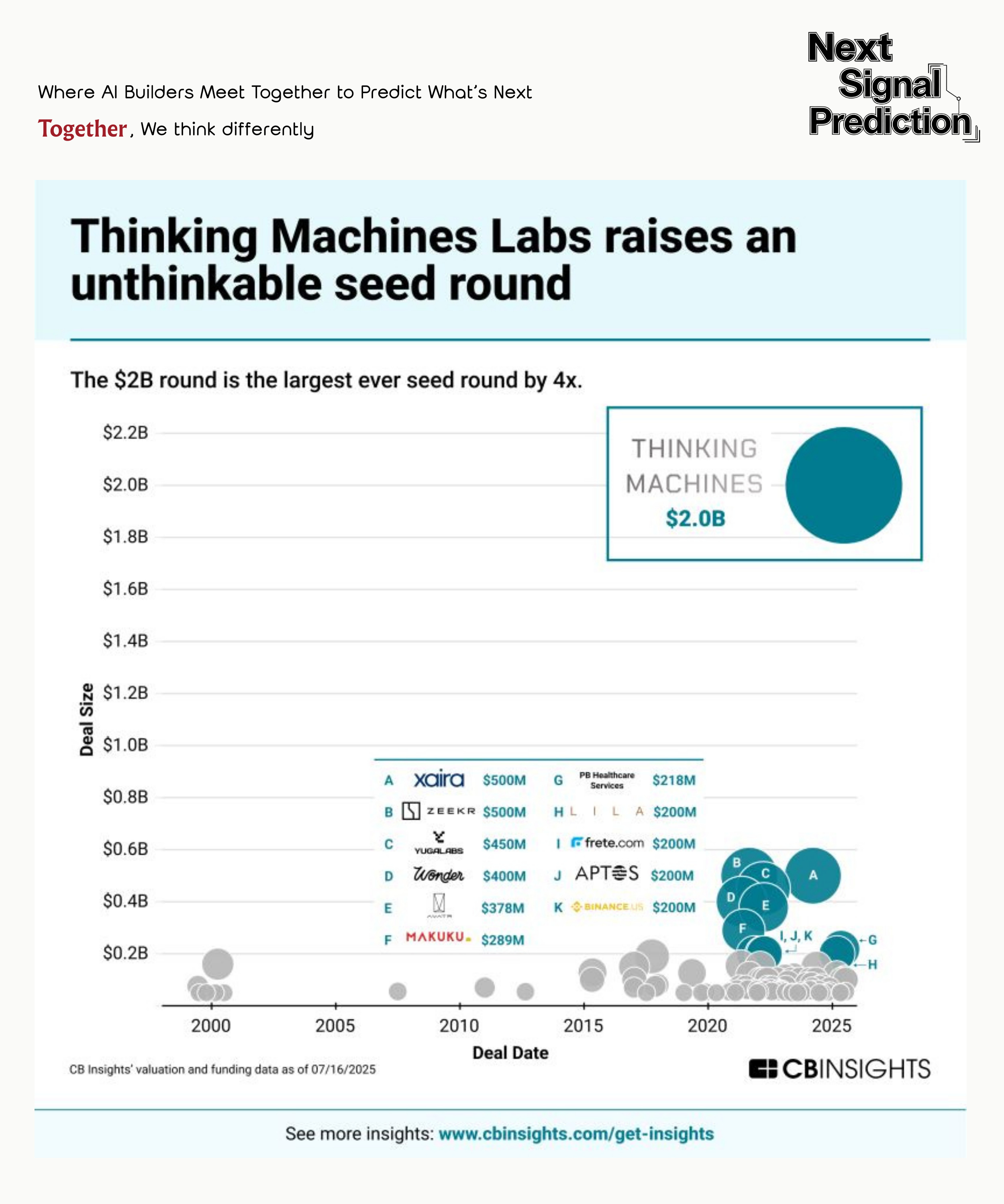
I genuinely believe the next generation of agents can achieve what we just discussed, and this is closely tied to self-evolution and active learning. For example, if an agent is operating over a long period, it has to evolve on the fly and decide what tasks to tackle, because the instructions it receives are extremely general. Today, our agents are increasingly becoming managed agents, agents that operate autonomously, rather than ones requiring constant back-and-forth interaction with a human.
From this perspective, the bar for the model is actually very high. The model is the agent, and the agent is the product. If everything is fully integrated, then building a foundation model is essentially the same as building the product itself. If we can keep pushing the upper bound of model capability, especially with things like test-time scaling, then this vision is genuinely achievable.
That said, there’s another critical piece, which is interaction with the environment. Right now, the environments we interact with are still quite simple, mostly confined to computers. I have friends working on AI for Science, and take AlphaFold as an example. Even there, we’re not fully at the next stage yet. In drug discovery, for instance, today’s AI doesn’t necessarily help that much, because you still need to run wet-lab experiments to get real feedback.
The question is whether, in the future, AI can operate in environments as complex as the real world, directing robots to run wet-lab experiments and dramatically speeding up the loop. Otherwise, at current human efficiency, progress is extremely slow. We still rely on large numbers of outsourced human workers to run experiments manually. Reaching that point is, in my mind, what would truly enable agents to do weeks or even months of human work, not just write documents or code inside a computer.
Some parts of this may come together fairly quickly, even within the next year. But over a three- to five-year horizon, this becomes much more interesting. At that point, it will almost certainly converge with embodied intelligence as well.
Host
Let me push you a bit on a sharper question. From your perspective, is the opportunity for a general-purpose agent more likely to belong to startups? Or is it simply a matter of time before foundation model companies inevitably build strong general agents themselves?
Junyang Lin
I can’t really play the role of a startup mentor just because I work on foundation models, that’s not something I’m qualified to do. So I’ll borrow a point made by Peak, the CTO of Manus. He once said that what’s most interesting about building general agents is actually the long tail. That’s where the real value is, and arguably where AI’s biggest appeal lies.
If it were just a winner-takes-all dynamic, where the head dominates, that’s relatively easy to solve. Back in the days of recommender systems, we saw recommendations overly concentrated at the head. People tried to push traffic toward the long tail, but when I worked on that, it was honestly painful. Coming from an NLP and multimodal background and trying to fix the Matthew effect in recommender systems was basically a dead end.
But in a sense, what people now call AGI is precisely about solving this problem. The question for a general agent is whether it can handle the long tail, those problems where a user has searched everywhere and still can’t find a solution. Then, in that exact moment, the AI steps in and solves it. Something no one else in the world could help with, but it can. That, to me, is the real magic of AI.
So should you build a general-purpose agent? I think it really depends. If you believe you’re exceptionally good at building wrappers, good enough to out-execute AI model companies, then sure, it’s worth trying. But if you don’t have that confidence, this might ultimately be a space for AI model companies, where “the model is the product.” When they run into a limitation, they can often just retrain the model or throw more compute at it, and the problem goes away. So there’s no single right answer, it really comes down to your own strengths and convictions.
Host
Actually, it seems like AI model companies could solve the long-tail problem pretty quickly with enough compute and data, right?
Junyang Lin
What I find most interesting about RL today is that fixing issues has become much easier. It used to be really difficult. For example, one B2B client wanted to do supervised fine-tuning themselves and asked, “Can you tell us how to balance the general data?” That was always a headache. Often, their data was really poor, even though they thought it was valuable.
Now, with RL, you often only need a very small data point, sometimes even without labels. As long as you have a query and a reward signal, a little training and combining the results becomes quite straightforward. That, to me, is where technology really shines today.
Host
Thank you, Junyang. Now, Qiang Yang, over to you.
Qiang Yang
I see the development of agents happening in four stages.
The first dimension is goal definition: is the goal set by humans, or can it be defined automatically?
The second dimension is planning, the intermediate actions. Planning can also be human-defined or autonomously generated by AI.
Combining these two dimensions naturally gives you four stages. Right now, we are at a very early stage: both goals and planning are defined by humans. The agent systems we have today are essentially just very advanced high-level programming languages.
But I anticipate that in the future, LLMs will observe human work and leverage human process data. Eventually, the goals themselves could be defined by the model, and the planning could also be fully model-driven. At that point, the agent would become a native system, fully emerging from the capabilities of the large model itself.
Host
Thank you, Qiang Yang. Jie Tang, over to you.
Jie Tang
I think there are a few factors that will determine how agents evolve in the future.
First, does the agent actually solve real human problems? And if so, how valuable is that solution? Take the early GPT-based agents as an example. Many of them were very simple, and often the problem was ultimately solved with just a prompt. Most of those agents eventually faded away. So the first question is: how much value does the agent create, and does it truly help people?
Second, what’s the cost of building and running it? If the cost is too high, that’s a problem. As Junyang mentioned, sometimes you can solve a problem by just calling an API. But there’s a tension here: if an API can solve it, then the API itself may incorporate the feature if it sees enough value. There’s always this inherent conflict between foundation models and applications.
The last factor is speed of execution. If you have a window of time, like six months, you can quickly deliver a working application and then iterate. In the era of LLMs, a lot of competition is really about speed and timing.
So sometimes a bet pays off, like we bet on coding, and maybe that was the right decision, allowing us to go further in that direction. But if a bet fails, it’s gone in six months. For now, our bet on coding and agents is already showing traction; our usage metrics look good. So I see developing agents very much as a strategic bet for the future.
Topic 4: the Future of AI in China
Host
In the past, foundation model companies were so focused on catching up on general capabilities that they didn’t spend as much energy exploring other directions. Now that general capabilities are largely there, I think for 2026 we can start looking forward to Qwen and Zhipu having their own “Claude Code moments” or “Manus moments.” That’s definitely worth anticipating.
For our fourth and final topic, I’d like to take a step back and look toward the future.
Here’s the question I’m most curious about: three to five years from now, what’s the likelihood that the world’s leading AI company will come from a Chinese team? For China to move from follower to leader, what cultural shifts and key conditions need to be in place?
Shunyu, since you’ve experienced both Silicon Valley and China, how would you assess that probability, and what do you see as the essential conditions for success?
Shunyu Yao
I think the probability is actually quite high. I’m optimistic because what we’ve seen so far is that whenever something is discovered or developed abroad, China tends to catch up quickly, often replicating it and sometimes even improving it in specific areas. We’ve seen this pattern repeatedly in industries like manufacturing and electric vehicles.
There are a few key factors. One is whether China can make breakthroughs in lithography. If compute becomes a bottleneck, can we solve it? Right now, we have advantages in power supply and infrastructure, but the main constraints may be production capacity, including lithography machines and the broader software ecosystem. Solving that would be a huge boost.
Another factor is whether there can be a more mature and competitive business market beyond consumer applications, or opportunities to compete internationally. Today, many productivity-focused or business models still emerge in the US, where willingness to pay is higher and the business culture is more developed. It is harder to do this domestically in China, so companies tend to go global.
But even more important is the human factor. From my conversations with many people, my sense is that China has an enormous pool of talent. Once something is proven feasible, there is a lot of enthusiasm to try and even improve on it.
The challenge is that there are still not enough people willing to pursue high-risk frontier exploration or aim for entirely new paradigms. This may be influenced by economic, business, and cultural factors.
Right now, once a paradigm emerges, we can catch up efficiently and sometimes even improve locally with relatively few resources. But the real question is whether we can lead a completely new paradigm. That, I think, is the core challenge for China today. In other areas such as commercialization, product design, and engineering, we are already performing at or above the level of the US in many ways.
Host
Let me follow up with one more question. What would you like to see in terms of research culture in Chinese labs? You’ve experienced the culture at OpenAI and DeepMind in the Bay Area, how does it differ from China, and what fundamental impact does this have on a company that is AI native?
Shunyu Yao
Research culture varies a lot from place to place. In the US, differences between labs can be bigger than the differences between China and the US. It’s the same within China. Personally, I see two main points.
First, in China, people tend to gravitate toward safer bets. For example, pre-training has been proven to work. It is still technically challenging, but once it’s feasible, there’s confidence that within a few months or so, the problem can be solved. But asking someone to explore something like long-term memory or continual learning, where the path isn’t clear, is still much harder.
It’s not just about preference for safer work. The accumulation of culture and shared understanding takes time. OpenAI may have started working on reinforcement learning in 2022, while in China it only began in 2023. Scaling up RL in China hasn’t been at the same level yet. A lot of it comes down to time, deeper cultural and technical foundations subtly shape how people work.
Second, in China there is often a stronger focus on rankings or numbers. Companies like Anthropic or DeepSeek pay less attention to leaderboard metrics. They focus more on doing the right thing and on whether the results feel genuinely effective or not.
This is interesting. For example, Claude might not top many programming or software engineering leaderboards, but everyone knows it’s highly usable. I think we need to move beyond the obsession with rankings and focus on what we know is right or genuinely good.
Host
Thanks. Junyang, can you share your thoughts on China’s chances of winning and the conditions for that?
Junyang Lin
That’s actually a tricky question. In a setting like this, it’s not really polite to dampen optimism. But if we look at it probabilistically, I can share some differences I’ve observed between China and the US.
For example, overall compute in the US might be one or two orders of magnitude larger than ours. But when I look at OpenAI or Anthropic, a large portion of their compute is devoted to next-generation research. In China, by contrast, most of our compute is tied up just in serving. That’s a significant difference.
Historically, it raises an interesting question: does innovation happen in the hands of the wealthy, or in the hands of those with fewer resources?
Being resource-limited doesn’t mean having no opportunity. Sometimes the “wealthy players” actually waste a lot of compute, they run countless ablation experiments, train models that don’t yield much. When you’re lean, you have to think differently. For example, the so-called joint optimization of algorithms and infrastructure becomes much more meaningful. If you have unlimited resources, you might not be motivated to explore that.
Taking it further, as Shunyu mentioned, there’s the lithography issue. In the future, combining hardware and software end-to-end could be a real possibility. Next-generation model architectures and chips could be co-designed together.
I still remember back in 2021, when we were working on large models, Alibaba had built a chip and asked me: can you predict whether three years from now the model will still be a Transformer? Or whether it will be multimodal? They said three years was the lead time for tape-out. I answered honestly: I don’t even know if I’ll still be at Alibaba in three years. But here I am today, and it was indeed a Transformer, multimodal. I regret not pushing harder at the time.
Back then, our communication was almost comical. We spoke past each other. They were describing things I didn’t understand, I was talking about our plans they couldn’t follow. We missed the chance. But could such an opportunity happen again? Even if we’re resource-poor, scarcity can drive ingenuity. Innovation could emerge from this.
I do think we need to change education. I’m from the early 90s cohort, Shunyu is from the later 90s, and many on our team are post-2000. I see the spirit of risk-taking growing. Americans naturally have a strong appetite for risk. The early EV pioneers, despite leaky roofs or potential fatal accidents, still pushed forward. In China, historically, wealthy people have preferred safer bets.
Today, though, risk-taking is improving, and the business environment is getting better. Innovation is possible. The probability may not be high, but it’s real.
Host
If you had to put a number on it?
Junyang Lin
You mean a percentage?
Host
Yes. Three to five years from now, what’s the probability that the world’s leading AI company is Chinese?
Junyang Lin
I’d say below 20 percent. And honestly, 20 percent already feels quite optimistic, given all the historical and structural factors involved.
Host
Let me follow up on that. Do you personally feel a strong sense of anxiety about the gap widening? In some areas China is catching up, but in others compute continues to pull further ahead.
Junyang Lin
If you work in this field, you can’t afford to be anxious. You need a very calm mindset. From my perspective, just being able to do this work is already a privilege. Being part of large model research at all is something to feel lucky about.
In the end, it comes down to your original motivation. Shunyu mentioned earlier that your model does not necessarily have to be the strongest, especially on the consumer side, and that can still be fine. I tend to think about it from another angle: what kind of value does our model bring to human society? As long as I believe it creates real value and genuinely helps people, I can accept that it may not be the strongest model out there.
Host
Thank you, Junyang. Qiang Yang, you’ve been through many AI cycles and have seen Chinese AI companies become world leaders. What’s your assessment?
Qiang Yang
Looking back at the development of the internet, it started in the U.S., but China quickly caught up, and products like WeChat became world-leading. I think AI is an enabling technology rather than a terminal product. But in China, there is a lot of talent that can push products to their limits, whether for B2B or B2C. Personally, I’m more optimistic about B2C because of the diversity of innovation, many people contributing ideas together.
B2B does face more specific constraints, like willingness to pay and corporate culture, though these are also changing. I’ve been closely observing business applications. For example, in the U.S., there’s a company called Palantir. Their philosophy is that no matter how AI develops, they can always find something useful to apply in enterprise settings. Of course, there is a gap, and we need to bridge it.
One approach they use is “Ontology-based”. Essentially, it’s similar to what we’ve done with transfer learning: taking a general solution and applying it to a specific scenario, using an ontology to transfer knowledge. This method is very clever and relies on an engineering approach, using Forward Deployed Engineers to implement it.
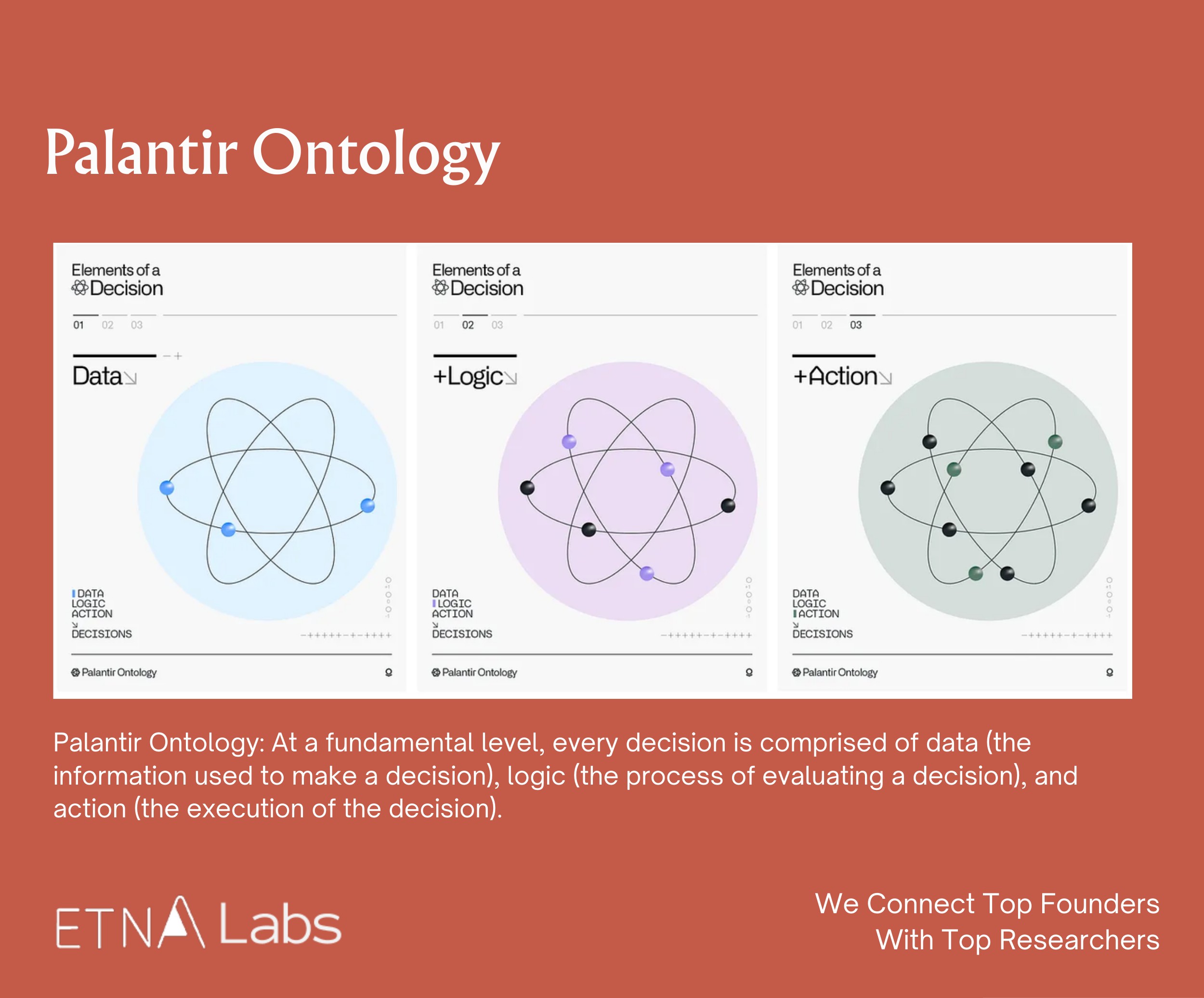
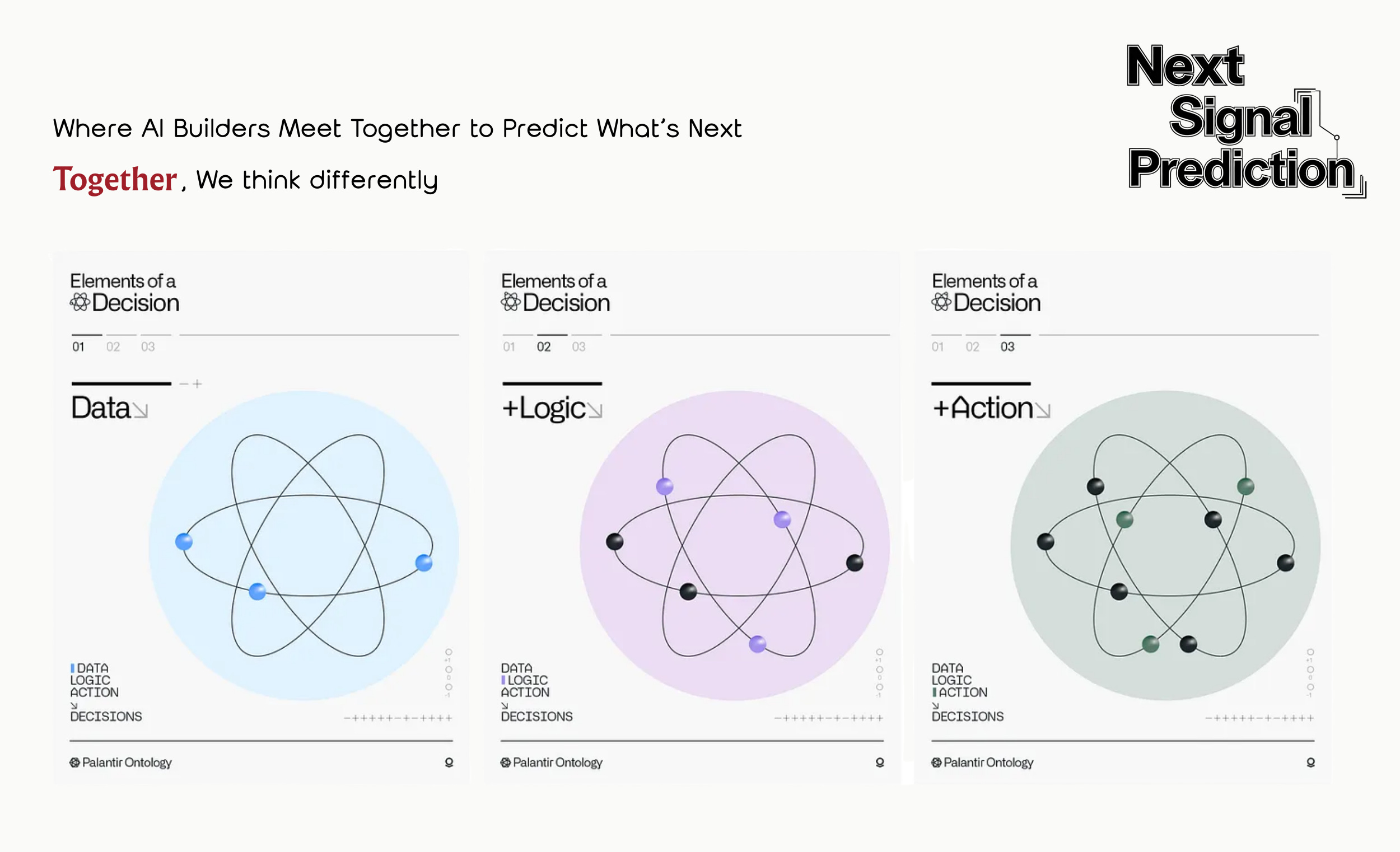
Palantir Ontology: At a fundamental level, every decision is comprised of data (the information used to make a decision), logic (the process of evaluating a decision), and action (the execution of the decision).
I think this is something worth learning from. Chinese AI-native companies should develop similar B2B solutions, and I believe they will. So, B2C will definitely see diverse innovation, and B2B will likely catch up quickly.
Host
Thank you. Jie Tang, over to you.
Jie Tang
First, I think we have to acknowledge that there is a gap between China and the U.S., especially in corporate AI labs and research. That’s the first point.
But I also believe China is gradually improving, especially with the rise of the post-90s and post-00s generation. They are far ahead of previous generations. I once joked at a YOCSEF(CCF Young Computer Scientists & Engineers Forum) meeting: our generation is the unluckiest. Why? The previous generation is still around, we’re still working hard without a big breakthrough, and the next generation is already taking over the world, effectively skipping us. That was just a joke.
What I find truly interesting is the potential opportunity for China in the future:
First, a group of smart people really dare to take big risks. I think this is happening now. The post-00s and post-90s generation, including people like Junyang, Kimi, and Shunyu, are willing and brave enough to take on these huge risks.
Second, the environment needs to be better. Whether it’s national policies, competition between large and small enterprises, or the overall business environment, including delivery and execution, as Junyang just mentioned, it’s about building a better environment so that these smart, risk-taking individuals have more time and space to innovate. This is something governments or the state could help improve.
Third, it comes down to persistence. Can we stick to a path, take risks, and keep going even if the environment is not perfect? The environment will never be perfect. I actually feel lucky to be experiencing a time when the environment is gradually improving. Those of us who persist, even in a clumsy way, may be the ones who succeed in the end. Thank you all.
Host
Thank you. Finally, I would also like to call for more resources and funding to be invested in China’s AGI sector. With more computing power and more opportunities for young AI researchers to work hands-on with large-scale training, even if they spend three to five years at it, China could develop three to five of its own “Ilyas.” That is what we are really looking forward to over the next three to five years.
Will Chinese AI Leap Ahead or Follow the Global Race? Insights from Chinese AI Leaders
Back to All
Intro
On Saturday, some of China’s leading AI figures shared highly insightful perspectives on LLM divergence, next-generation paradigms, and agentic systems, offering a rare window into the country’s evolving role in the global AI race.
The discussions took place at the AGI‑Next Summit, an event also covered by Bloomberg, bringing together Junyang Lin of Qwen, Shunyu Yao, formerly of OpenAI and now at Tencent, Jie Tang of Zhipu, and Qiang Yang, Fellow of the Canadian Academy of Engineering.
Coinciding with these discussions, DeepSeek released its latest research recently, Conditional Memory via Scalable Lookup: A New Axis of Sparsity for Large Language Models, and open-sourced its core module Engram on GitHub, drawing renewed attention from the global AI community.
We obtained the roundtable meeting minutes from the summit and translated them into English. What follows is a curated, near-verbatim transcript of the discussion, preserving the participants’ original remarks while highlighting the strategic considerations, technical challenges, and future directions that Chinese AI leaders are weighing as they navigate domestic priorities alongside the global AI landscape.
Thanks for reading! Subscribe for free to receive new posts and support our work.
Topic 1: How Will LLMs Diverge?
Host
After listening to the previous talks from the floor, I’d like to share a few reflections.
First, Jie Tang has a rare ability to bring people together. The strength of the Tsinghua network is hard to miss, not just in China, but worldwide. Its presence, including many alumni working abroad, is unusually strong.
Second, based on the presentations we’ve just seen from several Chinese AI companies, my impression is that they are not simply following trends or focusing narrowly on open source. Instead, they are actively exploring the next paradigm, going beyond coding capabilities to experiment with new product forms.
The timing matters. 2025 is becoming a breakout year for Chinese open-source models. Over the past year, coding capabilities have grown by 10 to 20 times. Globally, there’s also renewed debate about the limits of scaling and whether new paradigms are beginning to take shape.
That’s why this conversation, and this panel on what comes next, matters right now.
Let’s start with the first topic, which I think is particularly interesting. If you look at Silicon Valley right now, you can already see clear signs of divergence among the major players. That makes “differentiation” a good place to begin.
Anthropic, in particular, offers an important reference point for Chinese AI model companies. Competition in Silicon Valley is intense, but Anthropic didn’t try to do everything. Instead, it made deliberate choices, focusing on enterprise use cases, on coding, and on agentic systems.
That raises a broader question for China: as the market matures, how will Chinese foundation model companies choose to differentiate? Which directions will they commit to? I think that’s a compelling lens for this discussion.
Why don’t we start with you, Shunyu, tell us a bit about what you’ve been working on recently, and how you’re thinking about this question.
Shunyu Yao
Hi everyone. Am I basically a giant face on the screen right now? Sorry I couldn’t be in Beijing in person today, but I’m really glad to be part of this. Lately I’ve just been heads down building models and products. Honestly, that’s a pretty normal state of life if you’re working in AI. Being back in China feels great too, the food is definitely better.
Host
Could you expand a bit on how you think about this idea of model differentiation? We’re seeing it clearly in Silicon Valley, Anthropic leaning hard into coding, many Chinese models focusing on open source, rapid gains in coding capabilities over the past year. Even Google Gemini didn’t try to do everything at once; it really nailed multimodality first. OpenAI has been very focused on consumer products. Given that you’ve worked across both the US and China, I’d love to hear your perspective. Whether it’s your own work or the broader industry, how are you thinking about where this kind of differentiation goes next?
Shunyu Yao
I have two big takeaways.
First, there’s a clear split emerging between consumer-facing AI and enterprise-focused AI. Second, we’re also seeing divergence between two architectural paths: one centered on vertical integration, and the other on a more modular stack where models and applications are layered separately.
Let me start with the first. When people talk about AI “super apps” today, two products usually come up: ChatGPT and Claude Code. You can think of them as archetypes: ChatGPT on the consumer side, and Claude Code on the enterprise side. What’s interesting is that for most users, most of the time, ChatGPT today doesn’t feel dramatically different from a year ago. The improvements are real, but they’re subtle in everyday use.
Claude Code tells a very different story. A year ago, the coding shift hadn’t really begun. Over the past year, it has started to fundamentally change how work gets done across the software industry. People aren’t really writing code in the traditional sense anymore, they’re increasingly describing what they want in plain English and letting the system do the rest.
At the heart of this is a simple reality: on the consumer side, most people don’t actually need that level of intelligence most of the time. ChatGPT may now be far better at things like abstract algebra or Galois theory than it was a year ago, but that’s not something most users ever notice. For many people, especially in China, it still functions more like a supercharged search engine. And often, users don’t quite know how to interact with it in a way that truly brings out its full capabilities.
On the enterprise side, one clear point stands out: higher intelligence usually translates directly into higher productivity, and in turn, more revenue. Everything is interconnected. Another obvious observation is that businesses are often willing to pay for the best model. For example, one model might cost $200 a month, while a slightly weaker alternative is $50 or $20. What we see, at least in the U.S., is that many users are happy to pay the premium for the top-tier model.
Here’s why: imagine someone earning $200,000 a year who has 10 tasks to complete each day. A strong model like Opus 4.5 might get eight or nine of those tasks right, while a weaker model only gets five or six correct. The problem is, you don’t know in advance which five or six the weaker model will get right, so you end up spending a lot of extra time monitoring and correcting it. In enterprise settings, that gap makes the difference between models increasingly significant.
The second point is about the difference between vertical integration and a layered approach separating models from applications. A good example is ChatGPT with Agent functionality versus using Claude or Gemini with an application layer like Manus. Traditionally, people assumed that vertical integration would always lead to better results. But today, that’s not necessarily true. The skills needed for the model layer and the application layer are quite different. For enterprise and productivity use cases, large-scale pre-training is still critical, but it’s something product-focused companies struggle to do well. At the same time, to fully leverage a strong model, so it delivers real value, you also need significant work on the application side, or in the environment where it’s deployed.
What this means is that for consumer-facing applications, vertical integration still works. ChatGPT or Doubao, for instance, iterate closely between model and product, and the coupling is very tight. But for enterprise applications, the trend seems to be moving the other way: models are getting stronger, but there’s also more space for application-layer innovation, where different tools can take advantage of those models to improve productivity across multiple workflows.
Host
Let me follow up with one more question for you. With your new role at Tencent and your perspective on the Chinese market, what are the key bets or priorities you’re focusing on? Are there any standout themes or keywords you can share with us?
Shunyu Yao
Right. Tencent still has a strong consumer focus, so we’re thinking a lot about how the current wave of LLMs and AI development can deliver real value to users. But one core insight we’ve had is this: often, the bottleneck on the consumer side isn’t simply having a bigger model, better reinforcement learning, or a stronger reward model. More often, it’s about providing richer context and a better environment.
A recent example I often use illustrates this well. Suppose I ask, “What should I eat today?” Whether you ask ChatGPT today, last year, or tomorrow, the experience is often underwhelming. Improving it isn’t about a bigger model or stronger pre-training. The real bottleneck is usually additional input—more context.
For example, if the model knew, “It’s really cold today, I want something warm,” or “I’ll be in this part of the city,” or even “My wife is somewhere else, what might she want to eat?” it could give a much more useful answer. In other words, the bottleneck isn’t intelligence, it’s context. If we could feed a model our chat history from WeChat, or otherwise provide richer inputs, we could deliver far more value to users. This is how we think about the consumer side.
Enterprise AI in China is much harder. The productivity revolution, and the work many Chinese companies are doing building coding agents, often involves entering overseas markets. One key consideration is how to serve our own needs first. The difference between startups and large companies working on coding solutions is that big companies already have many real-world applications where productivity improvements are crucial. If our models perform better in these scenarios, they gain a real advantage and, importantly, capture more diverse real-world data.
Take Anthropic as an example. As a startup building coding agents, they rely on data vendors to label code data. Those vendors depend on engineers to decide what to label. The bottleneck is clear: there are only so many vendors and people, so diversity is limited. A company with 100,000 employees, however, can experiment differently, leveraging real-world data directly rather than relying solely on external labeling or distillation.
Host
Thanks, Shunyu. Let’s ask Junyang next. How do you see the future ecosystem or differentiation bets for Qwen? You’ve emphasized multimodality, and previously Alibaba Cloud was strong on the enterprise side. Now it seems your multimodal focus may lean more toward consumer applications. What are you thinking about this?
Junyang Lin
I can’t comment on company strategy. But I don’t think it’s just about a company’s DNA. Often, the people in each generation shape the company over time.
I’d like to share a bit of our own thinking about AGI. Whether it’s enterprise or consumer, at the end of the day, we’re serving real humans. So the question we ask is: how can we make the human world better? Even if you focus on consumer products, there will still be differentiation. Take OpenAI—it’s increasingly a platform—but if you’re building for consumers, who are the real users you’re ultimately serving?
A lot of AI today naturally gravitates toward specific domains, medical, legal, and so on. I believe Anthropic didn’t necessarily set out thinking, “Coding is hot, let’s bet on it.” They engage deeply with customers, and opportunities emerge organically. That’s something we ourselves still need to improve, even with our advantages. The Chinese SaaS market is different from the U.S.—companies there interact with clients constantly, which makes it easier to spot opportunities.
For example, when I talked with U.S. API providers, many hadn’t expected coding to consume so many tokens. In China, that’s not as pronounced, at least from what I see. In the U.S., coding dominates usage. That’s not something everyone would have predicted. Today, Anthropic is exploring more finance-related applications, again, based on insights from client interactions.
So I see differentiation as largely organic. I tend to believe AGI should focus on doing what AGI is meant to do, and let the rest follow naturally.
Host
Thanks, Junyang. Qiang Yang, how do you view the issue of differentiation?
Qiang Yang
When it comes to differentiation, I actually want to focus on the split between industry and academia. This is something we can observe across both the U.S. and China. Traditionally, academia has been more of an observer, while industry has been charging ahead. Now, many academics are starting to work on industrial-scale problems. Jie Tang is a good example. I see this as a positive development. It’s similar to the early days of astrophysics: initially, the focus was on observation, Galileo’s telescope, and only later came Newton.
In the next phase, once we have a stable set of LLMs and the field reaches a steady state, academia should catch up. What should we focus on? Problems that industry hasn’t had time to fully solve yet. One key question I’ve been thinking about is: what is the upper limit of intelligence? Given certain resources, computational or energy, how far can we push performance?
We can get even more specific. How do we allocate resources between training and inference? Early in my career, in the 1990s, I ran a small experiment: if we dedicate a certain amount of resources to memory, how much does that memory help reasoning? Could it backfire too much memory, including noise, actually interfering with inference? Is there an optimal balance? These are still fundamental questions today.
Lately, I’ve been thinking about another question. Anyone who’s studied computer science has taken theory courses, and one important theorem is Gödel’s incompleteness theorem. In simple terms, it says that a system, like a large model, cannot fully prove its own correctness. There will always be some hallucinations that cannot be completely eliminated. Sure, giving more resources may reduce them, but that raises a scientific question: how much resource investment is needed to reduce hallucinations by a certain amount? It’s a trade-off, very much like the risk-reward balance in economics. That’s why we sometimes call it the “no free lunch theorem.” These questions are perfect for collaboration between mathematics, algorithms, and industry, and they could lead to major breakthroughs.
Jie Tang also mentioned continual learning, which I think is a particularly interesting problem. It introduces the concept of time. In continual learning, if you chain multiple agents together, and each agent is not perfect, then after N agents, the overall performance tends to decline exponentially.
How can we prevent that decline? Humans provide a useful example. On day one, we learn; on day two, we build on the previous day’s knowledge, including its noise. This mirrors LLMs, where performance can degrade over time. Humans, however, have a method to counteract this: sleep.
I recommend a book called Why We Sleep. It explains that sleep serves to clear out noise, so the next day your accuracy can improve instead of accumulating errors. These kinds of theoretical studies are paving the way for a new kind of computing paradigm. Today, most attention is on Transformers and Agentic Computing, but I believe it’s necessary to explore new approaches as well. This is how I see the convergence of industry and academia, closing the gap and tackling fundamental questions together.
Host
Thank you, Qiang Yang. Jie Tang, from the outside, Zhipu today looks like it’s taken a path similar to Anthropic’s, very strong in coding, ranking high on the benchmarks, and with the long-horizon agent work you just mentioned. What do you think about this question of differentiation?
Jie Tang
I tend to go back to the most fundamental question. In the early days, what really mattered was still the foundation model and the upper bound of intelligence. Back in 2023, we were the first to launch a chat-based model. At the time, the instinct was simple: get it online as fast as possible. Later, because of unified regulatory requirements, everyone ended up launching around August or September.
When that happened, my first reaction was that suddenly there were more than a dozen large models on the market, and none of them had that many users. Today, the differentiation is even more pronounced.
After thinking about this for a year, I’ve come to believe that this wasn’t really solving the core problem. My original assumption was that LLMs would replace search. And yes, today many people do use models as a substitute for search, but they haven’t replaced Google. If anything, Google reinvented search itself. From that perspective, I felt that particular battle was essentially over, especially after DeepSeek came out.
So once DeepSeek arrived, the real question became: what’s the next bet? What’s the next battle? I think the next phase has to be about AI actually doing things. What those things are is where you place your bet. Around that time, our team debated this for many late nights. You could call it luck, but it was also a deliberate decision, we chose to bet on coding. From that point on, we essentially put all of our focus there.
Topic 2: the Next Paradigm for AGI
Host
I think the idea of placing bets is fascinating. Over the past year, China hasn’t just made strong progress in open source, teams have also started to make clear, differentiated bets of their own. That leads naturally to a second question.
Pre-training has been the dominant approach for about three years now, and many people feel it’s delivered perhaps 70 to 80 percent of its potential gains. Reinforcement learning has also become a broad consensus, but may only be halfway there, with maybe 40 to 50 percent of the upside realized so far. In Silicon Valley, there’s active discussion about what comes next as a new paradigm. Jie Tang just mentioned ideas like self-learning or continual learning.
Note: At present, there is no unified definition of this new paradigm within the AI community. Concepts such as active learning, continual learning, and self-learning essentially reflect the same underlying expectation: enhancing a model’s capacity for autonomous learning, enabling it to continuously improve its intelligence without human intervention.
Why don’t we start with Shunyu? You spent time at OpenAI, which helped push the first two paradigms forward for the field. From your perspective, what should we think about a third paradigm? What insights can you share based on that experience?
Shunyu Yao
Self-learning is a hot topic in Silicon Valley right now. You hear people talking about it everywhere and there’s almost a sense of consensus around it. That said, from what I’ve seen, people often mean very different things when they talk about it. I’ll make two points.
First, I don’t think the main bottleneck is methodology. It’s data, or more precisely, tasks. When we talk about self-learning, we need to be clear about the setting and the reward function. Personalization in chat is one form of self-learning. An AI learning a company’s internal codebase while writing software is another. Exploring a new scientific field, starting from zero and gradually becoming an expert, like a PhD student, that’s also self-learning. Each of these scenarios comes with very different challenges and requires different approaches.
Second, and this may not be a consensus view,I think this is already happening. When ChatGPT uses user interactions to better match a person’s conversational style, isn’t that a form of self-learning? Today, Claude Code has reportedly written about 95 percent of the Claude Code project itself, actively helping improve the system that runs it. Isn’t that also self-learning?
Back in 2022 and 2023, when we were working on SWE-agent, I gave a talk at AGI House. On the very first introductory slide, we wrote that the most important ingredient for ASI was self-learning. At a fundamental level, today’s AI systems all have two parts: a neural network, and a codebase. The codebase determines how the model is used, whether for reasoning, for acting as an agent, or something else.
Take Claude Code as an example. It consists of Opus as the neural network, plus a large amount of surrounding code that defines how that network is used, from GPU kernels and deployment infrastructure to the frontend. If a software agent can eventually improve its own repository, on its own, wouldn’t that qualify as a form of AGI?
In fact, Claude Code is already doing this at scale today. People just don’t always notice it, or they see it as something limited to a narrow use case. My view is that this shift is already underway, and it looks more like a gradual transition than a sudden break.
Host
Let me follow up on that. Some people are quite optimistic about self-learning and think we’ll start seeing clear signals by 2026. In your view, what concrete breakthroughs are still needed? For example, things like long context or parallel sampling at the model level. From where you sit, what key conditions have to be in place before those signals really show up?
Shunyu Yao
A lot of people say we won’t see those signals until 2026, but I think we’re already seeing some in 2025. Take Cursor, for example. Their auto-complete models retrain on fresh user data every few hours. The newer Composer models are also being trained on data generated in real environments.
People might say these aren’t exactly earth-shattering yet, partly because those teams don’t have large-scale pre-training capabilities, so the results can’t match something like Opus. But I do think these are real signals.
To me, the biggest bottleneck right now is imagination. With reinforcement learning or reasoning, it’s easy to picture what progress looks like. You can say, for instance, that a model like o1 goes from scoring 10 to 80 on math problems. But if in 2026 or 2027 a new paradigm emerges and we claim that self-learning has truly been achieved, how do we validate it? What task do we use?
Is it that the system becomes a profitable trading agent, an extension of something like a trading benchmark? Or does it solve a meaningful scientific problem? We need to be able to imagine, ahead of time, what that announcement blog post would actually look like.
Host
OpenAI has led two major paradigm shifts already. If a new paradigm emerges in 2026 or 2027, which company do you think is most likely to lead it, on a global scale?
Shunyu Yao
OpenAI is still the most likely candidate. Even though commercialization and organizational changes may have diluted some of its original research-driven culture, I still think it remains the place with the highest probability of producing the next paradigm.
Host
Junyang, what’s your take on the next paradigm? How do you see things unfolding toward 2026?
Junyang Lin
From a more practical perspective, the paradigms we’ve been discussing are still very early. Reinforcement learning hasn’t really been scaled in terms of compute, so much of its potential hasn’t been realized yet. We’re also running into a range of infrastructure bottlenecks, and these are global issues, not something unique to any one region.
If we talk about the next generation of paradigms, self-learning is an obvious direction. Earlier, we touched on the idea that humans can’t simply make AI smarter through interaction alone. Repeated interaction often just leads to longer context windows and sometimes even worse performance. Whether test-time scaling truly works is still an open question. Can a model actually become stronger just by consuming more tokens at inference time? The O-series models suggest that this is possible, at least to some extent.
Anthropic has talked about models being able to “work for 30 hours” on a task. Can that really enable them to solve extremely hard problems? I think the current push toward AI scientist systems is meaningful in this regard. These efforts are testing whether test-time scaling can help tackle problems that are genuinely difficult, or even problems humans haven’t solved yet. From this angle, AI does need to evolve on its own. Whether that evolution requires updating model parameters, or can be achieved through other technical approaches, is still an open question, and different teams may choose different paths.
The second point is agency. Can AI become more proactive? Today, AI systems are largely passive: they only act when a human provides a prompt. But could the environment itself become the signal? Could an AI observe its surroundings, reason independently, and decide to take action?
This also raises a new issue: safety. My safety concerns aren't about AI speech, but AI action. For example, if it were to form its own ideas and decide to throw a bomb into a venue, that’s obviously something none of us would ever want to see. Just like raising a child, we need to give AI the right guidance and boundaries. At the same time, the ability to learn proactively may still be an important part of the next paradigm.
Host
Yes, Junyang also raised the idea of proactive agent, which could be a critical bet heading into 2026.
Let me follow up on that. If we do start to see signals of self-learning by 2026, where do you think they’ll show up first? What kinds of tasks? Will it be models training other models, where the strongest models can improve themselves? Or fully automated AI researchers? Where do you expect the earliest signs to appear?
Junyang Lin
I actually think fully automated AI researchers may not even require self-learning in the strict sense. “AI training AI” could happen fairly soon. When I watch what our engineers are doing day to day, it honestly feels like Claude Code could replace much of that work in the near future.
That said, I think a more interesting direction is sustained understanding of users. Personalization really matters here. In traditional recommendation systems, user signals flow in continuously, and that alone can make the system much stronger, even with relatively simple algorithms. In the AI era, the question becomes: can the system truly understand you better over time? Can ongoing user input become its strongest signal?
We often talk about copilots, but in reality, we don’t even have true copilots yet. The real question is whether AI can genuinely become my copilot.
So if self-learning shows up first, I expect it to emerge through human interaction, especially personalization. That said, it’s hard to define the right metrics. In the recommendation era, better personalization meant more clicks or more purchases. But when AI starts touching every aspect of human life, what does “good personalization” actually mean? We don’t really know yet.
From my perspective, one of the biggest technical challenges right now is evaluation. We don’t yet know how to properly measure these systems. That may be one of the most important problems for us to work on next.
Host
Junyang, since you mentioned proactive agent and personalization, do you think that if we really crack “memory”, we could see a major technical leap by 2026?
Junyang Lin
Personally, I think many so-called “breakthroughs” are really about perception. Technologically, progress is often linear; it’s just that the way humans experience it feels dramatic. Take ChatGPT, for example. For those of us working on large models, it wasn’t a sudden jump, it was a fairly steady, linear improvement.
Right now, everyone is working on memory. Are the technical approaches right or wrong? I don’t think it’s that clear-cut. Many of them aren’t fundamentally wrong. But in terms of results, let me use our own work as an example, our memory system might know what I’ve done in the past, but mostly it just recalls facts. It remembers things, calls me by my name every time, but that alone doesn’t make it feel particularly intelligent.
The real question is whether memory can reach a tipping point. A point where, by combining memory with interaction, the system starts to feel like a real person in everyday life. People often mention the movie Her. That sense of suddenly feeling understood, that moment is when users might feel something has really clicked.
I do think that kind of moment could take at least another year. Technology itself doesn’t usually move that fast. It just feels fast because competition is intense and there’s something new every day. In reality, progress is still linear. We may just be at a stage where small improvements, like incremental gains in coding ability, translate into outsized productivity gains, which makes it feel exponential.
Honestly, when I look at what we work on day to day, it’s still pretty rough. We’re fixing bugs that are frankly not very elegant. There’s nothing glamorous about it.
But if even with this kind of messy work we can already achieve meaningful results, then looking ahead, when algorithms and infrastructure come together more tightly, I think there’s still a lot of upside to come.
Host
Thank you. Qiang Yang?
Qiang Yang
My work has long focused on federated learning. The core idea is multiple centers collaborating together.
Federated Learning: Your phone personalizes the model locally, based on your usage (A). Many users’ updates are aggregated (B) to form a consensus change (C) to the shared model, after which the procedure is repeated.
Increasingly, I see situations where local resources are limited, but the data itself comes with strong privacy and security requirements. So we can start to imagine: as large, general-purpose models become more capable, how can they collaborate with smaller, specialized local models or models created by domain experts?
I think this kind of collaboration is becoming increasingly feasible. In the U.S., for example, Zoom has been working on what they call Federated AI. They built a large shared foundation that others can plug into. In a decentralized setup, it allows models to communicate and collaborate effectively while still protecting privacy.
I also see great value in open-source approaches, both in terms of knowledge and code. Especially in domains like healthcare and finance, I expect we’ll increasingly see this kind of collaborative, open ecosystem emerge.
Host
Thank you, Jie Tang?
Jie Tang
I’m actually quite positive that we’ll see a major paradigm shift this year. I won’t go into too much detail on specifics, because several areas could spark change, like continual learning, memory, model architectures, even multimodality. All of these have the potential to create a new paradigm.
But I want to highlight a broader trend and why I think a paradigm shift could happen. Historically, industry has been far ahead of academia. I remember a couple of years ago, when I went back to Tsinghua and spoke with professors about building large models, many had almost no GPUs. Industry had 10,000 while universities had one or zero. The gap was immense.
Now, that’s changing. Many universities have more GPUs, and professors have begun conducting serious research on large models, including model architectures and continual learning. Even in Silicon Valley, many academics are now engaging in research that was once dominated by industry. By late 2025 into early 2026, this imbalance isn’t nearly as extreme. There may still be a tenfold difference—1,000 GPUs here versus 10,000 there—but the seeds for innovation in academia are now present. That’s the first point.
The second point is about how innovation emerges. It usually happens when there’s massive investment, but efficiency becomes a bottleneck. Right now, the scale of investment in large models is huge, but efficiency isn’t high. Scaling up still delivers gains, of course. For example, maybe in early 2025 we had 10 terabytes of data; now we’re at 30 terabytes, and we could even scale to 100 terabytes. But at that scale, what’s the return on investment? And what about the computational cost? If you don’t innovate, you could spend hundreds of millions with only marginal gains but it may not be worth it.
Similarly, for new intelligence-driven innovations: if every time we need to retrain a foundation model and redo extensive reinforcement learning, the early gains are significant, but eventually, additional RL provides diminishing returns. It’s still beneficial, but not significant, the efficiency becomes the bottleneck.
Looking ahead, I think there are two levers. First, we need scaling, “the dumbest approach is still scaling,” as I said earlier. More data and compute will certainly increase the upper bound of intelligence. That’s the engineering approach. But second, we need to focus on what I’d call intelligence efficiency, how much incremental intelligence you gain per unit of input. If we can get the same intelligence boost with less investment, that’s when we hit a bottleneck, and bottlenecks are exactly where new paradigms emerge.
So I strongly believe a new paradigm will occur in 2026. Of course, we’re also placing our own bets and hoping it happens in our work, but it’s not guaranteed.
Topic 3: Agent Strategies
Host
I’m very optimistic, too. Every leading model company has been seeing roughly tenfold compound growth in compute each year. With more compute, more talent entering the field, and more experiments being run, it’s essentially a massive engineering effort, so breakthroughs could come from any point.
Jie Tang also mentioned the challenge of measuring intelligence. I think a third topic worth discussing is Agent strategies. I’ve spoken with many researchers recently, and there’s a lot of expectation for 2026. Today, agents can run reasoning tasks in the background for 3–5 hours, roughly matching what a human could do in a day or two. The hope is that by 2026, agents could handle the equivalent of a full human workweek or even two.
That’s a major shift. It moves beyond being just a tool, like a chat interface, as Jie Tang mentioned, to actually automating an entire day or week’s workflow. If this happens, 2026 could be a milestone year where agents start generating real economic value.
This ties into what Shunyu mentioned earlier about vertical integration: combining models with agent products. We also see a few companies in Silicon Valley building end-to-end solutions, from model to agent.
Shunyu, you’ve spent a lot of time researching agents. For 2026, do you really think long-horizon agents could automate a human’s one- or two-week workload? How does this shape the strategic thinking for agents, especially from the perspective of foundation model companies?
Shunyu Yao
I think, as I mentioned earlier, the picture is quite different for consumer-facing versus enterprise applications.
For enterprise, things are already on a steady upward trajectory, with no sign of slowing down. Take Anthropic, for example. They’re interesting because they aren’t chasing flashy innovations. Their approach is simple: scale up pre-training, do reinforcement learning properly, and keep training on real-world tasks. As long as pre-training grows and fine-tuning is grounded in real tasks, the models just get smarter and deliver more value over time.
What’s especially interesting about enterprise is that the objectives are highly aligned. The smarter your model, the more tasks it can solve; the more tasks it solves, the more revenue it generates. That makes things straightforward.
Consumer-facing applications are trickier. Daily active users or product metrics often don’t correlate directly with model intelligence, in some cases, they can even move in opposite directions. This is part of why Anthropic can focus so cleanly on improving the model: in enterprise, better models automatically translate into more value, so everything is aligned.
Right now, I think productivity agents are just getting started. Beyond the models themselves, there are two main bottlenecks: one is the environment, or deployment.
Before I joined OpenAI, I interned at a company called Sierra, which was a B2B customer service company. Working in a B2B setting taught me a lot. The biggest takeaway was this: even if model development completely stopped today, just deploying existing models across a variety of companies could easily deliver ten to a hundred times more value than we’re seeing now. In other words, the impact on GDP could be 5 to 10 percent, but at present, it’s nowhere near 1 percent.
The second bottleneck is education. I’ve noticed that the gap between people is widening, not because AI is replacing jobs, but because those who know how to use these tools will outperform those who don’t. It’s like when computers were first introduced: if you learned programming while others were still using slide rules or abacuses, the gap was enormous.
I think one of the most meaningful things we can do in China right now is focus on better education, teaching people how to effectively use products like Claude Code or ChatGPT. Of course, Claude Code might not be available in China, but we can use domestic models like Kimi or Zhipu instead.
Host
Thank you, Shunyu. Junyang, what are your thoughts on agents, especially considering Qwen’s ecosystem, where Qwen is building its own agents and supporting general-purpose agents within the ecosystem?
Junyang Lin
This touches on a product philosophy question. Manus has been very successful, but whether building wrapper products is the future is still an open discussion. At this stage, I tend to agree with your view: the model is the product.
When I talk with people at Thinking Machines Lab, they call it “research as a product”, and I really like that idea. Even at OpenAI, many researchers are essentially acting as product managers, taking something end-to-end from research to a real product. Within our own team, researchers are increasingly eager to work on real-world applications.
I genuinely believe the next generation of agents can achieve what we just discussed, and this is closely tied to self-evolution and active learning. For example, if an agent is operating over a long period, it has to evolve on the fly and decide what tasks to tackle, because the instructions it receives are extremely general. Today, our agents are increasingly becoming managed agents, agents that operate autonomously, rather than ones requiring constant back-and-forth interaction with a human.
From this perspective, the bar for the model is actually very high. The model is the agent, and the agent is the product. If everything is fully integrated, then building a foundation model is essentially the same as building the product itself. If we can keep pushing the upper bound of model capability, especially with things like test-time scaling, then this vision is genuinely achievable.
That said, there’s another critical piece, which is interaction with the environment. Right now, the environments we interact with are still quite simple, mostly confined to computers. I have friends working on AI for Science, and take AlphaFold as an example. Even there, we’re not fully at the next stage yet. In drug discovery, for instance, today’s AI doesn’t necessarily help that much, because you still need to run wet-lab experiments to get real feedback.
The question is whether, in the future, AI can operate in environments as complex as the real world, directing robots to run wet-lab experiments and dramatically speeding up the loop. Otherwise, at current human efficiency, progress is extremely slow. We still rely on large numbers of outsourced human workers to run experiments manually. Reaching that point is, in my mind, what would truly enable agents to do weeks or even months of human work, not just write documents or code inside a computer.
Some parts of this may come together fairly quickly, even within the next year. But over a three- to five-year horizon, this becomes much more interesting. At that point, it will almost certainly converge with embodied intelligence as well.
Host
Let me push you a bit on a sharper question. From your perspective, is the opportunity for a general-purpose agent more likely to belong to startups? Or is it simply a matter of time before foundation model companies inevitably build strong general agents themselves?
Junyang Lin
I can’t really play the role of a startup mentor just because I work on foundation models, that’s not something I’m qualified to do. So I’ll borrow a point made by Peak, the CTO of Manus. He once said that what’s most interesting about building general agents is actually the long tail. That’s where the real value is, and arguably where AI’s biggest appeal lies.
If it were just a winner-takes-all dynamic, where the head dominates, that’s relatively easy to solve. Back in the days of recommender systems, we saw recommendations overly concentrated at the head. People tried to push traffic toward the long tail, but when I worked on that, it was honestly painful. Coming from an NLP and multimodal background and trying to fix the Matthew effect in recommender systems was basically a dead end.
But in a sense, what people now call AGI is precisely about solving this problem. The question for a general agent is whether it can handle the long tail, those problems where a user has searched everywhere and still can’t find a solution. Then, in that exact moment, the AI steps in and solves it. Something no one else in the world could help with, but it can. That, to me, is the real magic of AI.
So should you build a general-purpose agent? I think it really depends. If you believe you’re exceptionally good at building wrappers, good enough to out-execute AI model companies, then sure, it’s worth trying. But if you don’t have that confidence, this might ultimately be a space for AI model companies, where “the model is the product.” When they run into a limitation, they can often just retrain the model or throw more compute at it, and the problem goes away. So there’s no single right answer, it really comes down to your own strengths and convictions.
Host
Actually, it seems like AI model companies could solve the long-tail problem pretty quickly with enough compute and data, right?
Junyang Lin
What I find most interesting about RL today is that fixing issues has become much easier. It used to be really difficult. For example, one B2B client wanted to do supervised fine-tuning themselves and asked, “Can you tell us how to balance the general data?” That was always a headache. Often, their data was really poor, even though they thought it was valuable.
Now, with RL, you often only need a very small data point, sometimes even without labels. As long as you have a query and a reward signal, a little training and combining the results becomes quite straightforward. That, to me, is where technology really shines today.
Host
Thank you, Junyang. Now, Qiang Yang, over to you.
Qiang Yang
I see the development of agents happening in four stages.
The first dimension is goal definition: is the goal set by humans, or can it be defined automatically?
The second dimension is planning, the intermediate actions. Planning can also be human-defined or autonomously generated by AI.
Combining these two dimensions naturally gives you four stages. Right now, we are at a very early stage: both goals and planning are defined by humans. The agent systems we have today are essentially just very advanced high-level programming languages.
But I anticipate that in the future, LLMs will observe human work and leverage human process data. Eventually, the goals themselves could be defined by the model, and the planning could also be fully model-driven. At that point, the agent would become a native system, fully emerging from the capabilities of the large model itself.
Host
Thank you, Qiang Yang. Jie Tang, over to you.
Jie Tang
I think there are a few factors that will determine how agents evolve in the future.
First, does the agent actually solve real human problems? And if so, how valuable is that solution? Take the early GPT-based agents as an example. Many of them were very simple, and often the problem was ultimately solved with just a prompt. Most of those agents eventually faded away. So the first question is: how much value does the agent create, and does it truly help people?
Second, what’s the cost of building and running it? If the cost is too high, that’s a problem. As Junyang mentioned, sometimes you can solve a problem by just calling an API. But there’s a tension here: if an API can solve it, then the API itself may incorporate the feature if it sees enough value. There’s always this inherent conflict between foundation models and applications.
The last factor is speed of execution. If you have a window of time, like six months, you can quickly deliver a working application and then iterate. In the era of LLMs, a lot of competition is really about speed and timing.
So sometimes a bet pays off, like we bet on coding, and maybe that was the right decision, allowing us to go further in that direction. But if a bet fails, it’s gone in six months. For now, our bet on coding and agents is already showing traction; our usage metrics look good. So I see developing agents very much as a strategic bet for the future.
Topic 4: the Future of AI in China
Host
In the past, foundation model companies were so focused on catching up on general capabilities that they didn’t spend as much energy exploring other directions. Now that general capabilities are largely there, I think for 2026 we can start looking forward to Qwen and Zhipu having their own “Claude Code moments” or “Manus moments.” That’s definitely worth anticipating.
For our fourth and final topic, I’d like to take a step back and look toward the future.
Here’s the question I’m most curious about: three to five years from now, what’s the likelihood that the world’s leading AI company will come from a Chinese team? For China to move from follower to leader, what cultural shifts and key conditions need to be in place?
Shunyu, since you’ve experienced both Silicon Valley and China, how would you assess that probability, and what do you see as the essential conditions for success?
Shunyu Yao
I think the probability is actually quite high. I’m optimistic because what we’ve seen so far is that whenever something is discovered or developed abroad, China tends to catch up quickly, often replicating it and sometimes even improving it in specific areas. We’ve seen this pattern repeatedly in industries like manufacturing and electric vehicles.
There are a few key factors. One is whether China can make breakthroughs in lithography. If compute becomes a bottleneck, can we solve it? Right now, we have advantages in power supply and infrastructure, but the main constraints may be production capacity, including lithography machines and the broader software ecosystem. Solving that would be a huge boost.
Another factor is whether there can be a more mature and competitive business market beyond consumer applications, or opportunities to compete internationally. Today, many productivity-focused or business models still emerge in the US, where willingness to pay is higher and the business culture is more developed. It is harder to do this domestically in China, so companies tend to go global.
But even more important is the human factor. From my conversations with many people, my sense is that China has an enormous pool of talent. Once something is proven feasible, there is a lot of enthusiasm to try and even improve on it.
The challenge is that there are still not enough people willing to pursue high-risk frontier exploration or aim for entirely new paradigms. This may be influenced by economic, business, and cultural factors.
Right now, once a paradigm emerges, we can catch up efficiently and sometimes even improve locally with relatively few resources. But the real question is whether we can lead a completely new paradigm. That, I think, is the core challenge for China today. In other areas such as commercialization, product design, and engineering, we are already performing at or above the level of the US in many ways.
Host
Let me follow up with one more question. What would you like to see in terms of research culture in Chinese labs? You’ve experienced the culture at OpenAI and DeepMind in the Bay Area, how does it differ from China, and what fundamental impact does this have on a company that is AI native?
Shunyu Yao
Research culture varies a lot from place to place. In the US, differences between labs can be bigger than the differences between China and the US. It’s the same within China. Personally, I see two main points.
First, in China, people tend to gravitate toward safer bets. For example, pre-training has been proven to work. It is still technically challenging, but once it’s feasible, there’s confidence that within a few months or so, the problem can be solved. But asking someone to explore something like long-term memory or continual learning, where the path isn’t clear, is still much harder.
It’s not just about preference for safer work. The accumulation of culture and shared understanding takes time. OpenAI may have started working on reinforcement learning in 2022, while in China it only began in 2023. Scaling up RL in China hasn’t been at the same level yet. A lot of it comes down to time, deeper cultural and technical foundations subtly shape how people work.
Second, in China there is often a stronger focus on rankings or numbers. Companies like Anthropic or DeepSeek pay less attention to leaderboard metrics. They focus more on doing the right thing and on whether the results feel genuinely effective or not.
This is interesting. For example, Claude might not top many programming or software engineering leaderboards, but everyone knows it’s highly usable. I think we need to move beyond the obsession with rankings and focus on what we know is right or genuinely good.
Host
Thanks. Junyang, can you share your thoughts on China’s chances of winning and the conditions for that?
Junyang Lin
That’s actually a tricky question. In a setting like this, it’s not really polite to dampen optimism. But if we look at it probabilistically, I can share some differences I’ve observed between China and the US.
For example, overall compute in the US might be one or two orders of magnitude larger than ours. But when I look at OpenAI or Anthropic, a large portion of their compute is devoted to next-generation research. In China, by contrast, most of our compute is tied up just in serving. That’s a significant difference.
Historically, it raises an interesting question: does innovation happen in the hands of the wealthy, or in the hands of those with fewer resources?
Being resource-limited doesn’t mean having no opportunity. Sometimes the “wealthy players” actually waste a lot of compute, they run countless ablation experiments, train models that don’t yield much. When you’re lean, you have to think differently. For example, the so-called joint optimization of algorithms and infrastructure becomes much more meaningful. If you have unlimited resources, you might not be motivated to explore that.
Taking it further, as Shunyu mentioned, there’s the lithography issue. In the future, combining hardware and software end-to-end could be a real possibility. Next-generation model architectures and chips could be co-designed together.
I still remember back in 2021, when we were working on large models, Alibaba had built a chip and asked me: can you predict whether three years from now the model will still be a Transformer? Or whether it will be multimodal? They said three years was the lead time for tape-out. I answered honestly: I don’t even know if I’ll still be at Alibaba in three years. But here I am today, and it was indeed a Transformer, multimodal. I regret not pushing harder at the time.
Back then, our communication was almost comical. We spoke past each other. They were describing things I didn’t understand, I was talking about our plans they couldn’t follow. We missed the chance. But could such an opportunity happen again? Even if we’re resource-poor, scarcity can drive ingenuity. Innovation could emerge from this.
I do think we need to change education. I’m from the early 90s cohort, Shunyu is from the later 90s, and many on our team are post-2000. I see the spirit of risk-taking growing. Americans naturally have a strong appetite for risk. The early EV pioneers, despite leaky roofs or potential fatal accidents, still pushed forward. In China, historically, wealthy people have preferred safer bets.
Today, though, risk-taking is improving, and the business environment is getting better. Innovation is possible. The probability may not be high, but it’s real.
Host
If you had to put a number on it?
Junyang Lin
You mean a percentage?
Host
Yes. Three to five years from now, what’s the probability that the world’s leading AI company is Chinese?
Junyang Lin
I’d say below 20 percent. And honestly, 20 percent already feels quite optimistic, given all the historical and structural factors involved.
Host
Let me follow up on that. Do you personally feel a strong sense of anxiety about the gap widening? In some areas China is catching up, but in others compute continues to pull further ahead.
Junyang Lin
If you work in this field, you can’t afford to be anxious. You need a very calm mindset. From my perspective, just being able to do this work is already a privilege. Being part of large model research at all is something to feel lucky about.
In the end, it comes down to your original motivation. Shunyu mentioned earlier that your model does not necessarily have to be the strongest, especially on the consumer side, and that can still be fine. I tend to think about it from another angle: what kind of value does our model bring to human society? As long as I believe it creates real value and genuinely helps people, I can accept that it may not be the strongest model out there.
Host
Thank you, Junyang. Qiang Yang, you’ve been through many AI cycles and have seen Chinese AI companies become world leaders. What’s your assessment?
Qiang Yang
Looking back at the development of the internet, it started in the U.S., but China quickly caught up, and products like WeChat became world-leading. I think AI is an enabling technology rather than a terminal product. But in China, there is a lot of talent that can push products to their limits, whether for B2B or B2C. Personally, I’m more optimistic about B2C because of the diversity of innovation, many people contributing ideas together.
B2B does face more specific constraints, like willingness to pay and corporate culture, though these are also changing. I’ve been closely observing business applications. For example, in the U.S., there’s a company called Palantir. Their philosophy is that no matter how AI develops, they can always find something useful to apply in enterprise settings. Of course, there is a gap, and we need to bridge it.
One approach they use is “Ontology-based”. Essentially, it’s similar to what we’ve done with transfer learning: taking a general solution and applying it to a specific scenario, using an ontology to transfer knowledge. This method is very clever and relies on an engineering approach, using Forward Deployed Engineers to implement it.
Palantir Ontology: At a fundamental level, every decision is comprised of data (the information used to make a decision), logic (the process of evaluating a decision), and action (the execution of the decision).
I think this is something worth learning from. Chinese AI-native companies should develop similar B2B solutions, and I believe they will. So, B2C will definitely see diverse innovation, and B2B will likely catch up quickly.
Host
Thank you. Jie Tang, over to you.
Jie Tang
First, I think we have to acknowledge that there is a gap between China and the U.S., especially in corporate AI labs and research. That’s the first point.
But I also believe China is gradually improving, especially with the rise of the post-90s and post-00s generation. They are far ahead of previous generations. I once joked at a YOCSEF(CCF Young Computer Scientists & Engineers Forum) meeting: our generation is the unluckiest. Why? The previous generation is still around, we’re still working hard without a big breakthrough, and the next generation is already taking over the world, effectively skipping us. That was just a joke.
What I find truly interesting is the potential opportunity for China in the future:
First, a group of smart people really dare to take big risks. I think this is happening now. The post-00s and post-90s generation, including people like Junyang, Kimi, and Shunyu, are willing and brave enough to take on these huge risks.
Second, the environment needs to be better. Whether it’s national policies, competition between large and small enterprises, or the overall business environment, including delivery and execution, as Junyang just mentioned, it’s about building a better environment so that these smart, risk-taking individuals have more time and space to innovate. This is something governments or the state could help improve.
Third, it comes down to persistence. Can we stick to a path, take risks, and keep going even if the environment is not perfect? The environment will never be perfect. I actually feel lucky to be experiencing a time when the environment is gradually improving. Those of us who persist, even in a clumsy way, may be the ones who succeed in the end. Thank you all.
Host
Thank you. Finally, I would also like to call for more resources and funding to be invested in China’s AGI sector. With more computing power and more opportunities for young AI researchers to work hands-on with large-scale training, even if they spend three to five years at it, China could develop three to five of its own “Ilyas.” That is what we are really looking forward to over the next three to five years.