
The AI Bubble Reckoning: 1999 All Over Again, or a New Super‑Cycle?
back to All
TL;DR:
The escalating CapEx war—triggered by OpenAI’s staggering $1.4 trillion infrastructure plan and the relentless spending of the Mag7—has forced the market to confront the paralyzing “Dark Fiber” bubble analogy.
Is this time different?
Our core thesis, however, is that while high short-term volatility is certain, AI represents a genuine, long-term productivity revolution that carries a high opportunity cost for market pessimists.
- OpenAI’s $1.4 trillion CapEx implies a structural $1.2 trillion funding deficit that current capital markets cannot meet, despite the Mag7’s strong cash reserves.
- Credit markets are already pricing this extreme fragility (e.g., 6 percent borrowing costs).
- The relentless compute escalation is rational, driven by the enduring Scaling Law, the rapid shift to high-volume Inference, and the token consumption paradox.
- Bubble Test: The “Dark Fiber” utilization test is irrelevant. Today, GPUs are “lit up.” The only true collapse signal will be trillion-dollar-level debt defaults resulting from unjustifiable incremental CapEx.
- The ultimate risk is a Technical Black Swan—a new, low-cost paradigm (like Online Learning) that renders the entire Transformer/RL architecture obsolete. The market bubble, however, is more likely to peak around the OpenAI IPO event than the actual technical ceiling.
This analysis and these judgments were compiled from a collective Best Ideas community discussion.Join us to not just read the analysis—but help shape it as breakthroughs unfold. Apply here.
Thanks for reading! Subscribe for free to receive new posts and support our work.
Key Debate 1: OpenAI’s $1.4T CapEx, What the Market Should Really Care About
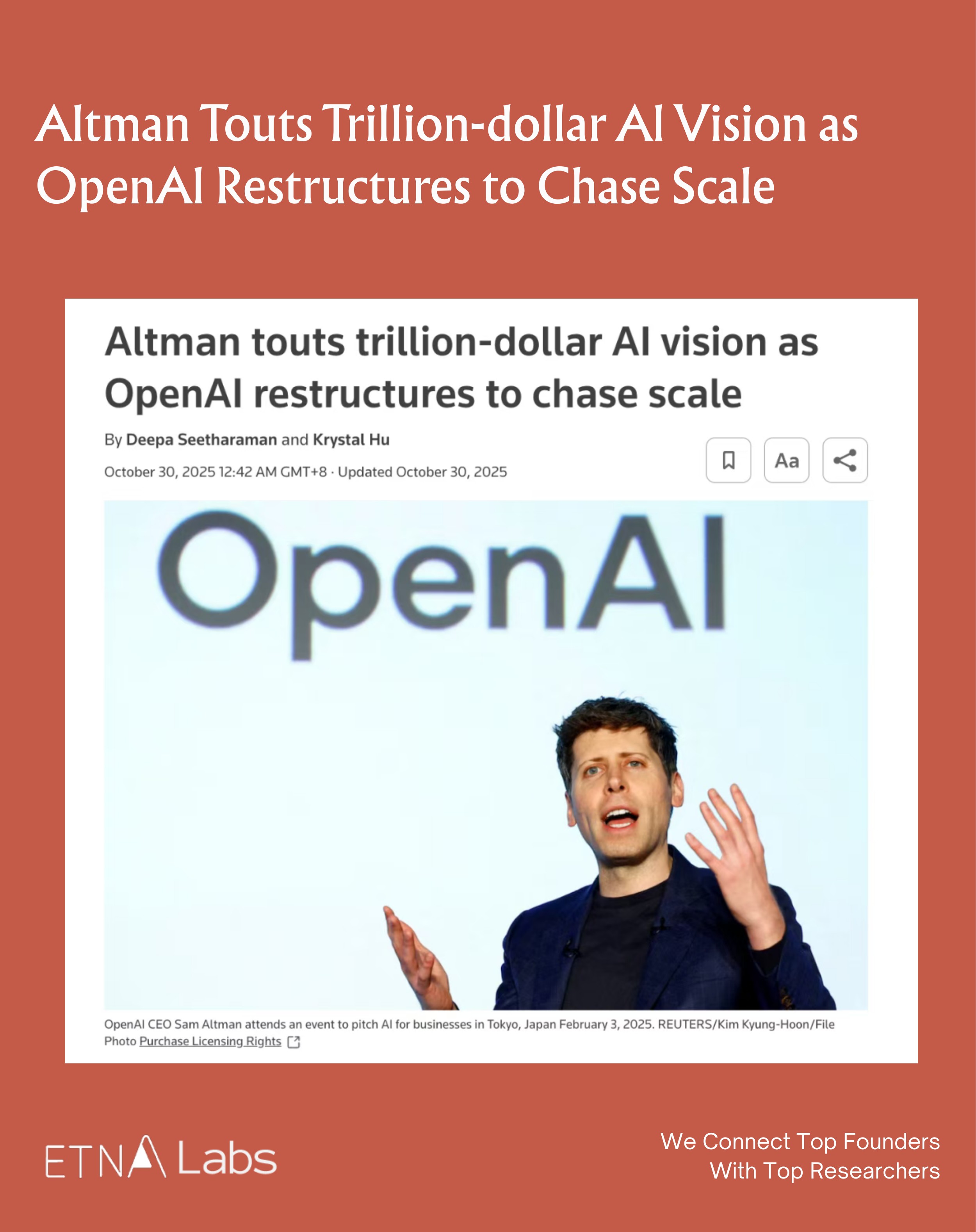
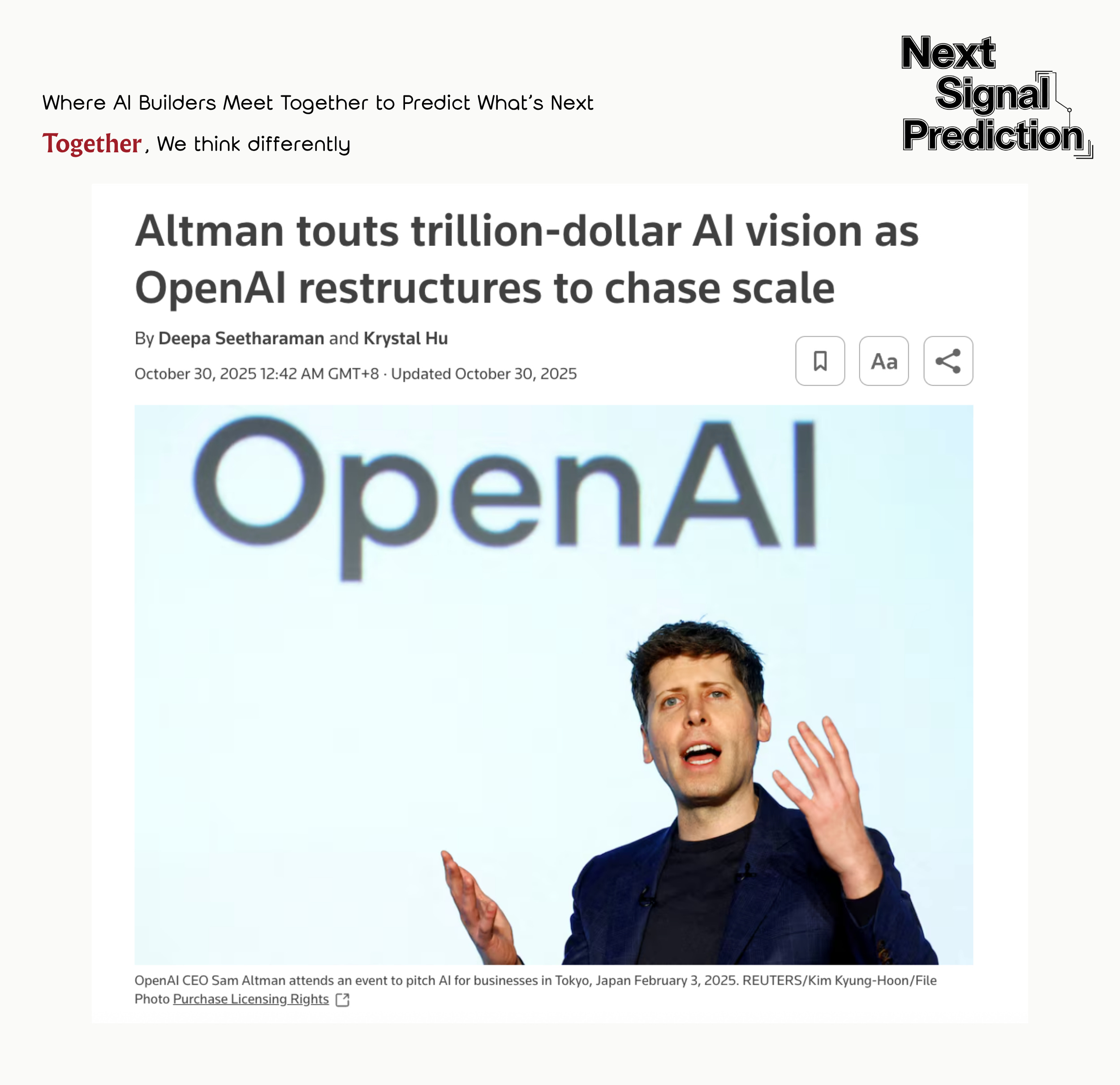
Beyond the recent noise around circular deals the latest catalyst for the AI bubble conversation was straightforward and concrete: OpenAI’s proposed $1.4 trillion CapEx plan.
Sam Altman said OpenAI intends to build roughly 30 GW of compute capacity, which he framed as requiring around $1.4 trillion of capital investment. He also mentioned that OpenAI targets $100 billion of revenue by 2027 early this year, implying that it would take just 2 to 3 years for OpenAI to scale revenue from the tens of billions to the $100B level.
From a monetization standpoint, what OpenAI is trying to pull off is something we basically haven’t seen before. If you run the usual consumer internet math—conversion to paid, DAU, pricing—it’s very hard to make $100B of revenue by 2027 feel comfortable.
The default assumption in the market has quietly become: OpenAI has to sprint on both fundraising and monetization over the next 1–2 years, almost regardless of the exact product roadmap. Altman has even gone on X to say he hopes the US government will step in and help fund AI infrastructure

If you run simple cash‑flow math, the challenge becomes obvious. Suppose, generously, that:
- OpenAI reaches $400B revenue by 2033;
- It turns cash‑flow positive around 2029;
- Over time, it can devote about $200B of internally generated cash to CapEx.
You still end up with a $1.2T funding gap against a $1.4T build‑out.
Where could the rest of the money come from? As of 2024, the aggregate Mag 7 profile looks roughly like this (calendar year, before deducting CapEx):
CompanyOperating Cash Flow ($M)CapEx
($M)Free Cash Flow
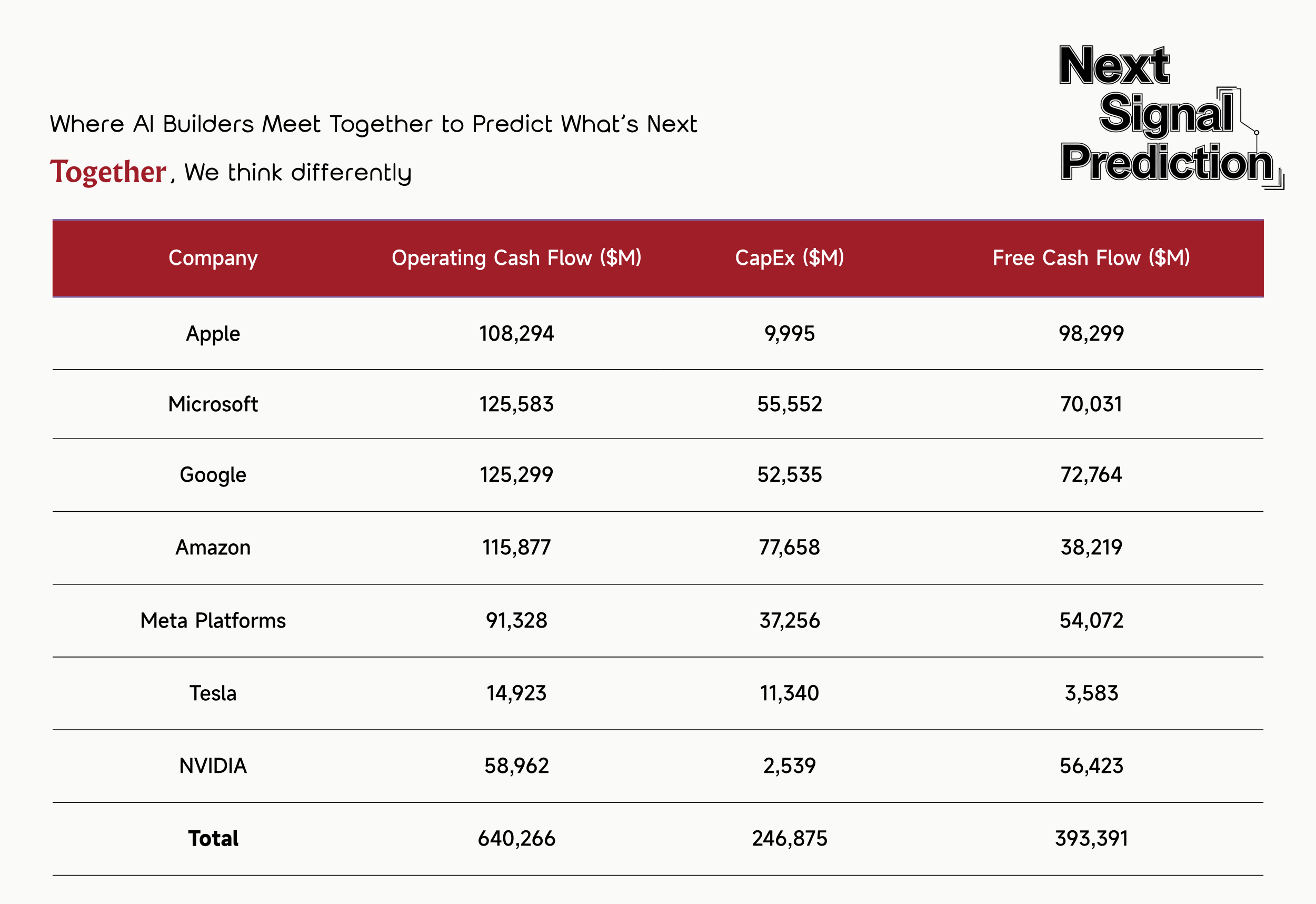
Even if you take the combined operating cash flow of ~$640B, and ignore their own CapEx needs, it is still well below the $1.2T OpenAI hypothetically needs to fill its gap.
So from a pure funding perspective, OpenAI cannot finance this alone, and even the combined Mag 7 cash generation is not obviously sufficient if they were to underwrite a large fraction of it.
It is important, however, to separate two questions:
- Can OpenAI realistically execute a $1.4T CapEx plan?
- Does the existence (or non‑existence) of that plan tell us whether there is an AI bubble in the broader market?
Those are not the same questions.
In day‑to‑day markets, Wall Street cares more about actual CapEx by the hyperscalers and big tech than about OpenAI’s theoretical long‑term ambitions. And by that metric, the picture looks more nuanced.
Since 2023, most of the Mag 7 have significantly raised CapEx, yet many have also improved ROIC. At the S&P 500 level, CapEx as a share of cash flow has averaged about 46% since 2005, well below the 70–80% levels of the 1990s. So yes, CapEx is climbing, but profitability and cash generation have also improved; the ratio still sits in a historically healthy band.
Today, after CapEx, US tech giants collectively generate on the order of $500B of free cash flow per year, with roughly $300B in cash on their balance sheets. That is about $800B of annual buffer, before accounting for growth.
There is, however, a more skeptical read: what if these companies are gradually turning into TSMC‑style, heavy‑CapEx utilities? If they end up fighting OpenAI and other labs for the same user entry points, and some lose, their historical profitability will not be repeatable. Starting around 2026, some may need to spend more than 100% of free cash flow on CapEx just to stay in the race.
On this view, ROE for some Mag 7 names is already drifting down, but that hasn’t been fully reflected in valuations yet.
The credit market is already signaling extreme caution. The high valuations of frontier labs like OpenAI and Anthropic are inherently fragile, contingent entirely on meeting their aggressive 2026 revenue projections. The cost of money is rising:
- xAI successfully issued bonds only after being compelled to raise the interest rate from 12 percent to 13 percent.
- Google saw its bond spread widen by 60 basis points over SOFR (Secured Overnight Financing Rate).
- OpenAI’s own borrowing cost is approximately 6 percent. Specifically, its 4 billion USD unsecured revolving line of credit (with a 2 billion USD accordion option) is priced at SOFR plus 100 basis points. With SOFR recently slightly above 5 percent, the all-in immediate borrowing cost is roughly 6 percent. For a high-growth tech company, this borrowing cost reflects serious market skepticism about the predictability of its future cash flows.
Finally, Meta’s joint venture with Blue Owl Capital—a new financing structure where Meta contributes only 20 percent of the data center capital—is a notable experiment in capital-efficient scaling, tacitly acknowledging the massive balance sheet risk in taking on this infrastructure build alone.
Key Debate 2: Why Is AI Compute CapEx Still Scaling Up?
Given how much has already been spent, it’s natural to ask why AI infrastructure CapEx keeps accelerating instead of stabilizing.
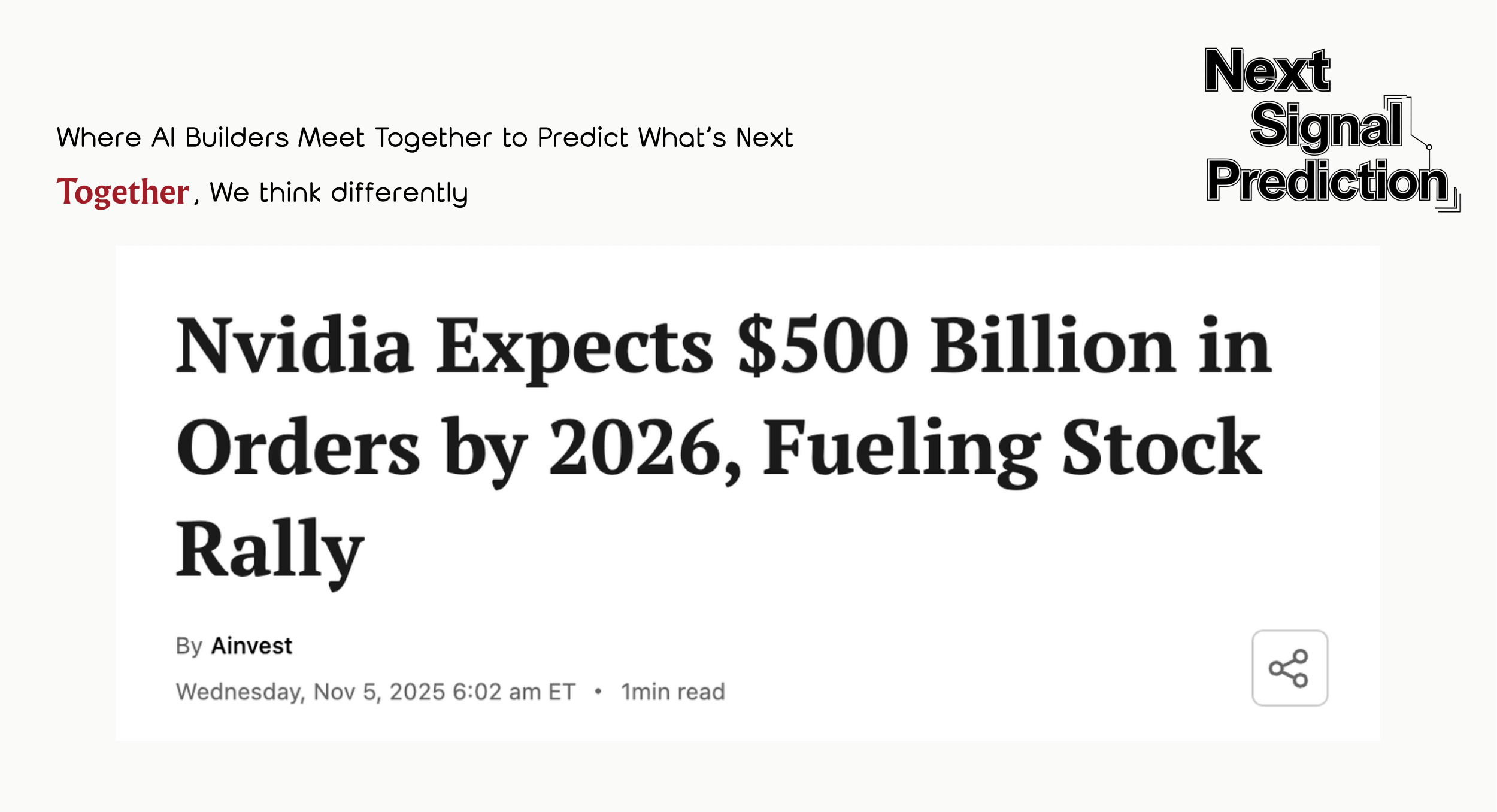
On the hardware side, Jensen Huang said at NVIDIA’s latest GTC that orders for Blackwell plus Rubin over the next five quarters are tracking toward $500B. Spread evenly, that’s roughly $100B of orders per quarter, versus NVIDIA’s most recent quarterly revenue of $46.7B (Q2 FY2026). So the booked demand per quarter is already at least 2× the last reported revenue run‑rate
On the data center side, Alibaba announced at Apsara Conference that Alibaba Cloud’s global data center energy usage will grow 10× over the next decade. If you assume:
- A four‑year depreciation period, and
- A roughly linear ramp toward that 10× increase,
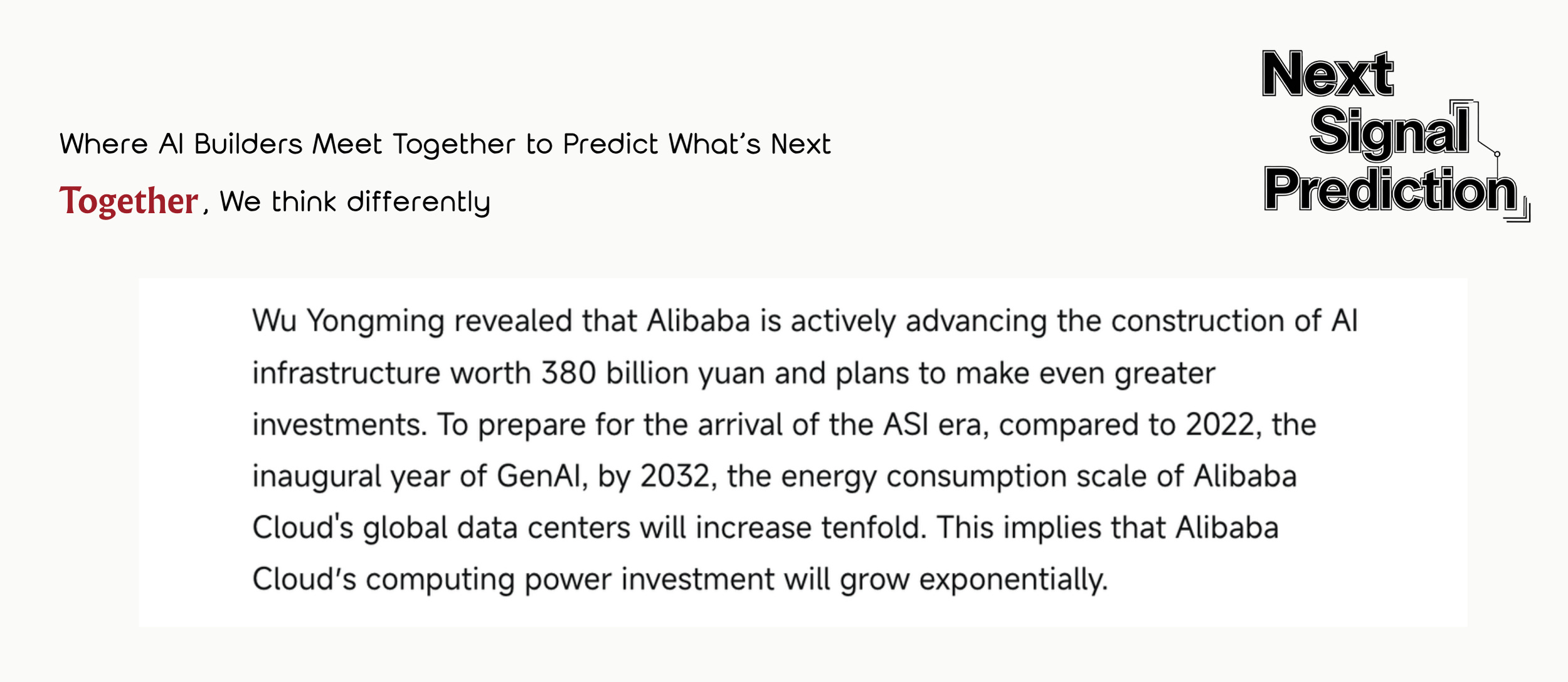
you get annual CapEx growth close to 30%, and by year 10, yearly CapEx at about 9–10× today’s level.
So why is spend still ramping?
1. Model competition is far from over
The model race in 2025 remains intense. New SOTA models appear almost every quarter, but their lead often lasts less than a month. That’s a big shift from 2023–2024, when the cadence was more like one new SOTA every six months. The improvement cycle has compressed sharply.
Most likely, frontier models will stay in the tool layer (L2–L3) for a while, rather than jumping straight to fully autonomous agents. But there is still strong confidence that model capabilities can keep improving meaningfully from here. On that premise, frontier labs will continue to pour enormous amounts of compute into training:
- Players like Meta and xAI need massive training runs just to catch up with the front.
- The current leaders still need to explore new paradigms beyond the existing architectures.
History suggests that scaling‑law‑driven “magic moments” are still worth betting on:
- Early in 2025, once Anthropic figured out how to do pre‑training correctly, Claude 3.7, Claude 4 and successors clearly pulled ahead in coding and agent abilities. Anthropic may generate tens of billions in revenue this year.
- After OpenAI cracked reasoning, essentially all of its current models and features have been built on that reasoning stack. OpenAI may have 800–900M WAU in 2025.
- Google fixed a series of pre‑training bugs, resurfaced into the top tier of models in early 2025, and might be back at SOTA by year‑end.
Training spend is also structurally different from pure capacity build‑out because it’s mostly R&D. It’s influenced not only by direct ROI, but also by:
- Macro conditions (e.g., interest rates),
- The financial strength of each participant,
- Their willingness to exit or stay in the race,
- And whether frontier marginal gains remain real.
If a truly new paradigm emerges, the whole tech and internet stack could be reshuffled, making it even less likely that incumbents simply step back. Compared with the dot‑com era, today’s giants have far stronger balance sheets and cash flows.
So even if training ROI is declining, as long as marginal progress is visible and no one wants to fall behind, training‑driven compute demand simply doesn’t obey traditional business logic.
The bear case requires something more dramatic: for example, if instead of a rate cut in December we get a rate hike, or if giants conclude that marginal training gains have flattened enough to stop scaling. That’s the kind of scenario that could compress AI demand and change the trajectory of the entire sector.
2. Inference are becoming the next demand leg
On top of training, inference demand is likely to be the next major incremental driver. The logic is straightforward: the applications side has started to validate real use cases.
With today’s models, if you design context handling, UI, and workflows well, you can already unlock many meaningful scenarios. As agent tool use gets better, we’re likely to see an explosion of multimodal use cases around 2026.
NVIDIA has suggested that token costs could fall 10–100× per year. Every major platform is now optimizing both software and hardware, so inference costs are structurally headed down. Once inference is cheap enough, usage explodes.
But cost per token is only half the picture. Products like Cursor still have negative gross margins. Users insist on using the latest frontier models, so every round of cost savings gets immediately consumed by upgrading to a more expensive model. In practice, the effective model cost per user hasn’t fallen much at the product level.
Because inference gross margins are still thin, model companies face serious near‑term cash‑flow pressure. That’s part of why the market obsesses over whether OpenAI’s $1.4T plan is even remotely fundable.
There’s a second twist: after OpenAI launched o1 in 2024, reasoning became its own scaling law. Tasks that used to take 10 tokens can easily consume 100× more under intensive reasoning. In the short term, this blows up the compute bill, soaking up much of the cost savings from Hopper→Blackwell and other hardware gains.
On paper, chips improved 30–50×. In practice, much of that is offset by reasoning‑driven token blow‑ups. From the user’s point of view, costs don’t feel like they’ve dropped much at all.
3. Data center ROI is still manageable—if you pick right
The case for continued AI investment is therefore not that “AI has already transformed everything,” but that we are clearly not in a collapse scenario either. That leaves a broad middle: companies that are mostly beta on AI will likely trade sideways or with sentiment swings, while capital will crowd into whatever looks like the tightest bottleneck in the value chain. That’s part of why storage and compute capacity assets keep getting bid up.
For data centers, the key questions are:
- Build vs rent;
- Where to build;
- How to balance power cost, geography, latency, and network.
ROI is, in principle, modelable, but true costs and depreciation profiles vary wildly by site.
For example, some cloud providers are willing to build inference‑optimized data centers where electricity may be 1.3–1.4×, even 2× higher than alternative locations—because latency is better. If your primary business is inference‑heavy, those “expensive but close” data centers can still deliver superior ROI.
The net result: the compute CapEx cycle is not just about GPUs; it’s about multi‑year bets on sites, power, and network topology.
Key Debate 3: Is “Dark GPU” the Right Bubble Metric?
During the 2000 internet bubble, one widely cited warning signal was the ballooning stock of dark fiber—fiber that had been laid but never lit. In the US, roughly 97% of newly laid fiber at the time was dark.
Translating that logic to AI, you’d call it a red flag if 70–90% of GPUs were sitting idle. But in reality, there is no obvious pool of idle GPUs today.
One way to approximate GPU slack is to look at AWS Spot Instance dynamics. The GPU idle rate can be thought of as the fraction of minutes in a 24‑hour period during which you can actually secure spot GPUs:
- At peak tightness, that number is 0%—no capacity available at any time.
- At maximum slack, with GPUs easy to rent everywhere, it approaches 100%.
AWS Spot pricing reflects the market price for AWS’s unused compute capacity. Spot instances are offered at a discount to on‑demand prices, with rates floating according to supply and demand.
Recent commentary suggests that around October, this effective GPU idle rate was still only around 5%, indicating that supply is still very tight. At least in the cloud, there is no meaningful idle GPU stock.
On‑prem is more complicated. Big enterprises like Apple might have clusters that are not used continuously and thus look “idle” from the outside. But that’s just utilization pattern and internal capacity management—it’s not a market‑wide oversupply.
More importantly, mapping the dark fiber analogy directly onto GPUs may be a category mistake.
Back in 1999, the value chain was simple: telecom operators bought fiber, laid it, then sold $30–50/month consumer packages. Fiber went dark because operators misjudged end‑user demand.
Today’s AI ecosystem is vastly more complex. GPUs have effectively become capital goods, not just intermediate pipes. The right question is not “are GPUs lit,” but:
After this much CapEx, where is the incremental revenue tied to that compute, and does that revenue justify the investment?
If you want historical markers, defaults are another lens. Both the dot‑com bust and the 2008 subprime crisis involved meaningful default cycles:
- Fiber‑related bankruptcies were under the trillion‑dollar level of debt.
- Lehman alone had over $600B of debt when it collapsed.
If this AI cycle ends badly, you’d expect one or more flagship names to blow up with trillion‑dollar‑scale defaults. That’s the order of magnitude to watch.
Key Debate 4: How Big Can AI Actually Get?
All of these CapEx and ROI debates hide a more basic question: how big can AI monetization be? OpenAI already has close to 500M users, but can it ever be a Meta‑sized product with 3B DAU?
The market’s expectations are currently high on both axes:
- It’s assuming very large CapEx for AI build‑out, and
- It’s also assuming peak‑optimistic revenue for ChatGPT and other tier‑one players by 2026.
Looking at the models now in training, it’s unlikely we’ll see entirely new categories of use cases in the next 6–12 months—nothing as dramatic as the 2025 agent boom. So the core challenge becomes: how do you earn back hundreds of billions in CapEx per company over just a few years?
Earlier we noted that US and Chinese giants have been ramping CapEx while still reporting strong revenue and profit growth. The main reason is that AI‑driven value is subtle and indirect:
- Cost savings and efficiency: By October 2025, US unemployment was around 1.1M, up 65% YoY. That’s one visible manifestation of cost reduction. At the same time, many enterprises have quietly cut back on new hiring because of AI—another under‑the‑surface efficiency gain.
- Enterprise AI adoption: Many Chinese companies had accumulated large internal datasets but lacked a conversational interface to unlock them. LLMs effectively act as a universal UI for those data stores. That’s part of why Alibaba Cloud’s FY2025 Q3 AI‑related revenue grew >100% YoY, while legacy cloud grew about 10%. Overall cloud revenue grew around 13% YoY, with AI products being the standout.
Jensen Huang likes to frame AI’s growth as a double exponential:
- User penetration.
The market probably overestimates current AI penetration, leading to pessimistic assumptions about TAM.
- In the US, AI penetration might be around 40%, versus 90%+ for the internet and PCs. There’s still space for another doubling in the US alone.
- In China, penetration is <20%, even counting all major LLMs and de‑duplicating users.
- Globally, outside the US and China, penetration may be 5–10%. Moving from 5–10% to 90–100% implies roughly a 10× expansion in user base.
Historically, the real flood of capital comes once a technology crosses the 30–40% penetration threshold—when even non‑technical users can adopt it without friction. By that metric, AI is still far from a “bubble‑stage” penetration.
- Tokens per user per query.
With Deep Research, advanced agents, and richer tools, the tokens consumed per query can explode.
In our internal discussions, one participant noted that over the past six months, their non‑coding spend on model platforms went up about 20×, not counting additional services like Replit and domains.
That spending growth came from:
- Paying for higher‑priced models like GPT‑5 Pro or Google Deep Think, which have 15–20× the token price of baseline GPT‑5 thinking models and much longer context. Single API calls at $1–3 are not unusual.
- Using agent‑based applications for tasks like complex Excel automation, often priced around $200/month per seat, with ARPU 20–30× higher than prior products.
From a business‑model angle, you can bucket AI monetization into three primary forms:
- Subscriptions (consumer and enterprise SaaS)
- Usage‑based billing (AI as labor replacement)
- Ads and e‑commerce
The “no bubble” camp argues that except for model providers, most parts of the AI value chain are already profitable. Think of the industry as a multi‑inlet reservoir: aside from power‑related pressure points, each inlet still looks structurally sound. There may be micro‑bubbles in specific companies or niches, but not an obvious system‑wide blow‑up yet.
The skeptics counter that most model companies and front‑end apps are still losing money, suggesting that the current monetization architecture is fragile and possibly unsustainable.
One plausible trajectory is that subscriptions end up capturing ~80% of the commercially valuable capabilities. Today’s usage‑billed SOTA models become subscription bundles next year, and free the year after. In that world, the “AI replaces programmer wages” revenue line may be much smaller than bulls hope.
Subscriptions
ChatGPT already has around 500M DAU and ~1B MAU. That implies extremely high coverage among knowledge workers, especially in Western markets. Pushing subscription ARPU much higher from here will be hard.
For mass‑market subscription products, pricing power is usually weak. Even if model capabilities keep improving, token costs also fall, leading many to believe that:
- The $20/month price point will remain the standard,
- The capability bundle within that $20 will expand, but headline prices will not rise much.
Even in high‑income markets like New York, people in the top 25% of income are unlikely to spend $200/month purely on AI tools. At $2,000/month, your user is almost certainly a business owner or similar, and the addressable base shrinks dramatically.
For AI products to command truly premium subscription pricing, AI must be able to autonomously do work—something akin to L4 automation. The Tesla analogy is instructive: in the L2.5 era, Full Self‑Driving doesn’t command high standalone prices and is often bundled cheaply with hardware. Once you approach L4, you can reasonably charge $99/month or more.
Meanwhile, competition and DAU‑maximization behavior will push toward cheaper and richer free tiers. It’s not hard to imagine a world where “good enough” AI is free, and you only pay for truly frontier capabilities.
Even so, subscription revenue is already significant. With hundreds of millions of users paying hundreds of dollars per year, you’re already talking about tens of billions of dollars in aggregate revenue.
Usage‑based billing
Usage‑based pricing relies on the idea that AI will do a large chunk of programmer and knowledge‑worker tasks, and providers can capture that freed‑up wage bill as revenue.
But there’s a flaw: just because AI can do more work doesn’t mean it captures the same economics. The more common pattern is that tasks which used to be valuable are now simply worth less. That shrinks the pricing power of both workers and tools.
Ads and E‑commerce
Recently, ChatGPT has started pushing into e‑commerce and advertising. Since these are the two dominant business models of the internet era, it’s natural to ask whether they can be a major upside driver for AI. The follow‑up question is: are we creating new demand, or just reallocating existing budgets?
The skeptical view: e‑commerce is constrained by overall commerce penetration, and ads are constrained by the ratio of online transactions. On that view, the AI layer mostly fights for the same pie, which explains why Meta, Google, and ByteDance are rushing to ship their own AI offerings—to defend share against OpenAI.
The more optimistic view: better AI‑driven targeting and interfaces can create new demand, not just reallocate it.
Take ChatGPT again. By 2026, it could plausibly have 1B DAU. At 3–5 queries per day per user, that’s 3–5B queries daily. Google today handles around 15B queries per day, so ChatGPT would be at 1/3–1/5 of Google’s scale.
Google queries are heavily skewed toward commercial intent—shopping, product recommendations, travel planning. But ChatGPT queries are often more detailed and better matched to user needs, potentially delivering:
- Higher ad precision,
- Higher value per impression.
Some overseas DTC brands already report that a meaningful share of their organic traffic now comes via ChatGPT and Gemini, even though neither is yet aggressively optimized for commerce. If OpenAI starts doing intent‑aware ranking and traffic optimization for commercial queries, the e‑commerce upside could surprise to the upside.
Importantly, ChatGPT does not appear to have meaningfully cannibalized Google’s organic traffic. Despite Google’s much larger base, its traffic growth slope in 2025 is not obviously lower than ChatGPT’s. That suggests the early AI wave may be expanding the total search‑like surface, not just reallocating it.
Companies like AppLovin have built entire businesses on the thesis that ads can generate incremental economic activity, not just shift it. If ChatGPT can understand users better and surface more relevant purchase opportunities, it can unlock optional consumption, rather than simply stealing revenue from Meta, Google, or Amazon.
Key Debate 5: What Are the “Technical Black Swans” in AI?
The “AI bubble” narrative often assumes a hyper‑accelerating technology curve with hard‑to‑price tail risks. In reality, AI’s current trajectory—fast as it is—still feels like something the market can roughly understand and discount.
The true “black swan” would be a fundamentally new model mechanism that beats Transformers at much lower cost. That would disrupt today’s entire tech stack. In that world, one possible hedge would be:
- Long CSPs, short power utilities, or
- Long semiconductor equipment, short AI servers.
As long as the Transformer + RL path remains viable and improving, it’s hard to call the core AI story a bubble. By comparison, autonomous driving and VLA (vision‑language‑action) may be more exposed to over‑valuation risk.
There is, however, real debate about whether the current path can carry us all the way.
Those who worry about “technical black swans” don’t doubt AI’s long‑term value. They are specifically unsure whether pre‑training + RL scaling can reach AGI or ASI, which may be why Ilya Sutskever is exploring alternatives like online learning or self‑learning.
Recent progress suggests that the Transformer path can allow AI to surpass most humans at knowledge tasks, but still struggles with reliable, end‑to‑end economic tasks. In that sense, AI is hitting a bottleneck similar to autonomous driving:
- Models perform well in domains with clear, well‑specified data distributions.
- In messy domains, you still need massive data collection and labeling, followed by compression into a model, before you see robust performance.
This reality helps explain why data‑labeling companies like Mercor and Surge are growing so quickly.
If you think in terms of a human‑brain analogy, it’s possible that today’s path is already “good enough” as an endpoint: it can automate a large share of economically valuable tasks. Combined with macro conditions, big‑tech cash flows, and state‑level backing, the AI story is likely to continue for 5–10 years, with enough time for investors to earn back their capital.
On the more aggressive side, Sam Altman has said that OpenAI’s major decisions are based not on what the current models can do, but on a belief that 1–2 years from now, model capabilities will undergo a qualitative shift. Under that assumption, the AI “bubble” label looks even weaker.
That qualitative shift is essentially shorthand for the next learning paradigm. The leading candidate is online learning, as the natural successor to pre‑training + RL scaling. Frontier labs haven’t converged on how to implement it, but many expect early positive signals over the next 3–6 months—roughly by next summer. If you’re bullish, you might say we are now six months before the “strawberry model” or the next‑cycle o1.
But there are important counter‑arguments. In a recent interview, Andrej Karpathy emphasized that the human brain is not just a pre‑trained system; it’s a product of biological evolution. The brain’s development is more about growth and maturation than about a single giant training run.
Today’s AI models do not have an evolutionary process. They compress everything into a single, massive pre‑training run. Karpathy likens this more to a ghost than to a real brain, and believes AGI will arrive later than Sam Altman expects.
You can see this caution embedded in OpenAI’s agreement with Microsoft, which implicitly assumes that AGI will not be immediate. If that’s right, the conversation returns to more familiar ground: are we over‑investing in the short term, even if the long term is real?
The most likely outcome is familiar from past cycles: markets will overestimate the short term and underestimate the long term. In between, there will be volatility, resets, and localized blow‑ups.
It’s also worth remembering that “bubble” is primarily a capital‑markets concept, not a technological one. The underlying tech can keep progressing while valuations overshoot and correct. Early in the internet era, there were real innovations and mostly rational decisions. Things became truly irrational later, when many believed the wave was nearing its end.
Today, NVIDIA trades at a P/S below 30×. That’s rich, but hardly definitive evidence of a systemic bubble. At most, it suggests that the risk‑reward has shifted, and you need to be more discerning about where in the stack you take exposure.
As long as AI tools are mainly used by high‑knowledge professionals and developers, it’s hard to get a classic retail bubble going; these users are relatively rational. True bubbles tend to form when technology reaches everyone, and when that diffusion coincides with rate‑cut cycles and abundant liquidity.
Right now, model capabilities and applications are improving in a steady, non‑explosive way. Given the macro environment, it is quite plausible that if there is an AI bubble peak, it might coincide with something like an OpenAI IPO—a moment when both technology hype and capital‑markets optimism temporarily converge.
The AI Bubble Reckoning: 1999 All Over Again, or a New Super‑Cycle?
Back to All
TL;DR:
The escalating CapEx war—triggered by OpenAI’s staggering $1.4 trillion infrastructure plan and the relentless spending of the Mag7—has forced the market to confront the paralyzing “Dark Fiber” bubble analogy.
Is this time different?
Our core thesis, however, is that while high short-term volatility is certain, AI represents a genuine, long-term productivity revolution that carries a high opportunity cost for market pessimists.
- OpenAI’s $1.4 trillion CapEx implies a structural $1.2 trillion funding deficit that current capital markets cannot meet, despite the Mag7’s strong cash reserves.
- Credit markets are already pricing this extreme fragility (e.g., 6 percent borrowing costs).
- The relentless compute escalation is rational, driven by the enduring Scaling Law, the rapid shift to high-volume Inference, and the token consumption paradox.
- Bubble Test: The “Dark Fiber” utilization test is irrelevant. Today, GPUs are “lit up.” The only true collapse signal will be trillion-dollar-level debt defaults resulting from unjustifiable incremental CapEx.
- The ultimate risk is a Technical Black Swan—a new, low-cost paradigm (like Online Learning) that renders the entire Transformer/RL architecture obsolete. The market bubble, however, is more likely to peak around the OpenAI IPO event than the actual technical ceiling.
This analysis and these judgments were compiled from a collective Best Ideas community discussion.Join us to not just read the analysis—but help shape it as breakthroughs unfold. Apply here.
Thanks for reading! Subscribe for free to receive new posts and support our work.
Key Debate 1: OpenAI’s $1.4T CapEx, What the Market Should Really Care About
Beyond the recent noise around circular deals the latest catalyst for the AI bubble conversation was straightforward and concrete: OpenAI’s proposed $1.4 trillion CapEx plan.
Sam Altman said OpenAI intends to build roughly 30 GW of compute capacity, which he framed as requiring around $1.4 trillion of capital investment. He also mentioned that OpenAI targets $100 billion of revenue by 2027 early this year, implying that it would take just 2 to 3 years for OpenAI to scale revenue from the tens of billions to the $100B level.
From a monetization standpoint, what OpenAI is trying to pull off is something we basically haven’t seen before. If you run the usual consumer internet math—conversion to paid, DAU, pricing—it’s very hard to make $100B of revenue by 2027 feel comfortable.
The default assumption in the market has quietly become: OpenAI has to sprint on both fundraising and monetization over the next 1–2 years, almost regardless of the exact product roadmap. Altman has even gone on X to say he hopes the US government will step in and help fund AI infrastructure
If you run simple cash‑flow math, the challenge becomes obvious. Suppose, generously, that:
- OpenAI reaches $400B revenue by 2033;
- It turns cash‑flow positive around 2029;
- Over time, it can devote about $200B of internally generated cash to CapEx.
You still end up with a $1.2T funding gap against a $1.4T build‑out.
Where could the rest of the money come from? As of 2024, the aggregate Mag 7 profile looks roughly like this (calendar year, before deducting CapEx):
CompanyOperating Cash Flow ($M)CapEx
($M)Free Cash Flow
Even if you take the combined operating cash flow of ~$640B, and ignore their own CapEx needs, it is still well below the $1.2T OpenAI hypothetically needs to fill its gap.
So from a pure funding perspective, OpenAI cannot finance this alone, and even the combined Mag 7 cash generation is not obviously sufficient if they were to underwrite a large fraction of it.
It is important, however, to separate two questions:
- Can OpenAI realistically execute a $1.4T CapEx plan?
- Does the existence (or non‑existence) of that plan tell us whether there is an AI bubble in the broader market?
Those are not the same questions.
In day‑to‑day markets, Wall Street cares more about actual CapEx by the hyperscalers and big tech than about OpenAI’s theoretical long‑term ambitions. And by that metric, the picture looks more nuanced.
Since 2023, most of the Mag 7 have significantly raised CapEx, yet many have also improved ROIC. At the S&P 500 level, CapEx as a share of cash flow has averaged about 46% since 2005, well below the 70–80% levels of the 1990s. So yes, CapEx is climbing, but profitability and cash generation have also improved; the ratio still sits in a historically healthy band.
Today, after CapEx, US tech giants collectively generate on the order of $500B of free cash flow per year, with roughly $300B in cash on their balance sheets. That is about $800B of annual buffer, before accounting for growth.
There is, however, a more skeptical read: what if these companies are gradually turning into TSMC‑style, heavy‑CapEx utilities? If they end up fighting OpenAI and other labs for the same user entry points, and some lose, their historical profitability will not be repeatable. Starting around 2026, some may need to spend more than 100% of free cash flow on CapEx just to stay in the race.
On this view, ROE for some Mag 7 names is already drifting down, but that hasn’t been fully reflected in valuations yet.
The credit market is already signaling extreme caution. The high valuations of frontier labs like OpenAI and Anthropic are inherently fragile, contingent entirely on meeting their aggressive 2026 revenue projections. The cost of money is rising:
- xAI successfully issued bonds only after being compelled to raise the interest rate from 12 percent to 13 percent.
- Google saw its bond spread widen by 60 basis points over SOFR (Secured Overnight Financing Rate).
- OpenAI’s own borrowing cost is approximately 6 percent. Specifically, its 4 billion USD unsecured revolving line of credit (with a 2 billion USD accordion option) is priced at SOFR plus 100 basis points. With SOFR recently slightly above 5 percent, the all-in immediate borrowing cost is roughly 6 percent. For a high-growth tech company, this borrowing cost reflects serious market skepticism about the predictability of its future cash flows.
Finally, Meta’s joint venture with Blue Owl Capital—a new financing structure where Meta contributes only 20 percent of the data center capital—is a notable experiment in capital-efficient scaling, tacitly acknowledging the massive balance sheet risk in taking on this infrastructure build alone.
Key Debate 2: Why Is AI Compute CapEx Still Scaling Up?
Given how much has already been spent, it’s natural to ask why AI infrastructure CapEx keeps accelerating instead of stabilizing.
On the hardware side, Jensen Huang said at NVIDIA’s latest GTC that orders for Blackwell plus Rubin over the next five quarters are tracking toward $500B. Spread evenly, that’s roughly $100B of orders per quarter, versus NVIDIA’s most recent quarterly revenue of $46.7B (Q2 FY2026). So the booked demand per quarter is already at least 2× the last reported revenue run‑rate
On the data center side, Alibaba announced at Apsara Conference that Alibaba Cloud’s global data center energy usage will grow 10× over the next decade. If you assume:
- A four‑year depreciation period, and
- A roughly linear ramp toward that 10× increase,
you get annual CapEx growth close to 30%, and by year 10, yearly CapEx at about 9–10× today’s level.
So why is spend still ramping?
1. Model competition is far from over
The model race in 2025 remains intense. New SOTA models appear almost every quarter, but their lead often lasts less than a month. That’s a big shift from 2023–2024, when the cadence was more like one new SOTA every six months. The improvement cycle has compressed sharply.
Most likely, frontier models will stay in the tool layer (L2–L3) for a while, rather than jumping straight to fully autonomous agents. But there is still strong confidence that model capabilities can keep improving meaningfully from here. On that premise, frontier labs will continue to pour enormous amounts of compute into training:
- Players like Meta and xAI need massive training runs just to catch up with the front.
- The current leaders still need to explore new paradigms beyond the existing architectures.
History suggests that scaling‑law‑driven “magic moments” are still worth betting on:
- Early in 2025, once Anthropic figured out how to do pre‑training correctly, Claude 3.7, Claude 4 and successors clearly pulled ahead in coding and agent abilities. Anthropic may generate tens of billions in revenue this year.
- After OpenAI cracked reasoning, essentially all of its current models and features have been built on that reasoning stack. OpenAI may have 800–900M WAU in 2025.
- Google fixed a series of pre‑training bugs, resurfaced into the top tier of models in early 2025, and might be back at SOTA by year‑end.
Training spend is also structurally different from pure capacity build‑out because it’s mostly R&D. It’s influenced not only by direct ROI, but also by:
- Macro conditions (e.g., interest rates),
- The financial strength of each participant,
- Their willingness to exit or stay in the race,
- And whether frontier marginal gains remain real.
If a truly new paradigm emerges, the whole tech and internet stack could be reshuffled, making it even less likely that incumbents simply step back. Compared with the dot‑com era, today’s giants have far stronger balance sheets and cash flows.
So even if training ROI is declining, as long as marginal progress is visible and no one wants to fall behind, training‑driven compute demand simply doesn’t obey traditional business logic.
The bear case requires something more dramatic: for example, if instead of a rate cut in December we get a rate hike, or if giants conclude that marginal training gains have flattened enough to stop scaling. That’s the kind of scenario that could compress AI demand and change the trajectory of the entire sector.
2. Inference are becoming the next demand leg
On top of training, inference demand is likely to be the next major incremental driver. The logic is straightforward: the applications side has started to validate real use cases.
With today’s models, if you design context handling, UI, and workflows well, you can already unlock many meaningful scenarios. As agent tool use gets better, we’re likely to see an explosion of multimodal use cases around 2026.
NVIDIA has suggested that token costs could fall 10–100× per year. Every major platform is now optimizing both software and hardware, so inference costs are structurally headed down. Once inference is cheap enough, usage explodes.
But cost per token is only half the picture. Products like Cursor still have negative gross margins. Users insist on using the latest frontier models, so every round of cost savings gets immediately consumed by upgrading to a more expensive model. In practice, the effective model cost per user hasn’t fallen much at the product level.
Because inference gross margins are still thin, model companies face serious near‑term cash‑flow pressure. That’s part of why the market obsesses over whether OpenAI’s $1.4T plan is even remotely fundable.
There’s a second twist: after OpenAI launched o1 in 2024, reasoning became its own scaling law. Tasks that used to take 10 tokens can easily consume 100× more under intensive reasoning. In the short term, this blows up the compute bill, soaking up much of the cost savings from Hopper→Blackwell and other hardware gains.
On paper, chips improved 30–50×. In practice, much of that is offset by reasoning‑driven token blow‑ups. From the user’s point of view, costs don’t feel like they’ve dropped much at all.
3. Data center ROI is still manageable—if you pick right
The case for continued AI investment is therefore not that “AI has already transformed everything,” but that we are clearly not in a collapse scenario either. That leaves a broad middle: companies that are mostly beta on AI will likely trade sideways or with sentiment swings, while capital will crowd into whatever looks like the tightest bottleneck in the value chain. That’s part of why storage and compute capacity assets keep getting bid up.
For data centers, the key questions are:
- Build vs rent;
- Where to build;
- How to balance power cost, geography, latency, and network.
ROI is, in principle, modelable, but true costs and depreciation profiles vary wildly by site.
For example, some cloud providers are willing to build inference‑optimized data centers where electricity may be 1.3–1.4×, even 2× higher than alternative locations—because latency is better. If your primary business is inference‑heavy, those “expensive but close” data centers can still deliver superior ROI.
The net result: the compute CapEx cycle is not just about GPUs; it’s about multi‑year bets on sites, power, and network topology.
Key Debate 3: Is “Dark GPU” the Right Bubble Metric?
During the 2000 internet bubble, one widely cited warning signal was the ballooning stock of dark fiber—fiber that had been laid but never lit. In the US, roughly 97% of newly laid fiber at the time was dark.
Translating that logic to AI, you’d call it a red flag if 70–90% of GPUs were sitting idle. But in reality, there is no obvious pool of idle GPUs today.
One way to approximate GPU slack is to look at AWS Spot Instance dynamics. The GPU idle rate can be thought of as the fraction of minutes in a 24‑hour period during which you can actually secure spot GPUs:
- At peak tightness, that number is 0%—no capacity available at any time.
- At maximum slack, with GPUs easy to rent everywhere, it approaches 100%.
AWS Spot pricing reflects the market price for AWS’s unused compute capacity. Spot instances are offered at a discount to on‑demand prices, with rates floating according to supply and demand.
Recent commentary suggests that around October, this effective GPU idle rate was still only around 5%, indicating that supply is still very tight. At least in the cloud, there is no meaningful idle GPU stock.
On‑prem is more complicated. Big enterprises like Apple might have clusters that are not used continuously and thus look “idle” from the outside. But that’s just utilization pattern and internal capacity management—it’s not a market‑wide oversupply.
More importantly, mapping the dark fiber analogy directly onto GPUs may be a category mistake.
Back in 1999, the value chain was simple: telecom operators bought fiber, laid it, then sold $30–50/month consumer packages. Fiber went dark because operators misjudged end‑user demand.
Today’s AI ecosystem is vastly more complex. GPUs have effectively become capital goods, not just intermediate pipes. The right question is not “are GPUs lit,” but:
After this much CapEx, where is the incremental revenue tied to that compute, and does that revenue justify the investment?
If you want historical markers, defaults are another lens. Both the dot‑com bust and the 2008 subprime crisis involved meaningful default cycles:
- Fiber‑related bankruptcies were under the trillion‑dollar level of debt.
- Lehman alone had over $600B of debt when it collapsed.
If this AI cycle ends badly, you’d expect one or more flagship names to blow up with trillion‑dollar‑scale defaults. That’s the order of magnitude to watch.
Key Debate 4: How Big Can AI Actually Get?
All of these CapEx and ROI debates hide a more basic question: how big can AI monetization be? OpenAI already has close to 500M users, but can it ever be a Meta‑sized product with 3B DAU?
The market’s expectations are currently high on both axes:
- It’s assuming very large CapEx for AI build‑out, and
- It’s also assuming peak‑optimistic revenue for ChatGPT and other tier‑one players by 2026.
Looking at the models now in training, it’s unlikely we’ll see entirely new categories of use cases in the next 6–12 months—nothing as dramatic as the 2025 agent boom. So the core challenge becomes: how do you earn back hundreds of billions in CapEx per company over just a few years?
Earlier we noted that US and Chinese giants have been ramping CapEx while still reporting strong revenue and profit growth. The main reason is that AI‑driven value is subtle and indirect:
- Cost savings and efficiency: By October 2025, US unemployment was around 1.1M, up 65% YoY. That’s one visible manifestation of cost reduction. At the same time, many enterprises have quietly cut back on new hiring because of AI—another under‑the‑surface efficiency gain.
- Enterprise AI adoption: Many Chinese companies had accumulated large internal datasets but lacked a conversational interface to unlock them. LLMs effectively act as a universal UI for those data stores. That’s part of why Alibaba Cloud’s FY2025 Q3 AI‑related revenue grew >100% YoY, while legacy cloud grew about 10%. Overall cloud revenue grew around 13% YoY, with AI products being the standout.
Jensen Huang likes to frame AI’s growth as a double exponential:
- User penetration.
The market probably overestimates current AI penetration, leading to pessimistic assumptions about TAM.
- In the US, AI penetration might be around 40%, versus 90%+ for the internet and PCs. There’s still space for another doubling in the US alone.
- In China, penetration is <20%, even counting all major LLMs and de‑duplicating users.
- Globally, outside the US and China, penetration may be 5–10%. Moving from 5–10% to 90–100% implies roughly a 10× expansion in user base.
Historically, the real flood of capital comes once a technology crosses the 30–40% penetration threshold—when even non‑technical users can adopt it without friction. By that metric, AI is still far from a “bubble‑stage” penetration.
- Tokens per user per query.
With Deep Research, advanced agents, and richer tools, the tokens consumed per query can explode.
In our internal discussions, one participant noted that over the past six months, their non‑coding spend on model platforms went up about 20×, not counting additional services like Replit and domains.
That spending growth came from:
- Paying for higher‑priced models like GPT‑5 Pro or Google Deep Think, which have 15–20× the token price of baseline GPT‑5 thinking models and much longer context. Single API calls at $1–3 are not unusual.
- Using agent‑based applications for tasks like complex Excel automation, often priced around $200/month per seat, with ARPU 20–30× higher than prior products.
From a business‑model angle, you can bucket AI monetization into three primary forms:
- Subscriptions (consumer and enterprise SaaS)
- Usage‑based billing (AI as labor replacement)
- Ads and e‑commerce
The “no bubble” camp argues that except for model providers, most parts of the AI value chain are already profitable. Think of the industry as a multi‑inlet reservoir: aside from power‑related pressure points, each inlet still looks structurally sound. There may be micro‑bubbles in specific companies or niches, but not an obvious system‑wide blow‑up yet.
The skeptics counter that most model companies and front‑end apps are still losing money, suggesting that the current monetization architecture is fragile and possibly unsustainable.
One plausible trajectory is that subscriptions end up capturing ~80% of the commercially valuable capabilities. Today’s usage‑billed SOTA models become subscription bundles next year, and free the year after. In that world, the “AI replaces programmer wages” revenue line may be much smaller than bulls hope.
Subscriptions
ChatGPT already has around 500M DAU and ~1B MAU. That implies extremely high coverage among knowledge workers, especially in Western markets. Pushing subscription ARPU much higher from here will be hard.
For mass‑market subscription products, pricing power is usually weak. Even if model capabilities keep improving, token costs also fall, leading many to believe that:
- The $20/month price point will remain the standard,
- The capability bundle within that $20 will expand, but headline prices will not rise much.
Even in high‑income markets like New York, people in the top 25% of income are unlikely to spend $200/month purely on AI tools. At $2,000/month, your user is almost certainly a business owner or similar, and the addressable base shrinks dramatically.
For AI products to command truly premium subscription pricing, AI must be able to autonomously do work—something akin to L4 automation. The Tesla analogy is instructive: in the L2.5 era, Full Self‑Driving doesn’t command high standalone prices and is often bundled cheaply with hardware. Once you approach L4, you can reasonably charge $99/month or more.
Meanwhile, competition and DAU‑maximization behavior will push toward cheaper and richer free tiers. It’s not hard to imagine a world where “good enough” AI is free, and you only pay for truly frontier capabilities.
Even so, subscription revenue is already significant. With hundreds of millions of users paying hundreds of dollars per year, you’re already talking about tens of billions of dollars in aggregate revenue.
Usage‑based billing
Usage‑based pricing relies on the idea that AI will do a large chunk of programmer and knowledge‑worker tasks, and providers can capture that freed‑up wage bill as revenue.
But there’s a flaw: just because AI can do more work doesn’t mean it captures the same economics. The more common pattern is that tasks which used to be valuable are now simply worth less. That shrinks the pricing power of both workers and tools.
Ads and E‑commerce
Recently, ChatGPT has started pushing into e‑commerce and advertising. Since these are the two dominant business models of the internet era, it’s natural to ask whether they can be a major upside driver for AI. The follow‑up question is: are we creating new demand, or just reallocating existing budgets?
The skeptical view: e‑commerce is constrained by overall commerce penetration, and ads are constrained by the ratio of online transactions. On that view, the AI layer mostly fights for the same pie, which explains why Meta, Google, and ByteDance are rushing to ship their own AI offerings—to defend share against OpenAI.
The more optimistic view: better AI‑driven targeting and interfaces can create new demand, not just reallocate it.
Take ChatGPT again. By 2026, it could plausibly have 1B DAU. At 3–5 queries per day per user, that’s 3–5B queries daily. Google today handles around 15B queries per day, so ChatGPT would be at 1/3–1/5 of Google’s scale.
Google queries are heavily skewed toward commercial intent—shopping, product recommendations, travel planning. But ChatGPT queries are often more detailed and better matched to user needs, potentially delivering:
- Higher ad precision,
- Higher value per impression.
Some overseas DTC brands already report that a meaningful share of their organic traffic now comes via ChatGPT and Gemini, even though neither is yet aggressively optimized for commerce. If OpenAI starts doing intent‑aware ranking and traffic optimization for commercial queries, the e‑commerce upside could surprise to the upside.
Importantly, ChatGPT does not appear to have meaningfully cannibalized Google’s organic traffic. Despite Google’s much larger base, its traffic growth slope in 2025 is not obviously lower than ChatGPT’s. That suggests the early AI wave may be expanding the total search‑like surface, not just reallocating it.
Companies like AppLovin have built entire businesses on the thesis that ads can generate incremental economic activity, not just shift it. If ChatGPT can understand users better and surface more relevant purchase opportunities, it can unlock optional consumption, rather than simply stealing revenue from Meta, Google, or Amazon.
Key Debate 5: What Are the “Technical Black Swans” in AI?
The “AI bubble” narrative often assumes a hyper‑accelerating technology curve with hard‑to‑price tail risks. In reality, AI’s current trajectory—fast as it is—still feels like something the market can roughly understand and discount.
The true “black swan” would be a fundamentally new model mechanism that beats Transformers at much lower cost. That would disrupt today’s entire tech stack. In that world, one possible hedge would be:
- Long CSPs, short power utilities, or
- Long semiconductor equipment, short AI servers.
As long as the Transformer + RL path remains viable and improving, it’s hard to call the core AI story a bubble. By comparison, autonomous driving and VLA (vision‑language‑action) may be more exposed to over‑valuation risk.
There is, however, real debate about whether the current path can carry us all the way.
Those who worry about “technical black swans” don’t doubt AI’s long‑term value. They are specifically unsure whether pre‑training + RL scaling can reach AGI or ASI, which may be why Ilya Sutskever is exploring alternatives like online learning or self‑learning.
Recent progress suggests that the Transformer path can allow AI to surpass most humans at knowledge tasks, but still struggles with reliable, end‑to‑end economic tasks. In that sense, AI is hitting a bottleneck similar to autonomous driving:
- Models perform well in domains with clear, well‑specified data distributions.
- In messy domains, you still need massive data collection and labeling, followed by compression into a model, before you see robust performance.
This reality helps explain why data‑labeling companies like Mercor and Surge are growing so quickly.
If you think in terms of a human‑brain analogy, it’s possible that today’s path is already “good enough” as an endpoint: it can automate a large share of economically valuable tasks. Combined with macro conditions, big‑tech cash flows, and state‑level backing, the AI story is likely to continue for 5–10 years, with enough time for investors to earn back their capital.
On the more aggressive side, Sam Altman has said that OpenAI’s major decisions are based not on what the current models can do, but on a belief that 1–2 years from now, model capabilities will undergo a qualitative shift. Under that assumption, the AI “bubble” label looks even weaker.
That qualitative shift is essentially shorthand for the next learning paradigm. The leading candidate is online learning, as the natural successor to pre‑training + RL scaling. Frontier labs haven’t converged on how to implement it, but many expect early positive signals over the next 3–6 months—roughly by next summer. If you’re bullish, you might say we are now six months before the “strawberry model” or the next‑cycle o1.
But there are important counter‑arguments. In a recent interview, Andrej Karpathy emphasized that the human brain is not just a pre‑trained system; it’s a product of biological evolution. The brain’s development is more about growth and maturation than about a single giant training run.
Today’s AI models do not have an evolutionary process. They compress everything into a single, massive pre‑training run. Karpathy likens this more to a ghost than to a real brain, and believes AGI will arrive later than Sam Altman expects.
You can see this caution embedded in OpenAI’s agreement with Microsoft, which implicitly assumes that AGI will not be immediate. If that’s right, the conversation returns to more familiar ground: are we over‑investing in the short term, even if the long term is real?
The most likely outcome is familiar from past cycles: markets will overestimate the short term and underestimate the long term. In between, there will be volatility, resets, and localized blow‑ups.
It’s also worth remembering that “bubble” is primarily a capital‑markets concept, not a technological one. The underlying tech can keep progressing while valuations overshoot and correct. Early in the internet era, there were real innovations and mostly rational decisions. Things became truly irrational later, when many believed the wave was nearing its end.
Today, NVIDIA trades at a P/S below 30×. That’s rich, but hardly definitive evidence of a systemic bubble. At most, it suggests that the risk‑reward has shifted, and you need to be more discerning about where in the stack you take exposure.
As long as AI tools are mainly used by high‑knowledge professionals and developers, it’s hard to get a classic retail bubble going; these users are relatively rational. True bubbles tend to form when technology reaches everyone, and when that diffusion coincides with rate‑cut cycles and abundant liquidity.
Right now, model capabilities and applications are improving in a steady, non‑explosive way. Given the macro environment, it is quite plausible that if there is an AI bubble peak, it might coincide with something like an OpenAI IPO—a moment when both technology hype and capital‑markets optimism temporarily converge.