
RSI Is Ahead of Schedule. Are We Ready?
back to All
Key takeaways
- Early RSI (recursive self-improvement) is already here. At frontier labs, AI is taking an increasingly active role in training and improving its successors. We define RSI as AI taking part across the model-training process. As compute scales, the research headcount for each gain in capability no longer has to grow proportionally.
- The acceleration is becoming visible in researchers’ daily work. Coding keeps getting better and unlocks gains elsewhere: synthetic data generation and infrastructure optimization benefit directly. We understand Lilian Weng has also put serious effort into RSI since returning to OpenAI. Meanwhile, we see Anthropic as the leader in internal RSI.
- RSI and continual learning solve different problems. RSI automates the production of intelligence and closes the research loop. Continual learning lets a system build capability through interaction, learning from limited experience, often without a clear right answer. RSI might help discover the learning mechanisms that make continual learning possible.
- How far continual learning can go within the current paradigm remains an open question. Continual learning may require a paradigm shift. We define it as a system turning new information gained through interaction into capability improvements that generalize across tasks.
- Both depend on environments where progress can be verified. Coding agents make tasks and simulated environments cheap to generate; the hard part is knowing whether an outcome is useful. Closing the loop takes judgment: designing meaningful tests, validating results, and knowing when a hypothesis has failed.
- Compute demand and product design will change together. Our thesis: mature RSI could make the physical limits of compute the binding constraint on AI progress. Continual learning would blur the boundary between training and inference, enabling much deeper personalization and stronger user retention than today’s API-based products.
- RSI could widen the gap between closed and open-source models. Advantages in compute and iteration speed can reinforce each other, allowing leading frontier labs to improve faster. This compounding research process could become their most durable competitive advantage.
Adaptation and self-improvement
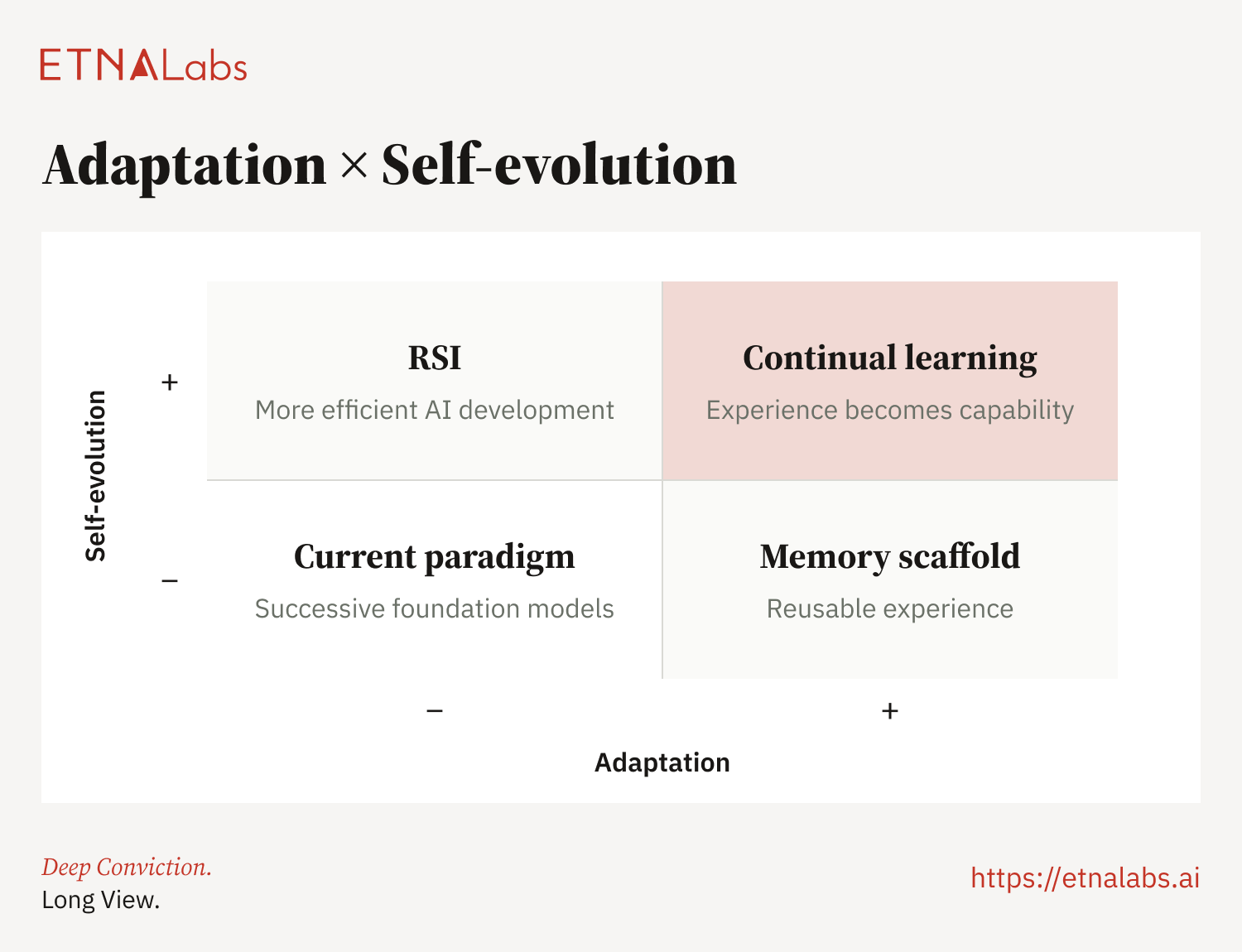
Two dimensions seperate RSI from continual learning:
- Adaptation asks whether an AI system can learn to fit a particular task or environment.
- Self-improvement asks whether it can close the loop and train better AI.
The traditional cycle of releasing a new foundation model every so often sits in the lower left. As frontier-lab training becomes more automated and industrialized, it moves toward the upper left.
Today’s chatbots and personal agents can adapt through a memory scaffold: external memory that stores useful experience and brings it into future tasks. A well-designed scaffold could improve how a system learns from use.
Continual learning sits in the upper right, where self-improvement meets adaptation to a specific user or environment.
Where companies are entering the field
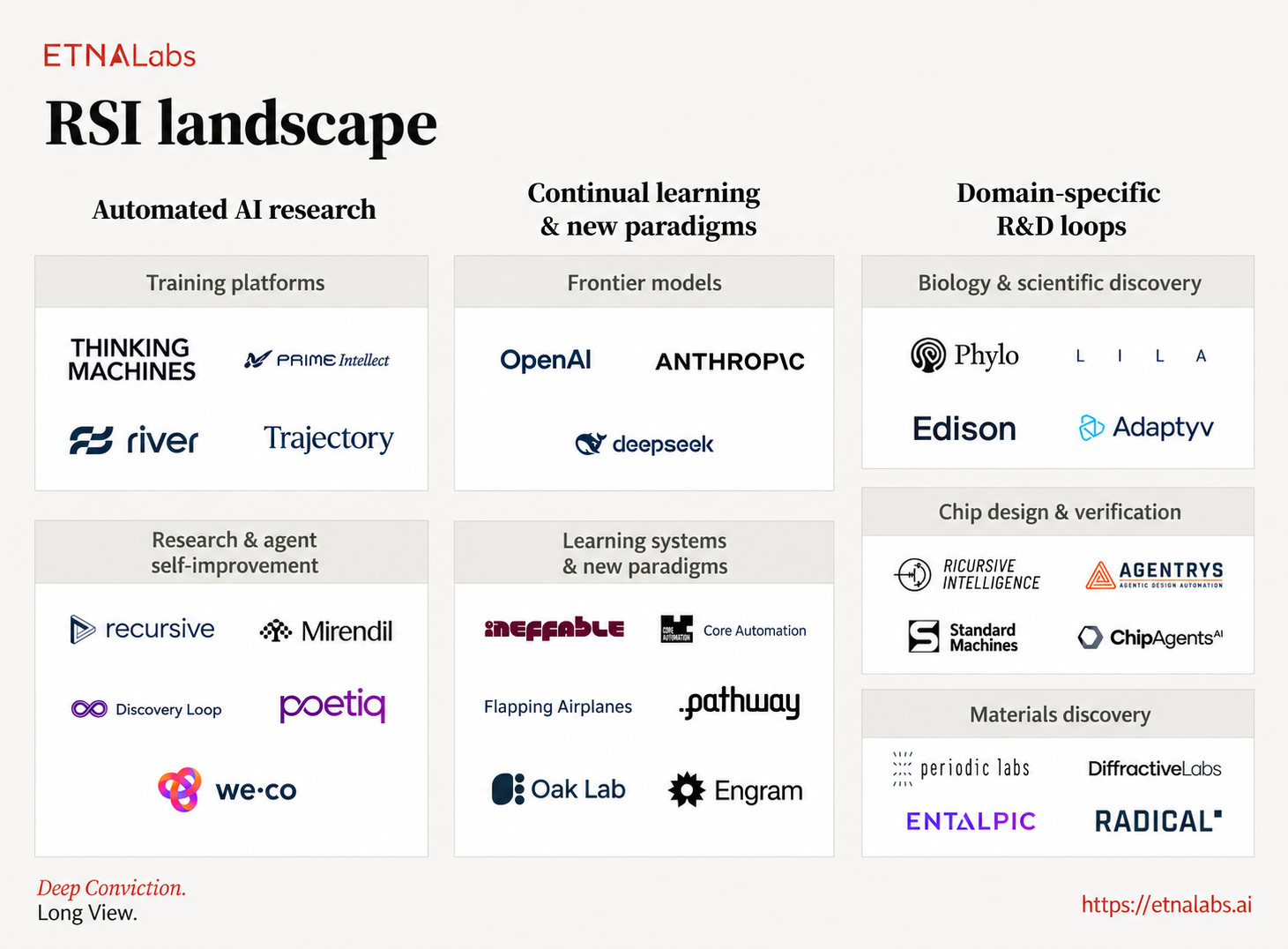
Before a deep dive into RSI technical pathways, first let’s see a quick map: a growing number of new AI labs and startups are pursuing these ideas, and they fall into three broad groups.
RSI and automated AI research. These companies go after RSI directly, through two kinds of business:
- Training platforms let enterprises train customized models through APIs or reinforcement-learning fine-tuning. They package parts of the research and training process into infrastructure that customers can use. Thinking Machines’ Tinker is one example.
- Research and agent self-improvement focuses on complete experimental loops in AI and other domains. Discovery Loop, co-founded by Jeff Dean, is one example.
Continual learning and new paradigms. Frontier labs still have a lot of room to run here. We believe OpenAI and Anthropic have already implemented parts of RSI internally; continual learning and algorithmic efficiency may be among their next priorities.
A second set of companies, founded by researchers betting on new approaches to learning, has more upside but, in our view, lower odds of success. Finding the next paradigm is a high-uncertainty research bet. Frontier labs could also crack continual learning within the existing paradigm, using RSI and better memory scaffolds.
Domain loops. The closer research gets to the physical world, the slower, costlier, and harder to reproduce experiments become. Compounding progress depends on how much a system learns from each round of feedback. The map highlights teams in several of these domains.
In science, the main approaches are scientific discovery agents and automated labs. In chip design and materials discovery, some teams build end products; others build the data and RL environments needed to get around physical-world constraints.
The state of recursive self-improvement
Early RSI begins with experiment automation
The first stage of self-improvement is model-training automation. It accelerated as coding capabilities improved sharply in late 2025. Agents are taking on more of the work across pre-training, post-training, and RL. Inside frontier labs, more tasks can run as complete agent loops. One researcher can pursue several questions at once and spend more time choosing directions, designing evaluations, and interpreting results.
RSI doesn’t require humans to leave the loop. The practical test is whether the number of researchers needed for a given gain in intelligence can stay flat, or even fall, as compute grows.
OpenAI’s September 2026 report offers a concrete measure. By the week of August 10, experiments per active experimenter, measured as a four-week trailing average, reached roughly 1.6 times the 2025 average. Our read: this matters even amid rapid hiring, because researchers are handing agents longer, more complex tasks.
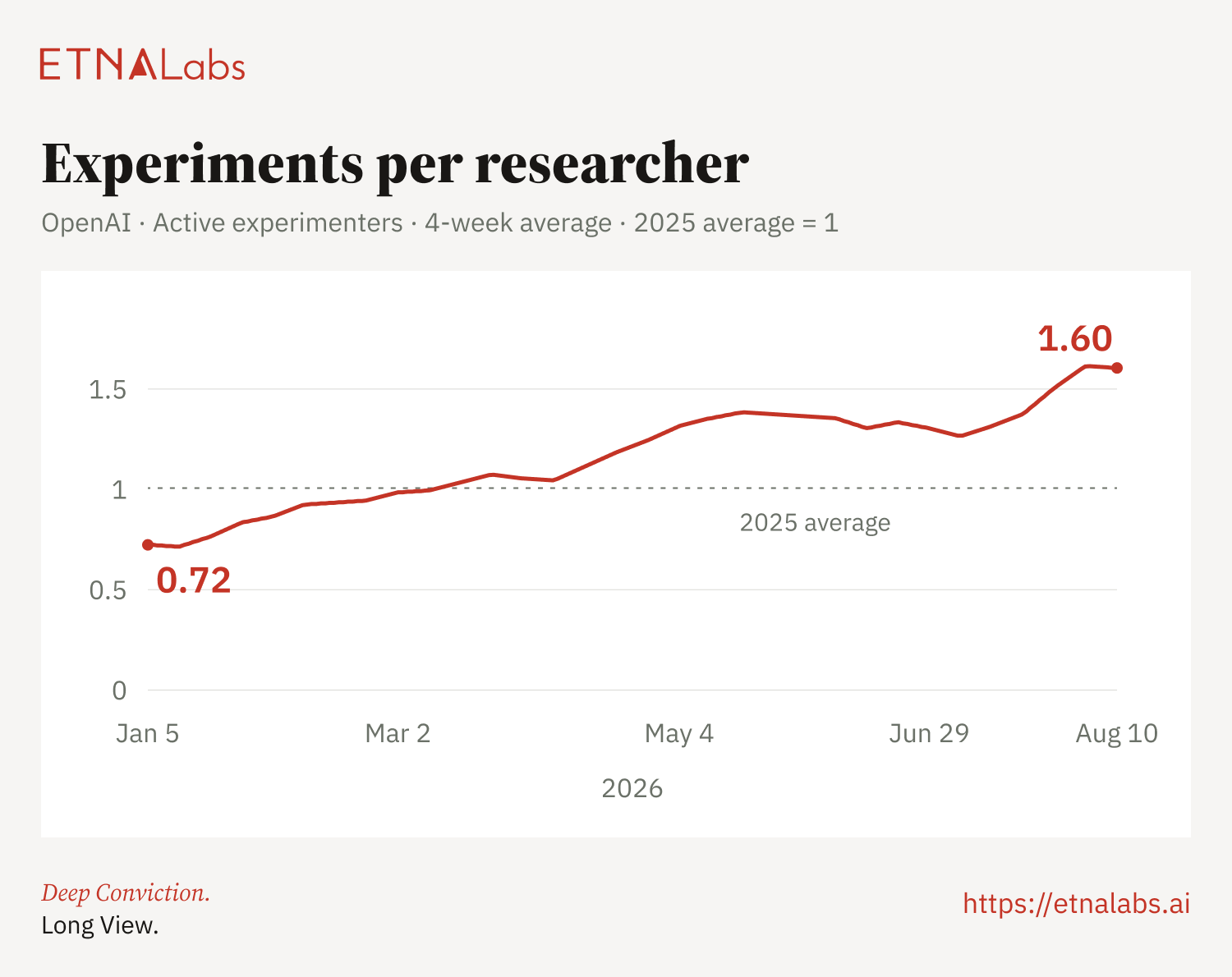
Two quantities matter: GPU-hours managed per researcher, and useful research output per GPU-hour. Automation increases the first, bringing more hypotheses into experiments. Improving the second requires better evaluation and research methods.
For RSI to compound, more experiments have to produce stronger research capability, which in turn speeds up the next round of model improvement. Our thesis: this loop could eventually make the pace of iteration grow exponentially.
Karpathy’s autoresearch makes the loop concrete. An agent edits training code, runs an experiment on one GPU with a five-minute training budget (training time only), and keeps or reverts the change based on a fixed evaluation. Humans set the objective and boundaries; the agent runs the loop.
Read code and results → change the training code → run and evaluate within a fixed compute budget → keep or revert → repeat.
Infrastructure must let agents operate, observe, and correct the training process. Callable training interfaces, reproducible environments, and independent evaluations determine how many research loops one person can supervise.
The remaining research bottlenecks
Once running experiments is automated, the scarce work shifts to four areas.
Transfer across scale and task complexity
An optimizer, data mixture, or architectural change that works on a small model still has to hold up in frontier training. Generalizing from simple tasks to complex ones is a central bottleneck.
Anthropic’s automated alignment researchers designed and iterated on candidate methods, but the best method produced no statistically significant improvement in Claude Sonnet 4 production training. Candidates that win cheap experiments still need human oversight.
Verifiable environments
Models need useful tasks to attempt and reliable verifiers to judge the results. Scalable oversight asks how to provide trustworthy feedback when tasks become too numerous for humans to inspect individually or too difficult for a supervisor to judge directly.
Building these verifiers also means trading off quality against throughput. One practical approach is to generate valid variants and incorrect distractors, then test whether the verifier can distinguish them.
Reconstructing environments from real work
Some open-source environments and benchmarks center on a single task, such as fixing an issue. Real work unfolds across a sequence of tasks, with changing files, runtime conditions, and user goals. Reconstructing environments from real trajectories brings training closer to these workflows. Three pieces need to work:
- Files and runtime. Recover file contents from traces, assemble the file tree, and use an agent to fill gaps and repair inconsistencies. Restore the language runtime, dependencies, and build configuration so the environment actually runs.
- Task boundaries. Identify coherent tasks within ambiguous user requests. A message such as “continue” needs to be reconstructed into a complete task with a clear goal and enough context to act.
- Verification. Judge completion through model behavior and actual changes in state. The original response may be imperfect, so reproducing it is a poor definition of success.
Research judgment and resource allocation
Which questions are worth pursuing? Which experiments deserve more compute? When should an idea be abandoned? These decisions rarely come with convenient short-term scores, yet they determine whether experiments yield valuable discoveries. Anthropic’s account of its internal research makes the same point: as execution gets automated, human direction matters more.
Progress requires these pieces to improve together: experiments must run autonomously, results must be verified at scale, and useful findings must feed into subsequent experiments and deployed models. In domains tied closely to the physical world, building reliable verification environments will stay hard.
RSI in specialized domains
Outside model training and coding, closing the loop needs more efforts. AI for science and robotics have early loops that make the verification problem concrete.
AI for science. Anthropic’s recent protein-design work connects specialist models such as AlphaFold, automated experimental submissions, and analysis of the results into an integrated workflow.
The next step is for agents to improve the scientific tools they use. Anthropic had Claude optimize inference code and GPU kernels for more than 30 open-source biomolecular models, alongside simpler prompts, streamlined agent workflows, and newer models. The company reported comparable computationally predicted binding scores using about 1% of the GPU hours required by its earlier design campaigns.
Phylo’s Biomni × TusoAI applies the same automation to building scientific models. Agents search data and code, review the literature, modify methods, and train and evaluate candidates. Phylo reported testing 500 candidates in one week to develop a genetic perturbation predictor combining multiple sources of gene embeddings with regression and k-nearest neighbors.
As computation gets cheaper, the quality and speed of real experimental feedback become tighter constraints. The next step for vertical RSI is to extract reliable signals from noisy results, develop new assays, and use the findings to improve subsequent experiments, tools, and models. This requires better scientific judgment and further progress in experimental automation.
Robotics. Models are helping with both robot integration and policy improvement. In phase two of Anthropic’s Project Fetch, Opus 4.7 completed five integration and programming tasks in an average total of 12 minutes 7 seconds across three trials. The Claude-assisted human team in the earlier phase took 264 minutes. Coding ability can compress the software side of robotics development.
RoboTTT, from NVIDIA, Stanford, and UT Austin, explores how robots can learn as they act. Fast weights in a vision-language-action (VLA) policy compress visual and action history and absorb new experience during execution. The paper demonstrates 8K timesteps of context, adaptation from a single human video demonstration, and online correction during long assembly tasks. Performance improves as training context grows, making context length another scaling axis for robot policies.
What continual learning requires
Continual learning goes to the heart of learning itself: turning experience quickly into greater capability. Progress depends on better sample efficiency, memory consolidation, and control over forgetting. Some gains may come from better memory scaffolds around existing models; others may require changes to how the models learn.
The mechanism has two steps:
- Acquire new information. Encounter new problems, ideas, and tools through users and the environment, or through the model’s own exploration. This is the new information, or “entropy,” available for learning.
- Turn information into capability. Incorporate the new experience into what the system knows and can do.
Under our definition, a system achieves continual learning when it can turn a new experience into usable knowledge as it works. Collecting experiences and waiting for a later, centrally scheduled training run remains part of the existing paradigm.
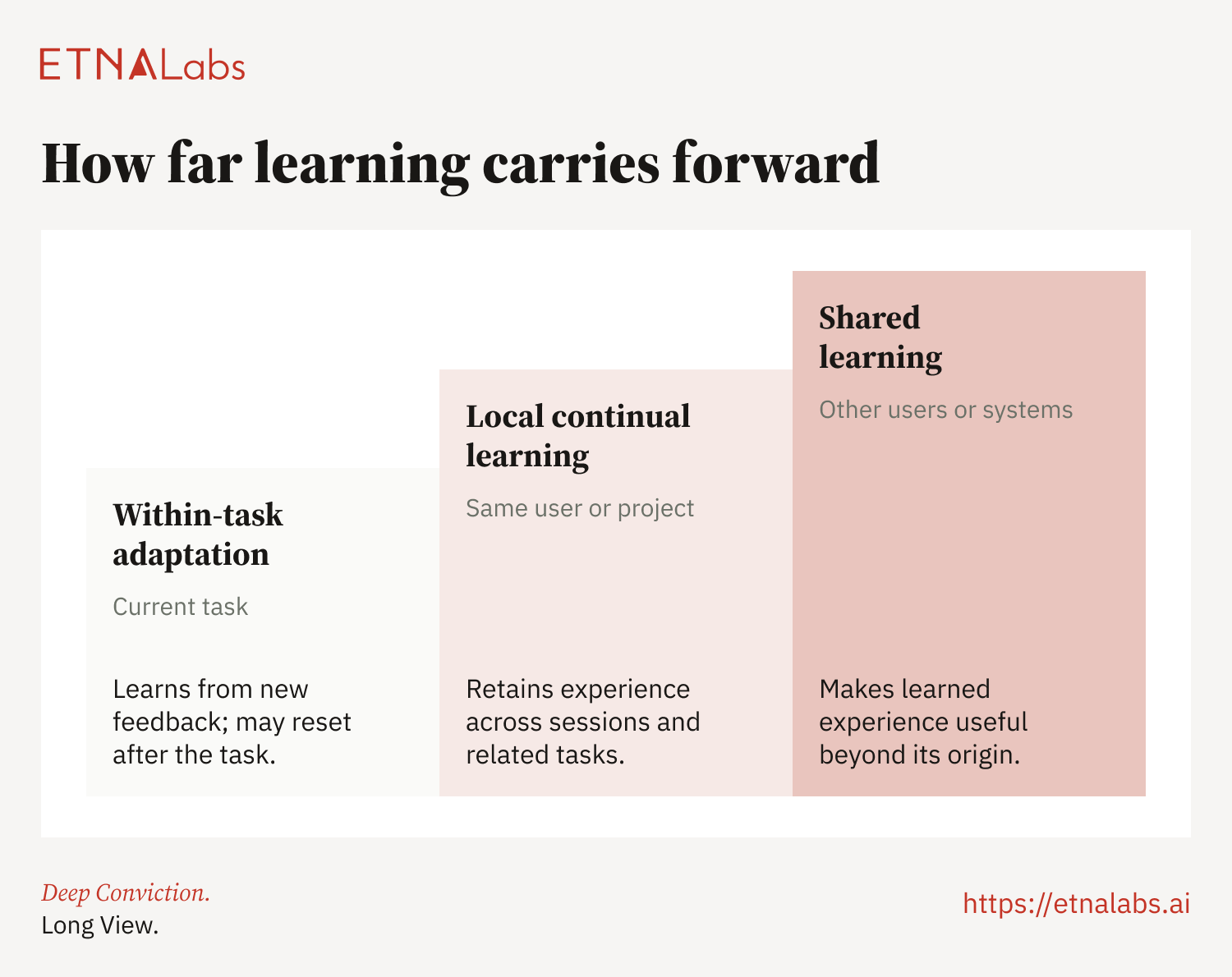
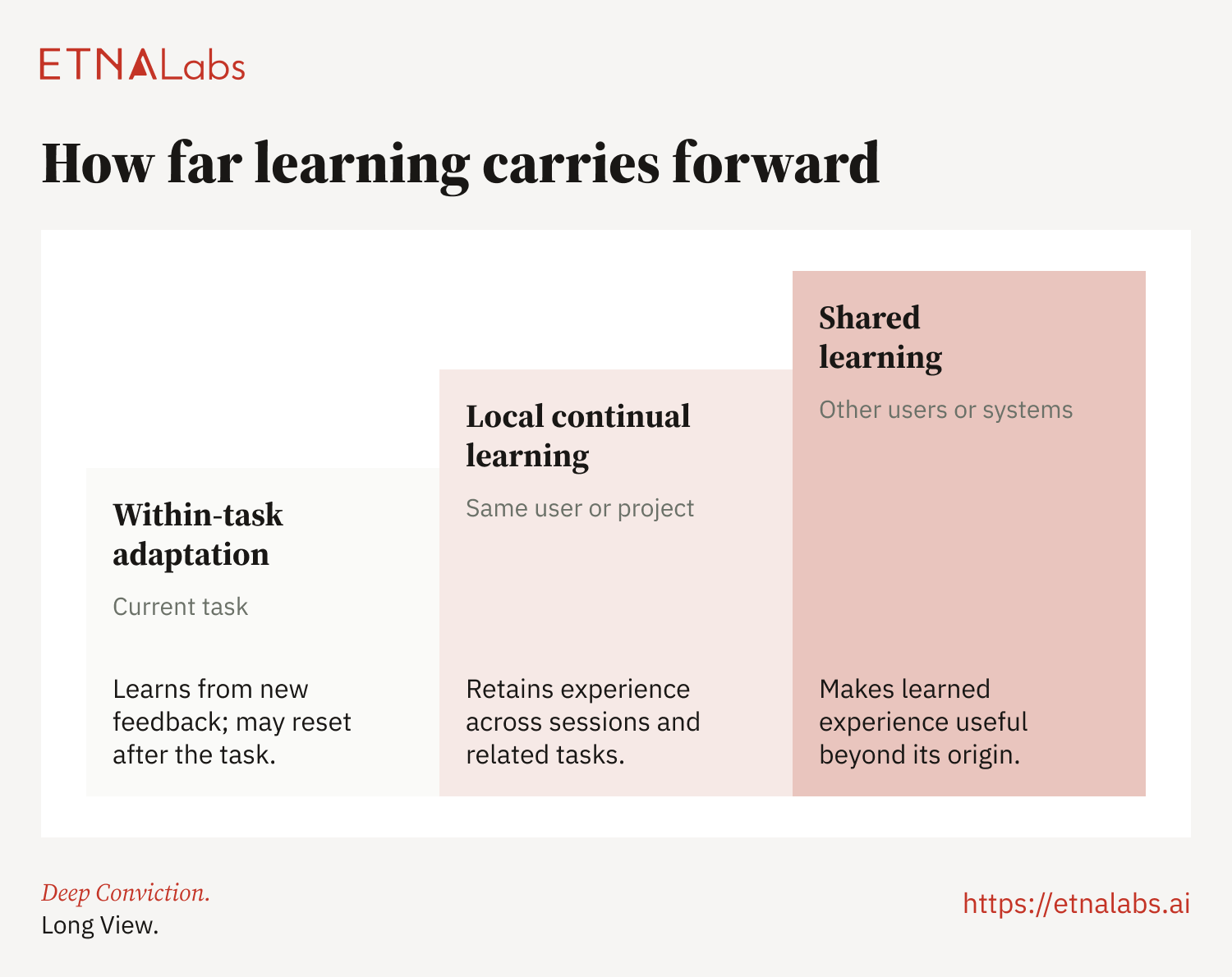
Continual learning also varies in how far learning carries forward. The immediate priority is the first level: a system that keeps learning within a long task and gets better as the work progresses. Memory scaffolds may already take us much further here; the harder test is whether those gains persist and transfer to unfamiliar tasks.
The core questions
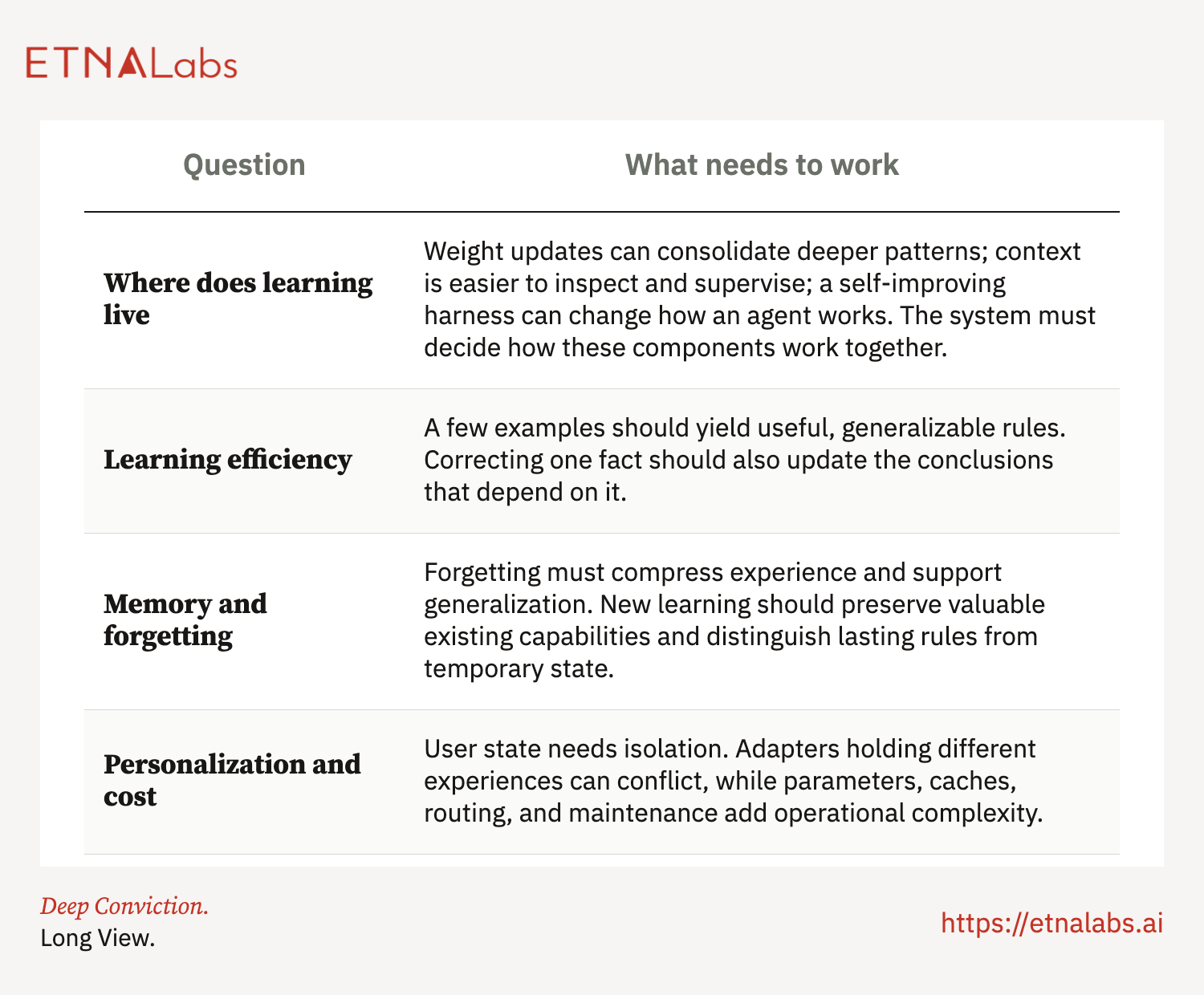
A system that improves through use must resolve four connected questions.
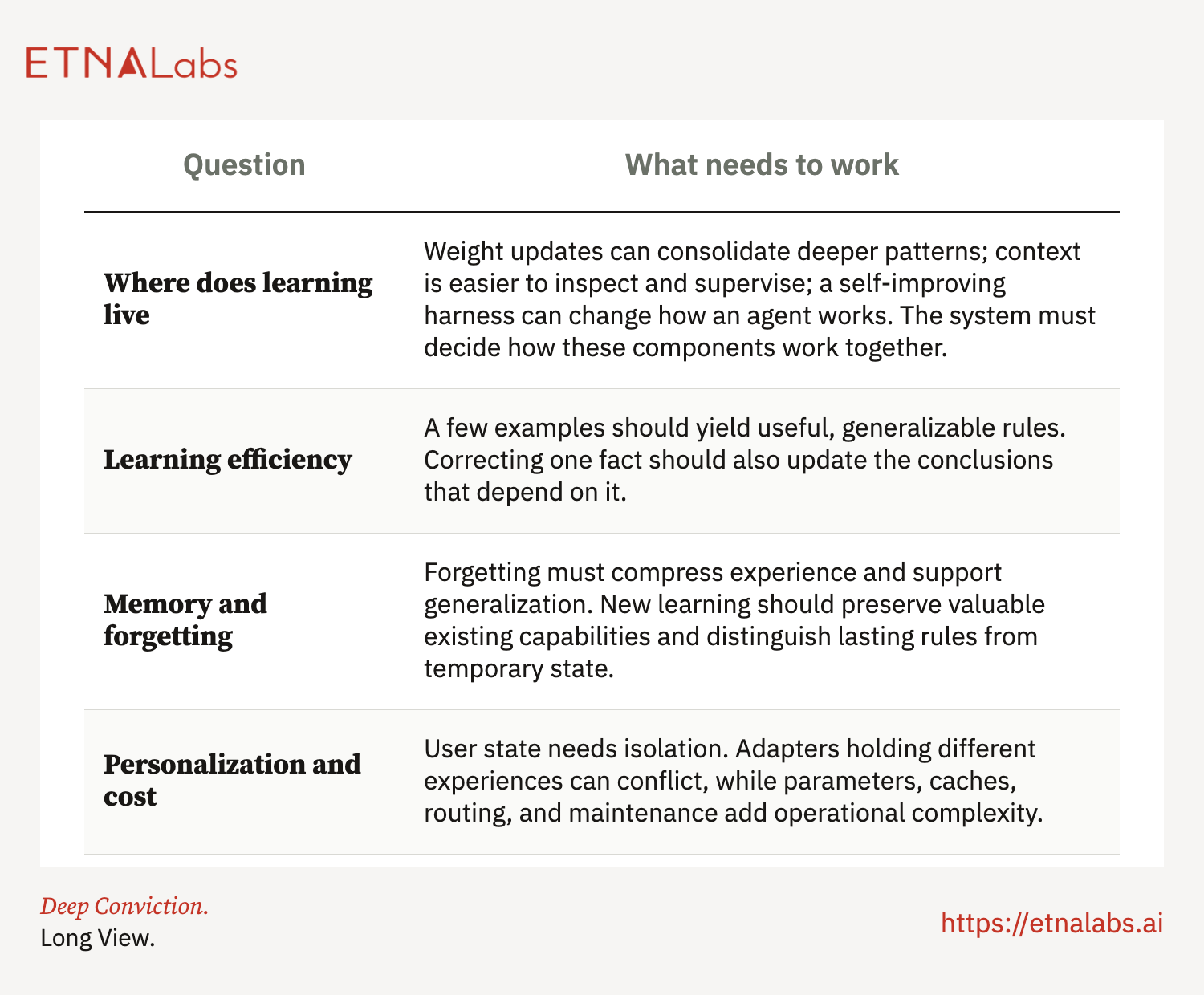
Sample efficiency is the central constraint
Software tests can often be reset and rerun in parallel. Feedback is fast and dense, sometimes available at each intermediate step. Such environments are highly “grindable”: tasks can be broken into smaller pieces and attempted repeatedly at low cost.
Physical-world work rarely offers the same combination of cheap repetition and reliable verification. A system therefore has to extract the essential lessons from far fewer observations.
The harder experience is to reproduce, the more a model must learn from each interaction. That makes sample efficiency the central challenge for continual learning.
Technical routes to continual learning
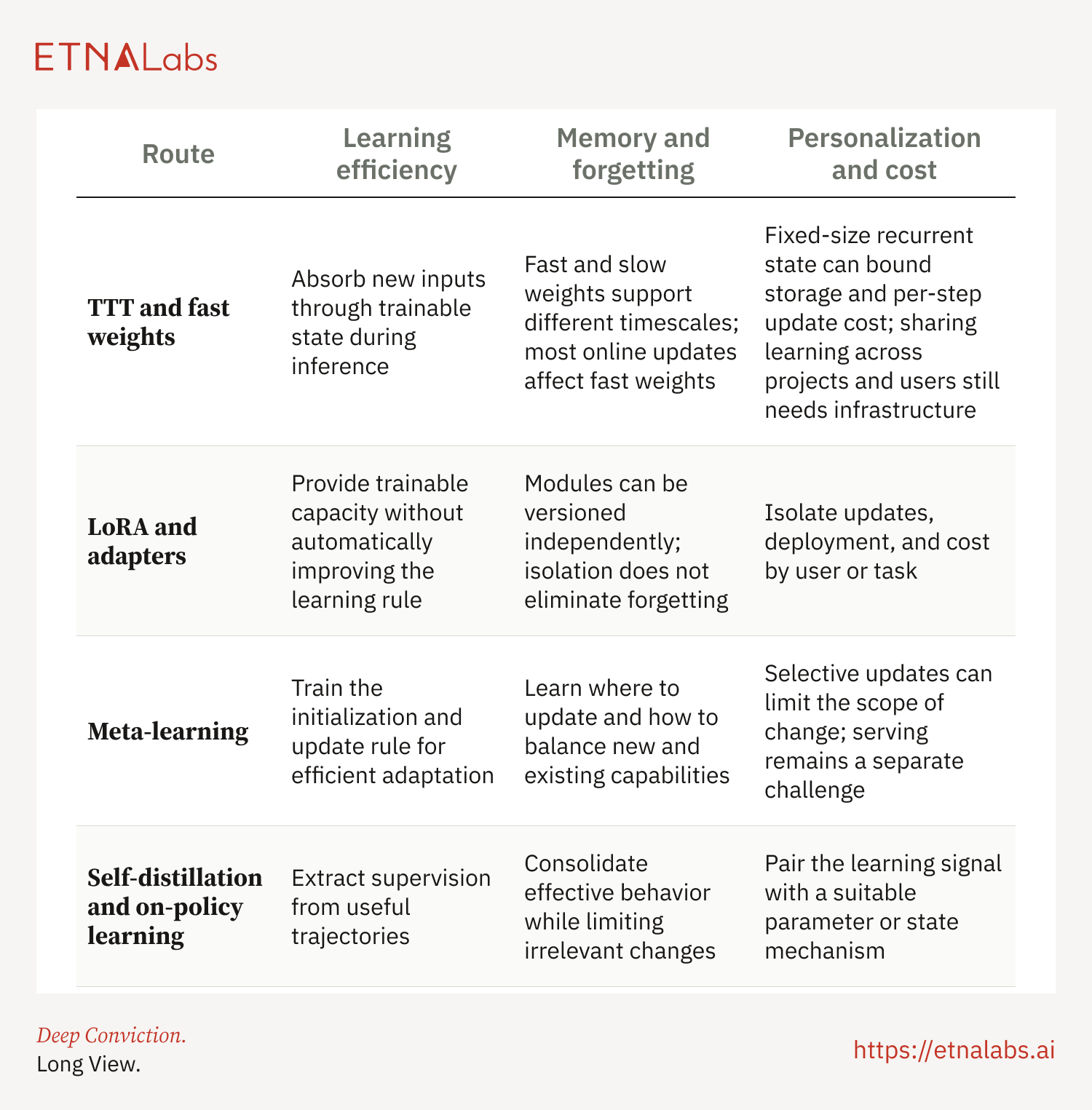
TTT and LoRA offer ways to update state or parameters during use. Meta-learning targets the learning mechanism itself and the efficiency with which it uses experience.
Test-time training and fast weights
Test-time training brings three important changes:
- Online updates: fast weights can change as new inputs arrive.
- Learning during inference: adaptation becomes part of processing a task.
- Compact recurrent state: With a fixed model and state size, memory storage and the per-step update cost can remain constant as the processed history grows.
Test-time training (TTT) can make a layer’s hidden state itself a small learnable model, allowing part of the system to update during use. The placement of these updates depends on the architecture. Fast weights compress long task histories, so the system must decide what is worth retaining.
Work since late 2025 has explored adding TTT to standard Transformers. Test-time learning may arrive through a new architecture or become a capability integrated into existing models. Several research efforts are exploring different implementations:
- TTT-E2E: applies test-time updates to a sliding-window Transformer and trains an initialization suited to those updates, helping existing architectures learn from long contexts.
- In-Place TTT: uses the output projection matrix of an existing MLP block as fast weights, introducing online updates inside the original Transformer.
- REFINE: trains fast weights with next-sequence prediction and sequence-level rewards to improve retention of long-range information.
- Falcon: designs fast-weight attention as an online learning process, exploring normalized delta rules and sliding-window updates to write more effectively into a fixed-size associative state.
TTT has yet to demonstrate its promise at full frontier scale. Data may be the next key constraint. Training sequences need to cover different update frequencies. Long trajectories and downstream outcomes can teach a model which experiences to retain, how to limit interference and forgetting, and which state should persist across sessions.
Adapters and multiple LoRAs
Low-rank adaptation (LoRA) is a common approach to online adaptation: freeze the base model and train a small set of low-rank parameters. Modular updates also include other adapters and sparse memory layers.
Thinking Machines’ Tinker, Trajectory, River, and Fireworks already use LoRA or multi-LoRA in training or serving. An adapter can become persistent local state: experience from a user, project, or domain stays in its own module, ready to be selected or combined for a task.
These approaches fit existing Transformer infrastructure without copying or updating the entire model. Modules can be trained and deployed separately.
The central benefit is control over the stability–plasticity trade-off: how much a system learns while preserving what it already knows. Restricting local learning to a routable, removable parameter module reduces the risk that one update damages the base model.
These methods mainly address personalization and cost; they do not supply a better learning rule on their own. They are therefore likely to coexist with other approaches. One possible hierarchy organizes learning at three timescales:
- Fast weights or task-local LoRA: retain recent, task-specific state across sessions.
- Slower adapters: consolidate stable skills.
- Base weights: absorb general capabilities repeatedly validated across users.
The central challenge for multi-LoRA is scaling the number of adapters that can be trained and used. Each adapter must be lightweight and efficient to update. Concurrent training, routing, and serving then become essential to giving large numbers of users and projects state that accumulates their own experience.
Learning how to learn
Unconfirmed reports suggest that Safe Superintelligence (SSI) has made substantial progress in meta-learning. The idea is to train how a model learns: which initialization supports adaptation and generalization, which layers to update, how much to change, and what information to retain. Meta-learning directly targets learning efficiency and memory management.
Nested Learning and its Hope model organize learning into nested optimization processes operating at different timescales. Faster components adapt to the current context; slower ones retain more stable knowledge. TTT-E2E follows a related idea, using pre-training to prepare a model for effective next-token-prediction updates at deployment.
Research such as SCoL lets a model generate update instructions from its current context, specifying which of its own Transformer layers to modify. Meta-reinforcement learning trains this strategy over a continuing stream of experience.
This addresses a question TTT alone leaves open: which fast-weight updates deserve to become lasting knowledge? A learned gate could decide which experiences should enter long-term weights. Ilya Sutskever’s discussion of an internal value or steering system offers an intuition: people can judge whether an attempt is worthwhile without designing a new verifier for every task.
The most valuable goal is effective adaptation to unfamiliar tasks from a small amount of experience. Researchers working on difficult problems often encounter the opposite today: a model that has learned a fixed method within a familiar distribution. Meta-learning aims to make the update strategy itself generalize.
Self-distillation and on-policy learning
On-policy self-distillation (OPSD) offers a promising route to continual learning: distill useful information from a task session back into the model so it can perform better on subsequent work.
Distillation transfers behavior from a teacher to a student. A frozen teacher checkpoint can help preserve existing capabilities; a stronger teacher can pass capabilities and behavior to a smaller model.
A central issue is how closely the training signal matches the model’s current policy. On-policy distillation supplies guidance on trajectories generated by the learner itself. It aims to provide stable learning, in the spirit of online RL, without requiring an explicit scalar reward function.
In OPSD, a “veteran” teacher with access to the full session guides a base student. Differences between their token distributions supply denser feedback than a final outcome alone. Trajectory-refined distillation continues guiding the student from states reached after its own mistakes, reducing the distribution shift associated with training only on teacher-generated paths.
Does continual learning need a new architecture?
Some leading researchers believe continual learning may emerge without a new architecture. Designing and scaling an entirely new model family can take years; progress may arrive sooner through learning objectives and feedback loops that accumulate gains over time.
Dario Amodei’s discussions of coding point in this direction. In domains where knowledge and procedures can be externalized, existing Transformers, long context, RL, and memory scaffolds may support substantial learning and economic value. We see Anthropic’s investment in Skills and the surrounding agent ecosystem as consistent with this view.
The opposing view is that Transformers are poorly suited to continual learning. Critics argue that attention can rely too heavily on retrieving similar examples and reusing their answers, without extracting durable, generalizable rules. The deeper goal is for a model to work through a hundred math problems, compress the experience into underlying mathematical principles, and use those principles to solve new problems. Pre-training already derives much of its power from this compression into parameters.
Richard Sutton’s critique is more fundamental: today’s LLMs primarily learn by imitating human data, rather than by learning how the world changes through a continuing stream of sensation, action, and reward. In this view, current gradient-based training offers no guarantee of the generalization that sustained learning requires.
Dwarkesh Patel takes a position between the two camps. He accepts that current models lack a high-throughput mechanism for learning from experience, but sees imitation and experience as complementary. Pretrained models can provide a strong prior, with self-distillation and other mechanisms bringing them closer to continual learning.
Beyond Transformers
Recurrent neural networks. Approaches such as RWKV and xLSTM retain history in a compact state, avoiding the need to store an ever-growing history during long-sequence inference. A finite state can lose detail, making precise recall harder. To replace attention broadly, these models still need to demonstrate strong performance on complex tasks and stronger agent capabilities at scale.
State space models. Mamba uses structured state and input-dependent selection to control what is written and forgotten, making long sequences efficient to process. The trade-off between compressed memory and precise retrieval remains. Specialized kernels can improve efficiency, but replacing mature Transformer systems requires evidence of broader benefits in large-scale training.
Hybrid architectures. These retain some of attention’s strengths. Qwen3-Next, for example, combines Gated DeltaNet with attention, using recurrent memory to reduce cost while preserving access to detail. The trade-offs include a remaining attention cache and greater system complexity.
Three hypotheses about what comes next
The possibilities can be ordered by how much change they require.
- The existing-paradigm hypothesis. Longer context, stronger models, better memory scaffolds, and suitable training data will be enough to meet most needs.
- The learning-rule hypothesis. Transformers remain, but continual learning requires new algorithms: meta-learned fast and slow updates, distillation, and mechanisms that decide what enters long-term memory.
- The architecture hypothesis. Continual learning requires models and optimization dynamics designed from the ground up for ongoing updates.
RSI is already making the development of intelligence more efficient. Continual learning could make real-world use a source of capability growth. These two processes can reinforce each other: automated research discovers better learning methods, and models that learn more effectively accelerate the next round of research.
The next breakthrough depends on whether models can turn a little experience into real capability gains, and whether today’s approaches can get there. That’s where the lasting advantage lies: whoever keeps raising the rate at which experience becomes capability stays on the steeper curve.
RSI Is Ahead of Schedule. Are We Ready?
Back to All
Key takeaways
- Early RSI (recursive self-improvement) is already here. At frontier labs, AI is taking an increasingly active role in training and improving its successors. We define RSI as AI taking part across the model-training process. As compute scales, the research headcount for each gain in capability no longer has to grow proportionally.
- The acceleration is becoming visible in researchers’ daily work. Coding keeps getting better and unlocks gains elsewhere: synthetic data generation and infrastructure optimization benefit directly. We understand Lilian Weng has also put serious effort into RSI since returning to OpenAI. Meanwhile, we see Anthropic as the leader in internal RSI.
- RSI and continual learning solve different problems. RSI automates the production of intelligence and closes the research loop. Continual learning lets a system build capability through interaction, learning from limited experience, often without a clear right answer. RSI might help discover the learning mechanisms that make continual learning possible.
- How far continual learning can go within the current paradigm remains an open question. Continual learning may require a paradigm shift. We define it as a system turning new information gained through interaction into capability improvements that generalize across tasks.
- Both depend on environments where progress can be verified. Coding agents make tasks and simulated environments cheap to generate; the hard part is knowing whether an outcome is useful. Closing the loop takes judgment: designing meaningful tests, validating results, and knowing when a hypothesis has failed.
- Compute demand and product design will change together. Our thesis: mature RSI could make the physical limits of compute the binding constraint on AI progress. Continual learning would blur the boundary between training and inference, enabling much deeper personalization and stronger user retention than today’s API-based products.
- RSI could widen the gap between closed and open-source models. Advantages in compute and iteration speed can reinforce each other, allowing leading frontier labs to improve faster. This compounding research process could become their most durable competitive advantage.
Adaptation and self-improvement
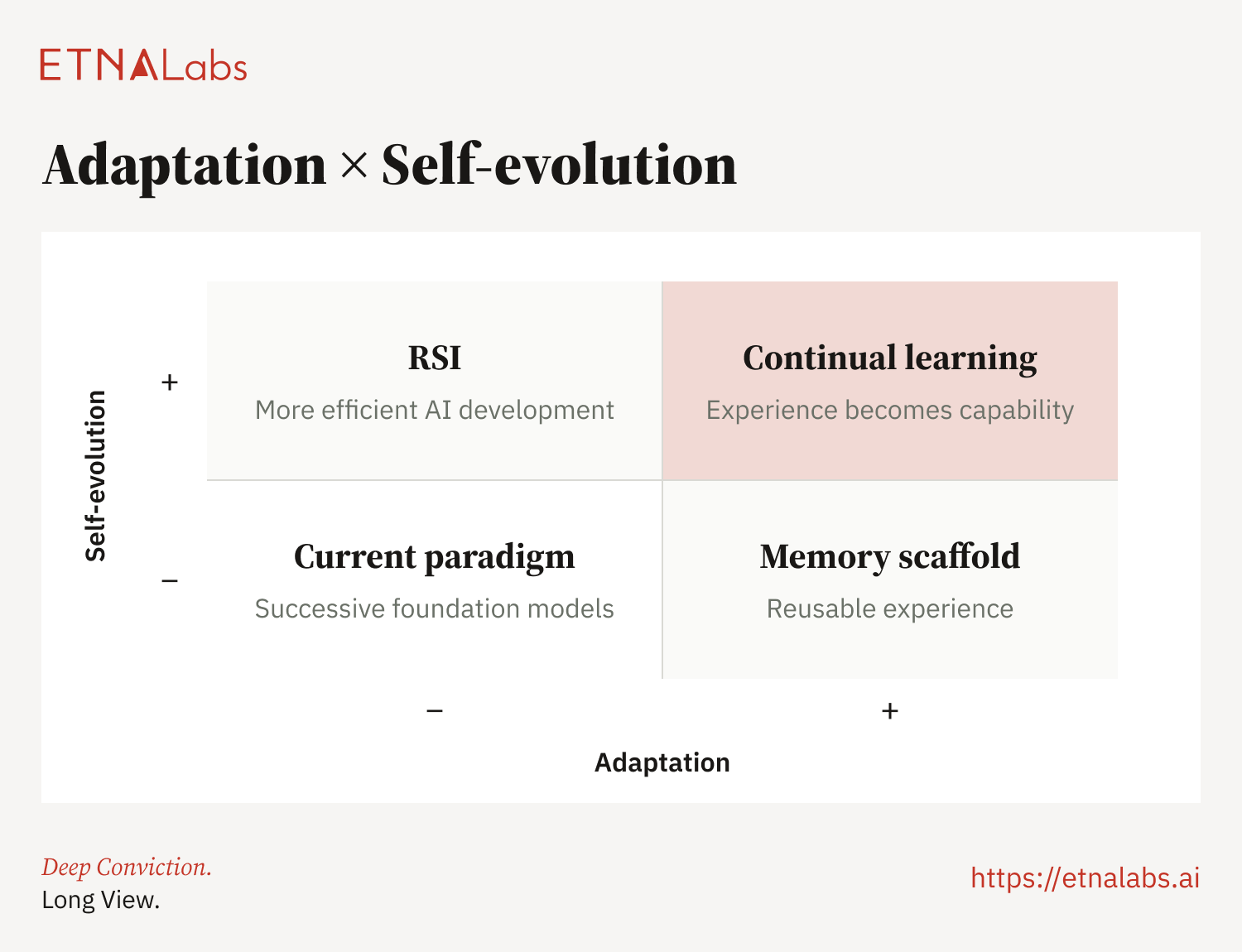
Two dimensions seperate RSI from continual learning:
- Adaptation asks whether an AI system can learn to fit a particular task or environment.
- Self-improvement asks whether it can close the loop and train better AI.
The traditional cycle of releasing a new foundation model every so often sits in the lower left. As frontier-lab training becomes more automated and industrialized, it moves toward the upper left.
Today’s chatbots and personal agents can adapt through a memory scaffold: external memory that stores useful experience and brings it into future tasks. A well-designed scaffold could improve how a system learns from use.
Continual learning sits in the upper right, where self-improvement meets adaptation to a specific user or environment.
Where companies are entering the field
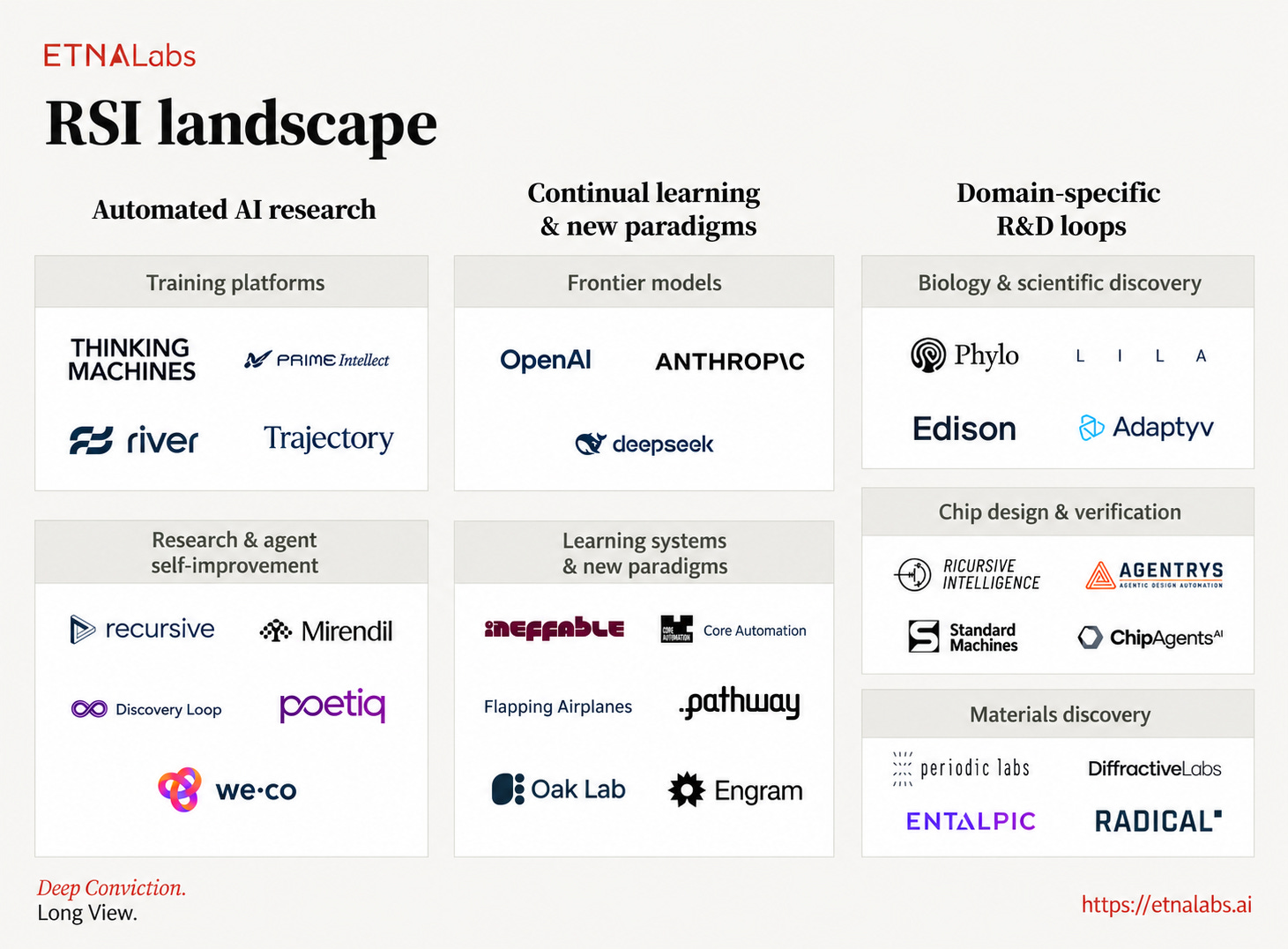
Before a deep dive into RSI technical pathways, first let’s see a quick map: a growing number of new AI labs and startups are pursuing these ideas, and they fall into three broad groups.
RSI and automated AI research. These companies go after RSI directly, through two kinds of business:
- Training platforms let enterprises train customized models through APIs or reinforcement-learning fine-tuning. They package parts of the research and training process into infrastructure that customers can use. Thinking Machines’ Tinker is one example.
- Research and agent self-improvement focuses on complete experimental loops in AI and other domains. Discovery Loop, co-founded by Jeff Dean, is one example.
Continual learning and new paradigms. Frontier labs still have a lot of room to run here. We believe OpenAI and Anthropic have already implemented parts of RSI internally; continual learning and algorithmic efficiency may be among their next priorities.
A second set of companies, founded by researchers betting on new approaches to learning, has more upside but, in our view, lower odds of success. Finding the next paradigm is a high-uncertainty research bet. Frontier labs could also crack continual learning within the existing paradigm, using RSI and better memory scaffolds.
Domain loops. The closer research gets to the physical world, the slower, costlier, and harder to reproduce experiments become. Compounding progress depends on how much a system learns from each round of feedback. The map highlights teams in several of these domains.
In science, the main approaches are scientific discovery agents and automated labs. In chip design and materials discovery, some teams build end products; others build the data and RL environments needed to get around physical-world constraints.
The state of recursive self-improvement
Early RSI begins with experiment automation
The first stage of self-improvement is model-training automation. It accelerated as coding capabilities improved sharply in late 2025. Agents are taking on more of the work across pre-training, post-training, and RL. Inside frontier labs, more tasks can run as complete agent loops. One researcher can pursue several questions at once and spend more time choosing directions, designing evaluations, and interpreting results.
RSI doesn’t require humans to leave the loop. The practical test is whether the number of researchers needed for a given gain in intelligence can stay flat, or even fall, as compute grows.
OpenAI’s September 2026 report offers a concrete measure. By the week of August 10, experiments per active experimenter, measured as a four-week trailing average, reached roughly 1.6 times the 2025 average. Our read: this matters even amid rapid hiring, because researchers are handing agents longer, more complex tasks.
Two quantities matter: GPU-hours managed per researcher, and useful research output per GPU-hour. Automation increases the first, bringing more hypotheses into experiments. Improving the second requires better evaluation and research methods.
For RSI to compound, more experiments have to produce stronger research capability, which in turn speeds up the next round of model improvement. Our thesis: this loop could eventually make the pace of iteration grow exponentially.
Karpathy’s autoresearch makes the loop concrete. An agent edits training code, runs an experiment on one GPU with a five-minute training budget (training time only), and keeps or reverts the change based on a fixed evaluation. Humans set the objective and boundaries; the agent runs the loop.
Read code and results → change the training code → run and evaluate within a fixed compute budget → keep or revert → repeat.
Infrastructure must let agents operate, observe, and correct the training process. Callable training interfaces, reproducible environments, and independent evaluations determine how many research loops one person can supervise.
The remaining research bottlenecks
Once running experiments is automated, the scarce work shifts to four areas.
Transfer across scale and task complexity
An optimizer, data mixture, or architectural change that works on a small model still has to hold up in frontier training. Generalizing from simple tasks to complex ones is a central bottleneck.
Anthropic’s automated alignment researchers designed and iterated on candidate methods, but the best method produced no statistically significant improvement in Claude Sonnet 4 production training. Candidates that win cheap experiments still need human oversight.
Verifiable environments
Models need useful tasks to attempt and reliable verifiers to judge the results. Scalable oversight asks how to provide trustworthy feedback when tasks become too numerous for humans to inspect individually or too difficult for a supervisor to judge directly.
Building these verifiers also means trading off quality against throughput. One practical approach is to generate valid variants and incorrect distractors, then test whether the verifier can distinguish them.
Reconstructing environments from real work
Some open-source environments and benchmarks center on a single task, such as fixing an issue. Real work unfolds across a sequence of tasks, with changing files, runtime conditions, and user goals. Reconstructing environments from real trajectories brings training closer to these workflows. Three pieces need to work:
- Files and runtime. Recover file contents from traces, assemble the file tree, and use an agent to fill gaps and repair inconsistencies. Restore the language runtime, dependencies, and build configuration so the environment actually runs.
- Task boundaries. Identify coherent tasks within ambiguous user requests. A message such as “continue” needs to be reconstructed into a complete task with a clear goal and enough context to act.
- Verification. Judge completion through model behavior and actual changes in state. The original response may be imperfect, so reproducing it is a poor definition of success.
Research judgment and resource allocation
Which questions are worth pursuing? Which experiments deserve more compute? When should an idea be abandoned? These decisions rarely come with convenient short-term scores, yet they determine whether experiments yield valuable discoveries. Anthropic’s account of its internal research makes the same point: as execution gets automated, human direction matters more.
Progress requires these pieces to improve together: experiments must run autonomously, results must be verified at scale, and useful findings must feed into subsequent experiments and deployed models. In domains tied closely to the physical world, building reliable verification environments will stay hard.
RSI in specialized domains
Outside model training and coding, closing the loop needs more efforts. AI for science and robotics have early loops that make the verification problem concrete.
AI for science. Anthropic’s recent protein-design work connects specialist models such as AlphaFold, automated experimental submissions, and analysis of the results into an integrated workflow.
The next step is for agents to improve the scientific tools they use. Anthropic had Claude optimize inference code and GPU kernels for more than 30 open-source biomolecular models, alongside simpler prompts, streamlined agent workflows, and newer models. The company reported comparable computationally predicted binding scores using about 1% of the GPU hours required by its earlier design campaigns.
Phylo’s Biomni × TusoAI applies the same automation to building scientific models. Agents search data and code, review the literature, modify methods, and train and evaluate candidates. Phylo reported testing 500 candidates in one week to develop a genetic perturbation predictor combining multiple sources of gene embeddings with regression and k-nearest neighbors.
As computation gets cheaper, the quality and speed of real experimental feedback become tighter constraints. The next step for vertical RSI is to extract reliable signals from noisy results, develop new assays, and use the findings to improve subsequent experiments, tools, and models. This requires better scientific judgment and further progress in experimental automation.
Robotics. Models are helping with both robot integration and policy improvement. In phase two of Anthropic’s Project Fetch, Opus 4.7 completed five integration and programming tasks in an average total of 12 minutes 7 seconds across three trials. The Claude-assisted human team in the earlier phase took 264 minutes. Coding ability can compress the software side of robotics development.
RoboTTT, from NVIDIA, Stanford, and UT Austin, explores how robots can learn as they act. Fast weights in a vision-language-action (VLA) policy compress visual and action history and absorb new experience during execution. The paper demonstrates 8K timesteps of context, adaptation from a single human video demonstration, and online correction during long assembly tasks. Performance improves as training context grows, making context length another scaling axis for robot policies.
What continual learning requires
Continual learning goes to the heart of learning itself: turning experience quickly into greater capability. Progress depends on better sample efficiency, memory consolidation, and control over forgetting. Some gains may come from better memory scaffolds around existing models; others may require changes to how the models learn.
The mechanism has two steps:
- Acquire new information. Encounter new problems, ideas, and tools through users and the environment, or through the model’s own exploration. This is the new information, or “entropy,” available for learning.
- Turn information into capability. Incorporate the new experience into what the system knows and can do.
Under our definition, a system achieves continual learning when it can turn a new experience into usable knowledge as it works. Collecting experiences and waiting for a later, centrally scheduled training run remains part of the existing paradigm.
Continual learning also varies in how far learning carries forward. The immediate priority is the first level: a system that keeps learning within a long task and gets better as the work progresses. Memory scaffolds may already take us much further here; the harder test is whether those gains persist and transfer to unfamiliar tasks.
The core questions
A system that improves through use must resolve four connected questions.
Sample efficiency is the central constraint
Software tests can often be reset and rerun in parallel. Feedback is fast and dense, sometimes available at each intermediate step. Such environments are highly “grindable”: tasks can be broken into smaller pieces and attempted repeatedly at low cost.
Physical-world work rarely offers the same combination of cheap repetition and reliable verification. A system therefore has to extract the essential lessons from far fewer observations.
The harder experience is to reproduce, the more a model must learn from each interaction. That makes sample efficiency the central challenge for continual learning.
Technical routes to continual learning
TTT and LoRA offer ways to update state or parameters during use. Meta-learning targets the learning mechanism itself and the efficiency with which it uses experience.
Test-time training and fast weights
Test-time training brings three important changes:
- Online updates: fast weights can change as new inputs arrive.
- Learning during inference: adaptation becomes part of processing a task.
- Compact recurrent state: With a fixed model and state size, memory storage and the per-step update cost can remain constant as the processed history grows.
Test-time training (TTT) can make a layer’s hidden state itself a small learnable model, allowing part of the system to update during use. The placement of these updates depends on the architecture. Fast weights compress long task histories, so the system must decide what is worth retaining.
Work since late 2025 has explored adding TTT to standard Transformers. Test-time learning may arrive through a new architecture or become a capability integrated into existing models. Several research efforts are exploring different implementations:
- TTT-E2E: applies test-time updates to a sliding-window Transformer and trains an initialization suited to those updates, helping existing architectures learn from long contexts.
- In-Place TTT: uses the output projection matrix of an existing MLP block as fast weights, introducing online updates inside the original Transformer.
- REFINE: trains fast weights with next-sequence prediction and sequence-level rewards to improve retention of long-range information.
- Falcon: designs fast-weight attention as an online learning process, exploring normalized delta rules and sliding-window updates to write more effectively into a fixed-size associative state.
TTT has yet to demonstrate its promise at full frontier scale. Data may be the next key constraint. Training sequences need to cover different update frequencies. Long trajectories and downstream outcomes can teach a model which experiences to retain, how to limit interference and forgetting, and which state should persist across sessions.
Adapters and multiple LoRAs
Low-rank adaptation (LoRA) is a common approach to online adaptation: freeze the base model and train a small set of low-rank parameters. Modular updates also include other adapters and sparse memory layers.
Thinking Machines’ Tinker, Trajectory, River, and Fireworks already use LoRA or multi-LoRA in training or serving. An adapter can become persistent local state: experience from a user, project, or domain stays in its own module, ready to be selected or combined for a task.
These approaches fit existing Transformer infrastructure without copying or updating the entire model. Modules can be trained and deployed separately.
The central benefit is control over the stability–plasticity trade-off: how much a system learns while preserving what it already knows. Restricting local learning to a routable, removable parameter module reduces the risk that one update damages the base model.
These methods mainly address personalization and cost; they do not supply a better learning rule on their own. They are therefore likely to coexist with other approaches. One possible hierarchy organizes learning at three timescales:
- Fast weights or task-local LoRA: retain recent, task-specific state across sessions.
- Slower adapters: consolidate stable skills.
- Base weights: absorb general capabilities repeatedly validated across users.
The central challenge for multi-LoRA is scaling the number of adapters that can be trained and used. Each adapter must be lightweight and efficient to update. Concurrent training, routing, and serving then become essential to giving large numbers of users and projects state that accumulates their own experience.
Learning how to learn
Unconfirmed reports suggest that Safe Superintelligence (SSI) has made substantial progress in meta-learning. The idea is to train how a model learns: which initialization supports adaptation and generalization, which layers to update, how much to change, and what information to retain. Meta-learning directly targets learning efficiency and memory management.
Nested Learning and its Hope model organize learning into nested optimization processes operating at different timescales. Faster components adapt to the current context; slower ones retain more stable knowledge. TTT-E2E follows a related idea, using pre-training to prepare a model for effective next-token-prediction updates at deployment.
Research such as SCoL lets a model generate update instructions from its current context, specifying which of its own Transformer layers to modify. Meta-reinforcement learning trains this strategy over a continuing stream of experience.
This addresses a question TTT alone leaves open: which fast-weight updates deserve to become lasting knowledge? A learned gate could decide which experiences should enter long-term weights. Ilya Sutskever’s discussion of an internal value or steering system offers an intuition: people can judge whether an attempt is worthwhile without designing a new verifier for every task.
The most valuable goal is effective adaptation to unfamiliar tasks from a small amount of experience. Researchers working on difficult problems often encounter the opposite today: a model that has learned a fixed method within a familiar distribution. Meta-learning aims to make the update strategy itself generalize.
Self-distillation and on-policy learning
On-policy self-distillation (OPSD) offers a promising route to continual learning: distill useful information from a task session back into the model so it can perform better on subsequent work.
Distillation transfers behavior from a teacher to a student. A frozen teacher checkpoint can help preserve existing capabilities; a stronger teacher can pass capabilities and behavior to a smaller model.
A central issue is how closely the training signal matches the model’s current policy. On-policy distillation supplies guidance on trajectories generated by the learner itself. It aims to provide stable learning, in the spirit of online RL, without requiring an explicit scalar reward function.
In OPSD, a “veteran” teacher with access to the full session guides a base student. Differences between their token distributions supply denser feedback than a final outcome alone. Trajectory-refined distillation continues guiding the student from states reached after its own mistakes, reducing the distribution shift associated with training only on teacher-generated paths.
Does continual learning need a new architecture?
Some leading researchers believe continual learning may emerge without a new architecture. Designing and scaling an entirely new model family can take years; progress may arrive sooner through learning objectives and feedback loops that accumulate gains over time.
Dario Amodei’s discussions of coding point in this direction. In domains where knowledge and procedures can be externalized, existing Transformers, long context, RL, and memory scaffolds may support substantial learning and economic value. We see Anthropic’s investment in Skills and the surrounding agent ecosystem as consistent with this view.
The opposing view is that Transformers are poorly suited to continual learning. Critics argue that attention can rely too heavily on retrieving similar examples and reusing their answers, without extracting durable, generalizable rules. The deeper goal is for a model to work through a hundred math problems, compress the experience into underlying mathematical principles, and use those principles to solve new problems. Pre-training already derives much of its power from this compression into parameters.
Richard Sutton’s critique is more fundamental: today’s LLMs primarily learn by imitating human data, rather than by learning how the world changes through a continuing stream of sensation, action, and reward. In this view, current gradient-based training offers no guarantee of the generalization that sustained learning requires.
Dwarkesh Patel takes a position between the two camps. He accepts that current models lack a high-throughput mechanism for learning from experience, but sees imitation and experience as complementary. Pretrained models can provide a strong prior, with self-distillation and other mechanisms bringing them closer to continual learning.
Beyond Transformers
Recurrent neural networks. Approaches such as RWKV and xLSTM retain history in a compact state, avoiding the need to store an ever-growing history during long-sequence inference. A finite state can lose detail, making precise recall harder. To replace attention broadly, these models still need to demonstrate strong performance on complex tasks and stronger agent capabilities at scale.
State space models. Mamba uses structured state and input-dependent selection to control what is written and forgotten, making long sequences efficient to process. The trade-off between compressed memory and precise retrieval remains. Specialized kernels can improve efficiency, but replacing mature Transformer systems requires evidence of broader benefits in large-scale training.
Hybrid architectures. These retain some of attention’s strengths. Qwen3-Next, for example, combines Gated DeltaNet with attention, using recurrent memory to reduce cost while preserving access to detail. The trade-offs include a remaining attention cache and greater system complexity.
Three hypotheses about what comes next
The possibilities can be ordered by how much change they require.
- The existing-paradigm hypothesis. Longer context, stronger models, better memory scaffolds, and suitable training data will be enough to meet most needs.
- The learning-rule hypothesis. Transformers remain, but continual learning requires new algorithms: meta-learned fast and slow updates, distillation, and mechanisms that decide what enters long-term memory.
- The architecture hypothesis. Continual learning requires models and optimization dynamics designed from the ground up for ongoing updates.
RSI is already making the development of intelligence more efficient. Continual learning could make real-world use a source of capability growth. These two processes can reinforce each other: automated research discovers better learning methods, and models that learn more effectively accelerate the next round of research.
The next breakthrough depends on whether models can turn a little experience into real capability gains, and whether today’s approaches can get there. That’s where the lasting advantage lies: whoever keeps raising the rate at which experience becomes capability stays on the steeper curve.
RSI Is Ahead of Schedule. Are We Ready?
Back to All
Key takeaways
- Early RSI (recursive self-improvement) is already here. At frontier labs, AI is taking an increasingly active role in training and improving its successors. We define RSI as AI taking part across the model-training process. As compute scales, the research headcount for each gain in capability no longer has to grow proportionally.
- The acceleration is becoming visible in researchers’ daily work. Coding keeps getting better and unlocks gains elsewhere: synthetic data generation and infrastructure optimization benefit directly. We understand Lilian Weng has also put serious effort into RSI since returning to OpenAI. Meanwhile, we see Anthropic as the leader in internal RSI.
- RSI and continual learning solve different problems. RSI automates the production of intelligence and closes the research loop. Continual learning lets a system build capability through interaction, learning from limited experience, often without a clear right answer. RSI might help discover the learning mechanisms that make continual learning possible.
- How far continual learning can go within the current paradigm remains an open question. Continual learning may require a paradigm shift. We define it as a system turning new information gained through interaction into capability improvements that generalize across tasks.
- Both depend on environments where progress can be verified. Coding agents make tasks and simulated environments cheap to generate; the hard part is knowing whether an outcome is useful. Closing the loop takes judgment: designing meaningful tests, validating results, and knowing when a hypothesis has failed.
- Compute demand and product design will change together. Our thesis: mature RSI could make the physical limits of compute the binding constraint on AI progress. Continual learning would blur the boundary between training and inference, enabling much deeper personalization and stronger user retention than today’s API-based products.
- RSI could widen the gap between closed and open-source models. Advantages in compute and iteration speed can reinforce each other, allowing leading frontier labs to improve faster. This compounding research process could become their most durable competitive advantage.
Adaptation and self-improvement
Two dimensions seperate RSI from continual learning:
- Adaptation asks whether an AI system can learn to fit a particular task or environment.
- Self-improvement asks whether it can close the loop and train better AI.
The traditional cycle of releasing a new foundation model every so often sits in the lower left. As frontier-lab training becomes more automated and industrialized, it moves toward the upper left.
Today’s chatbots and personal agents can adapt through a memory scaffold: external memory that stores useful experience and brings it into future tasks. A well-designed scaffold could improve how a system learns from use.
Continual learning sits in the upper right, where self-improvement meets adaptation to a specific user or environment.
Where companies are entering the field
Before a deep dive into RSI technical pathways, first let’s see a quick map: a growing number of new AI labs and startups are pursuing these ideas, and they fall into three broad groups.
RSI and automated AI research. These companies go after RSI directly, through two kinds of business:
- Training platforms let enterprises train customized models through APIs or reinforcement-learning fine-tuning. They package parts of the research and training process into infrastructure that customers can use. Thinking Machines’ Tinker is one example.
- Research and agent self-improvement focuses on complete experimental loops in AI and other domains. Discovery Loop, co-founded by Jeff Dean, is one example.
Continual learning and new paradigms. Frontier labs still have a lot of room to run here. We believe OpenAI and Anthropic have already implemented parts of RSI internally; continual learning and algorithmic efficiency may be among their next priorities.
A second set of companies, founded by researchers betting on new approaches to learning, has more upside but, in our view, lower odds of success. Finding the next paradigm is a high-uncertainty research bet. Frontier labs could also crack continual learning within the existing paradigm, using RSI and better memory scaffolds.
Domain loops. The closer research gets to the physical world, the slower, costlier, and harder to reproduce experiments become. Compounding progress depends on how much a system learns from each round of feedback. The map highlights teams in several of these domains.
In science, the main approaches are scientific discovery agents and automated labs. In chip design and materials discovery, some teams build end products; others build the data and RL environments needed to get around physical-world constraints.
The state of recursive self-improvement
Early RSI begins with experiment automation
The first stage of self-improvement is model-training automation. It accelerated as coding capabilities improved sharply in late 2025. Agents are taking on more of the work across pre-training, post-training, and RL. Inside frontier labs, more tasks can run as complete agent loops. One researcher can pursue several questions at once and spend more time choosing directions, designing evaluations, and interpreting results.
RSI doesn’t require humans to leave the loop. The practical test is whether the number of researchers needed for a given gain in intelligence can stay flat, or even fall, as compute grows.
OpenAI’s September 2026 report offers a concrete measure. By the week of August 10, experiments per active experimenter, measured as a four-week trailing average, reached roughly 1.6 times the 2025 average. Our read: this matters even amid rapid hiring, because researchers are handing agents longer, more complex tasks.
Two quantities matter: GPU-hours managed per researcher, and useful research output per GPU-hour. Automation increases the first, bringing more hypotheses into experiments. Improving the second requires better evaluation and research methods.
For RSI to compound, more experiments have to produce stronger research capability, which in turn speeds up the next round of model improvement. Our thesis: this loop could eventually make the pace of iteration grow exponentially.
Karpathy’s autoresearch makes the loop concrete. An agent edits training code, runs an experiment on one GPU with a five-minute training budget (training time only), and keeps or reverts the change based on a fixed evaluation. Humans set the objective and boundaries; the agent runs the loop.
Read code and results → change the training code → run and evaluate within a fixed compute budget → keep or revert → repeat.
Infrastructure must let agents operate, observe, and correct the training process. Callable training interfaces, reproducible environments, and independent evaluations determine how many research loops one person can supervise.
The remaining research bottlenecks
Once running experiments is automated, the scarce work shifts to four areas.
Transfer across scale and task complexity
An optimizer, data mixture, or architectural change that works on a small model still has to hold up in frontier training. Generalizing from simple tasks to complex ones is a central bottleneck.
Anthropic’s automated alignment researchers designed and iterated on candidate methods, but the best method produced no statistically significant improvement in Claude Sonnet 4 production training. Candidates that win cheap experiments still need human oversight.
Verifiable environments
Models need useful tasks to attempt and reliable verifiers to judge the results. Scalable oversight asks how to provide trustworthy feedback when tasks become too numerous for humans to inspect individually or too difficult for a supervisor to judge directly.
Building these verifiers also means trading off quality against throughput. One practical approach is to generate valid variants and incorrect distractors, then test whether the verifier can distinguish them.
Reconstructing environments from real work
Some open-source environments and benchmarks center on a single task, such as fixing an issue. Real work unfolds across a sequence of tasks, with changing files, runtime conditions, and user goals. Reconstructing environments from real trajectories brings training closer to these workflows. Three pieces need to work:
- Files and runtime. Recover file contents from traces, assemble the file tree, and use an agent to fill gaps and repair inconsistencies. Restore the language runtime, dependencies, and build configuration so the environment actually runs.
- Task boundaries. Identify coherent tasks within ambiguous user requests. A message such as “continue” needs to be reconstructed into a complete task with a clear goal and enough context to act.
- Verification. Judge completion through model behavior and actual changes in state. The original response may be imperfect, so reproducing it is a poor definition of success.
Research judgment and resource allocation
Which questions are worth pursuing? Which experiments deserve more compute? When should an idea be abandoned? These decisions rarely come with convenient short-term scores, yet they determine whether experiments yield valuable discoveries. Anthropic’s account of its internal research makes the same point: as execution gets automated, human direction matters more.
Progress requires these pieces to improve together: experiments must run autonomously, results must be verified at scale, and useful findings must feed into subsequent experiments and deployed models. In domains tied closely to the physical world, building reliable verification environments will stay hard.
RSI in specialized domains
Outside model training and coding, closing the loop needs more efforts. AI for science and robotics have early loops that make the verification problem concrete.
AI for science. Anthropic’s recent protein-design work connects specialist models such as AlphaFold, automated experimental submissions, and analysis of the results into an integrated workflow.
The next step is for agents to improve the scientific tools they use. Anthropic had Claude optimize inference code and GPU kernels for more than 30 open-source biomolecular models, alongside simpler prompts, streamlined agent workflows, and newer models. The company reported comparable computationally predicted binding scores using about 1% of the GPU hours required by its earlier design campaigns.
Phylo’s Biomni × TusoAI applies the same automation to building scientific models. Agents search data and code, review the literature, modify methods, and train and evaluate candidates. Phylo reported testing 500 candidates in one week to develop a genetic perturbation predictor combining multiple sources of gene embeddings with regression and k-nearest neighbors.
As computation gets cheaper, the quality and speed of real experimental feedback become tighter constraints. The next step for vertical RSI is to extract reliable signals from noisy results, develop new assays, and use the findings to improve subsequent experiments, tools, and models. This requires better scientific judgment and further progress in experimental automation.
Robotics. Models are helping with both robot integration and policy improvement. In phase two of Anthropic’s Project Fetch, Opus 4.7 completed five integration and programming tasks in an average total of 12 minutes 7 seconds across three trials. The Claude-assisted human team in the earlier phase took 264 minutes. Coding ability can compress the software side of robotics development.
RoboTTT, from NVIDIA, Stanford, and UT Austin, explores how robots can learn as they act. Fast weights in a vision-language-action (VLA) policy compress visual and action history and absorb new experience during execution. The paper demonstrates 8K timesteps of context, adaptation from a single human video demonstration, and online correction during long assembly tasks. Performance improves as training context grows, making context length another scaling axis for robot policies.
What continual learning requires
Continual learning goes to the heart of learning itself: turning experience quickly into greater capability. Progress depends on better sample efficiency, memory consolidation, and control over forgetting. Some gains may come from better memory scaffolds around existing models; others may require changes to how the models learn.
The mechanism has two steps:
- Acquire new information. Encounter new problems, ideas, and tools through users and the environment, or through the model’s own exploration. This is the new information, or “entropy,” available for learning.
- Turn information into capability. Incorporate the new experience into what the system knows and can do.
Under our definition, a system achieves continual learning when it can turn a new experience into usable knowledge as it works. Collecting experiences and waiting for a later, centrally scheduled training run remains part of the existing paradigm.
Continual learning also varies in how far learning carries forward. The immediate priority is the first level: a system that keeps learning within a long task and gets better as the work progresses. Memory scaffolds may already take us much further here; the harder test is whether those gains persist and transfer to unfamiliar tasks.
The core questions
A system that improves through use must resolve four connected questions.
Sample efficiency is the central constraint
Software tests can often be reset and rerun in parallel. Feedback is fast and dense, sometimes available at each intermediate step. Such environments are highly “grindable”: tasks can be broken into smaller pieces and attempted repeatedly at low cost.
Physical-world work rarely offers the same combination of cheap repetition and reliable verification. A system therefore has to extract the essential lessons from far fewer observations.
The harder experience is to reproduce, the more a model must learn from each interaction. That makes sample efficiency the central challenge for continual learning.
Technical routes to continual learning
TTT and LoRA offer ways to update state or parameters during use. Meta-learning targets the learning mechanism itself and the efficiency with which it uses experience.
Test-time training and fast weights
Test-time training brings three important changes:
- Online updates: fast weights can change as new inputs arrive.
- Learning during inference: adaptation becomes part of processing a task.
- Compact recurrent state: With a fixed model and state size, memory storage and the per-step update cost can remain constant as the processed history grows.
Test-time training (TTT) can make a layer’s hidden state itself a small learnable model, allowing part of the system to update during use. The placement of these updates depends on the architecture. Fast weights compress long task histories, so the system must decide what is worth retaining.
Work since late 2025 has explored adding TTT to standard Transformers. Test-time learning may arrive through a new architecture or become a capability integrated into existing models. Several research efforts are exploring different implementations:
- TTT-E2E: applies test-time updates to a sliding-window Transformer and trains an initialization suited to those updates, helping existing architectures learn from long contexts.
- In-Place TTT: uses the output projection matrix of an existing MLP block as fast weights, introducing online updates inside the original Transformer.
- REFINE: trains fast weights with next-sequence prediction and sequence-level rewards to improve retention of long-range information.
- Falcon: designs fast-weight attention as an online learning process, exploring normalized delta rules and sliding-window updates to write more effectively into a fixed-size associative state.
TTT has yet to demonstrate its promise at full frontier scale. Data may be the next key constraint. Training sequences need to cover different update frequencies. Long trajectories and downstream outcomes can teach a model which experiences to retain, how to limit interference and forgetting, and which state should persist across sessions.
Adapters and multiple LoRAs
Low-rank adaptation (LoRA) is a common approach to online adaptation: freeze the base model and train a small set of low-rank parameters. Modular updates also include other adapters and sparse memory layers.
Thinking Machines’ Tinker, Trajectory, River, and Fireworks already use LoRA or multi-LoRA in training or serving. An adapter can become persistent local state: experience from a user, project, or domain stays in its own module, ready to be selected or combined for a task.
These approaches fit existing Transformer infrastructure without copying or updating the entire model. Modules can be trained and deployed separately.
The central benefit is control over the stability–plasticity trade-off: how much a system learns while preserving what it already knows. Restricting local learning to a routable, removable parameter module reduces the risk that one update damages the base model.
These methods mainly address personalization and cost; they do not supply a better learning rule on their own. They are therefore likely to coexist with other approaches. One possible hierarchy organizes learning at three timescales:
- Fast weights or task-local LoRA: retain recent, task-specific state across sessions.
- Slower adapters: consolidate stable skills.
- Base weights: absorb general capabilities repeatedly validated across users.
The central challenge for multi-LoRA is scaling the number of adapters that can be trained and used. Each adapter must be lightweight and efficient to update. Concurrent training, routing, and serving then become essential to giving large numbers of users and projects state that accumulates their own experience.
Learning how to learn
Unconfirmed reports suggest that Safe Superintelligence (SSI) has made substantial progress in meta-learning. The idea is to train how a model learns: which initialization supports adaptation and generalization, which layers to update, how much to change, and what information to retain. Meta-learning directly targets learning efficiency and memory management.
Nested Learning and its Hope model organize learning into nested optimization processes operating at different timescales. Faster components adapt to the current context; slower ones retain more stable knowledge. TTT-E2E follows a related idea, using pre-training to prepare a model for effective next-token-prediction updates at deployment.
Research such as SCoL lets a model generate update instructions from its current context, specifying which of its own Transformer layers to modify. Meta-reinforcement learning trains this strategy over a continuing stream of experience.
This addresses a question TTT alone leaves open: which fast-weight updates deserve to become lasting knowledge? A learned gate could decide which experiences should enter long-term weights. Ilya Sutskever’s discussion of an internal value or steering system offers an intuition: people can judge whether an attempt is worthwhile without designing a new verifier for every task.
The most valuable goal is effective adaptation to unfamiliar tasks from a small amount of experience. Researchers working on difficult problems often encounter the opposite today: a model that has learned a fixed method within a familiar distribution. Meta-learning aims to make the update strategy itself generalize.
Self-distillation and on-policy learning
On-policy self-distillation (OPSD) offers a promising route to continual learning: distill useful information from a task session back into the model so it can perform better on subsequent work.
Distillation transfers behavior from a teacher to a student. A frozen teacher checkpoint can help preserve existing capabilities; a stronger teacher can pass capabilities and behavior to a smaller model.
A central issue is how closely the training signal matches the model’s current policy. On-policy distillation supplies guidance on trajectories generated by the learner itself. It aims to provide stable learning, in the spirit of online RL, without requiring an explicit scalar reward function.
In OPSD, a “veteran” teacher with access to the full session guides a base student. Differences between their token distributions supply denser feedback than a final outcome alone. Trajectory-refined distillation continues guiding the student from states reached after its own mistakes, reducing the distribution shift associated with training only on teacher-generated paths.
Does continual learning need a new architecture?
Some leading researchers believe continual learning may emerge without a new architecture. Designing and scaling an entirely new model family can take years; progress may arrive sooner through learning objectives and feedback loops that accumulate gains over time.
Dario Amodei’s discussions of coding point in this direction. In domains where knowledge and procedures can be externalized, existing Transformers, long context, RL, and memory scaffolds may support substantial learning and economic value. We see Anthropic’s investment in Skills and the surrounding agent ecosystem as consistent with this view.
The opposing view is that Transformers are poorly suited to continual learning. Critics argue that attention can rely too heavily on retrieving similar examples and reusing their answers, without extracting durable, generalizable rules. The deeper goal is for a model to work through a hundred math problems, compress the experience into underlying mathematical principles, and use those principles to solve new problems. Pre-training already derives much of its power from this compression into parameters.
Richard Sutton’s critique is more fundamental: today’s LLMs primarily learn by imitating human data, rather than by learning how the world changes through a continuing stream of sensation, action, and reward. In this view, current gradient-based training offers no guarantee of the generalization that sustained learning requires.
Dwarkesh Patel takes a position between the two camps. He accepts that current models lack a high-throughput mechanism for learning from experience, but sees imitation and experience as complementary. Pretrained models can provide a strong prior, with self-distillation and other mechanisms bringing them closer to continual learning.
Beyond Transformers
Recurrent neural networks. Approaches such as RWKV and xLSTM retain history in a compact state, avoiding the need to store an ever-growing history during long-sequence inference. A finite state can lose detail, making precise recall harder. To replace attention broadly, these models still need to demonstrate strong performance on complex tasks and stronger agent capabilities at scale.
State space models. Mamba uses structured state and input-dependent selection to control what is written and forgotten, making long sequences efficient to process. The trade-off between compressed memory and precise retrieval remains. Specialized kernels can improve efficiency, but replacing mature Transformer systems requires evidence of broader benefits in large-scale training.
Hybrid architectures. These retain some of attention’s strengths. Qwen3-Next, for example, combines Gated DeltaNet with attention, using recurrent memory to reduce cost while preserving access to detail. The trade-offs include a remaining attention cache and greater system complexity.
Three hypotheses about what comes next
The possibilities can be ordered by how much change they require.
- The existing-paradigm hypothesis. Longer context, stronger models, better memory scaffolds, and suitable training data will be enough to meet most needs.
- The learning-rule hypothesis. Transformers remain, but continual learning requires new algorithms: meta-learned fast and slow updates, distillation, and mechanisms that decide what enters long-term memory.
- The architecture hypothesis. Continual learning requires models and optimization dynamics designed from the ground up for ongoing updates.
RSI is already making the development of intelligence more efficient. Continual learning could make real-world use a source of capability growth. These two processes can reinforce each other: automated research discovers better learning methods, and models that learn more effectively accelerate the next round of research.
The next breakthrough depends on whether models can turn a little experience into real capability gains, and whether today’s approaches can get there. That’s where the lasting advantage lies: whoever keeps raising the rate at which experience becomes capability stays on the steeper curve.