
Pulse: How OpenAI Starts Outrunning Google
back to All
TL;DR
Over the past month, OpenAI has looked more like a consumer tech company than ever before.
Starting with Pulse, the AI lab rolled out the Sora app and an AI-native browser in quick succession, all in service of Sam Altman’s audacious goal: 1 billion WAUs .Given OpenAI’s recent pace, that target suddenly feels within reach.
Among these launches, Pulse looked unremarkable. Paywalled (Pulse is a premium feature gated behind the $200 USD/Month subscription). No viral potential like Sora. Easy to dismiss.
That’s a mistake. In Sam Altman’s “1 billion WAU super‑app” roadmap for ChatGPT, Pulse is not a side quest, it is one of OpenAI’s bids to shift the internet’s center of gravity from retrieval to anticipation.
1. What is the internet’s next center of gravity?
For twenty years, the web’s dominant posture was retrieval. You formulate intent, type a query, and a search engine distributes answers. Google perfected that posture and captured distribution, monetizing the moment of articulated need.
By launching Pulse, ChatGPT may change its posture. Based on chat history, durable Memory, and user-authorized data sources—calendars, email, messages, bills, documents—ChatGPT moves from waiting to be asked to proposing what to do next.
This is OpenAI’s credible path to outrun Google. Not by building a better search page, but by installing an agent that lives alongside work and life, learns preferences, and pushes help before you frame a question.
The pattern echoes ByteDance’s playbook: recommendation beats retrieval when you control what people see first.
2. A Distribution play, not a feature drop
Pulse is not just a feature, it’s a bid to own the default surface where decisions happen.
In a world where users are drowning in apps, the interface that curates what matters and lets you act in one click will win attention, and control distribution.
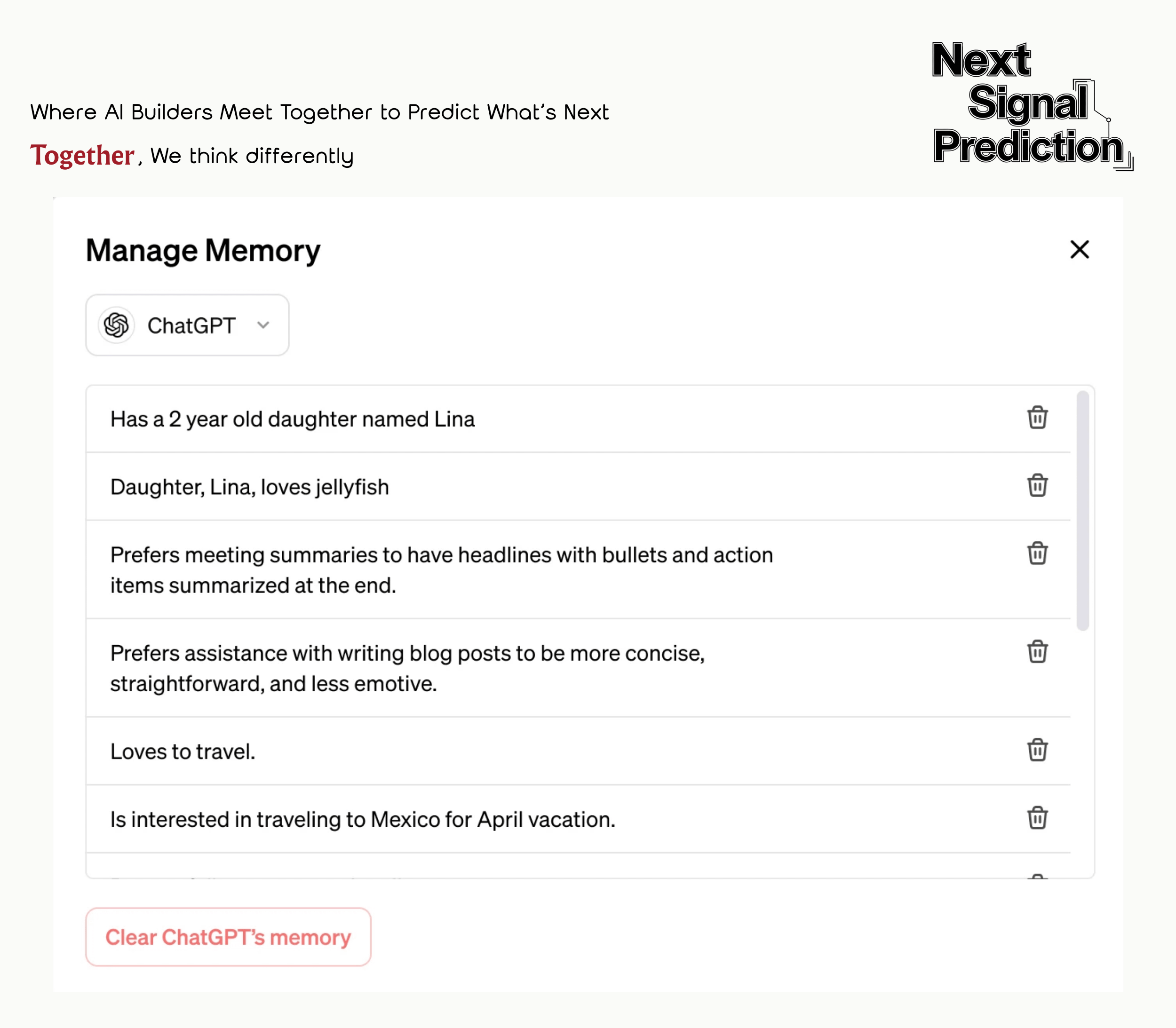
Memory was OpenAI’s wedge into continuity. Pulse is the wedge into daily habit.
Source:OpenAI
The mechanics are straightforward and powerful:
- Proactive cards convert fragments of context into preference signals—accept, dismiss, ignore, act.
- Every micro‑interaction tightens personalization; task outcomes feed back into the model’s understanding of what “success” looks like for you.
- This creates a data flywheel rival platforms can’t easily replicate, unless they also have your memory and your interaction trail.
This is also why Pulse can pull ChatGPT toward daily usage parity. Currently, ChatGPT’s DAU/MAU likely sits around 30–40%. With Pulse, that ratio could approach 1:1, iMessage-level stickiness.
Without the prompt tax, the addressable audience grows beyond power users. If the pushes remain useful and restrained, ChatGPT graduates from “tool you open” to “assistant that shows up.”
3. Pulse is OpenAI’s new data fly wheel
OpenAI is not the first to explore proactive agents, but it’s the first to ship at scale with integrated memory and cross-app context. That reflects both execution speed and data advantage: OpenAI sees what works across millions of users and can move decisively.
OpenAI’s first data flywheel was Memory.
Persistent memory keeps context across sessions, improves answer quality, and nudges users to share more about themselves.
That’s flywheel one: context → better responses → more context. It’s quiet but foundational—without continuity of memory, all proactive efforts drift toward generic content.
Pulse is flywheel No. 2. Proactive touchpoints multiply interactions even when the user isn’t prompting. Every accept, dismiss, and card-level action yields preference and outcome data. Connect Gmail, calendars, subscriptions, and accounts, and the personalization slope steepens.
But the real advantage builds at the model level. Unlike recommendation systems that optimize for clicks, Pulse learns how you work—what you prioritize, what you defer, and where you need help.
This will create three compounding advantages:
- Cross-domain synthesis
Most SaaS tools see one slice: email or calendar or documents. Pulse sees across them.It can learn you habit:
- rescheduling meetings when stressed (calendar + chat tone),
- responding faster to certain senders (email patterns),
- and document preference (document interaction ).
- Continuous fine-tuning through outcomes
Each card interaction is a training signal. When you accept a suggested reply, defer a meeting proposal, or dismiss a reminder, the model updates not just what to show you, but how success is defined for you. Over months, Pulse evolves from generic assistant to personal chief of staff who knows your quirks, your priorities, and your edge cases. This is model-level personalization that compounds with use.
- The cold-start problem becomes a moat
New entrants face brutal disadvantage: they start with zero context. Even if Google launches a competing agent, it won’t know that you always ignore LinkedIn notifications, need 15-minute buffers between calls, or that “following up” means different urgency depending on sender.
Building that understanding takes months of granted permission and quiet observation—time OpenAI already has with active users, and from which it has already benefited through compounding effects.
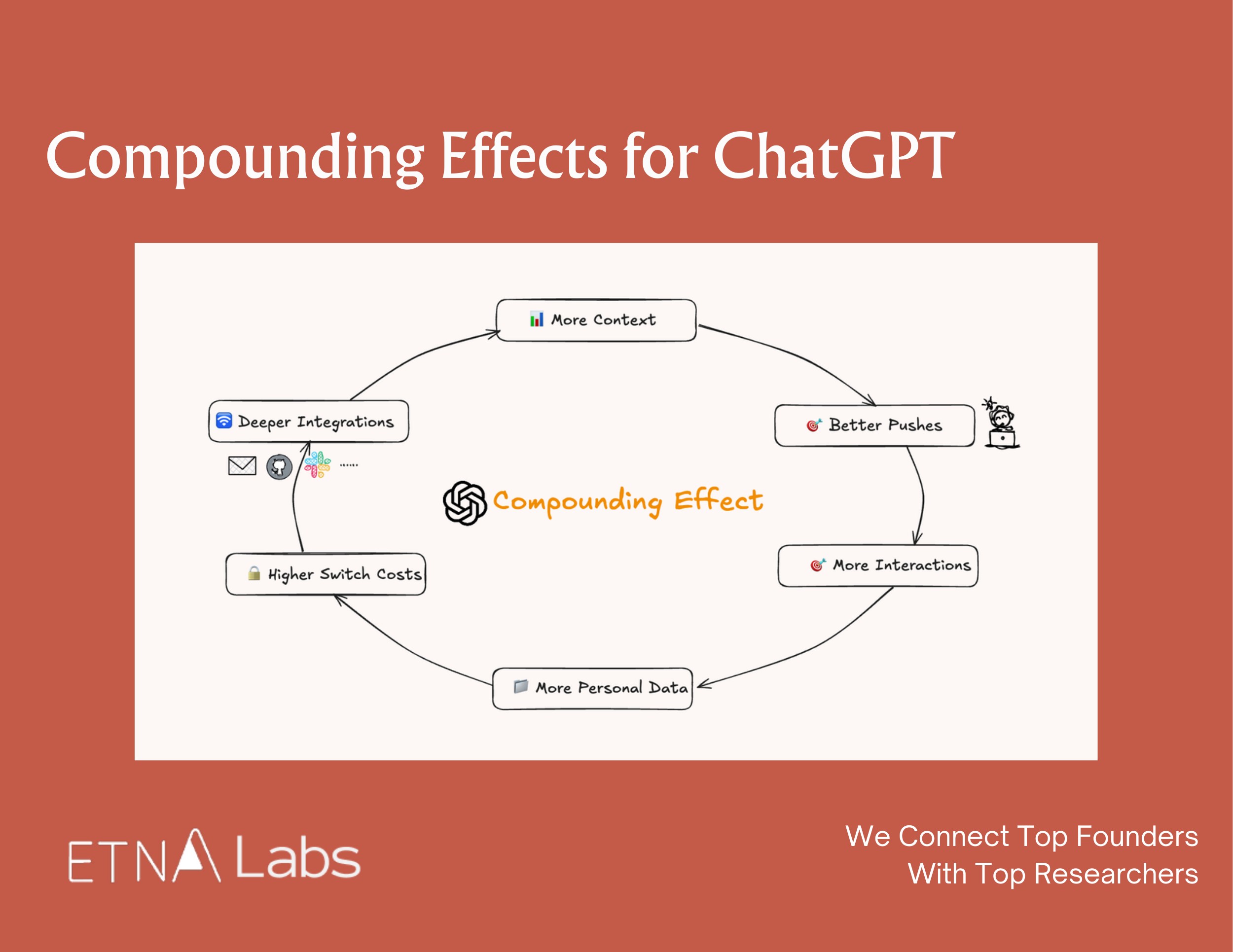
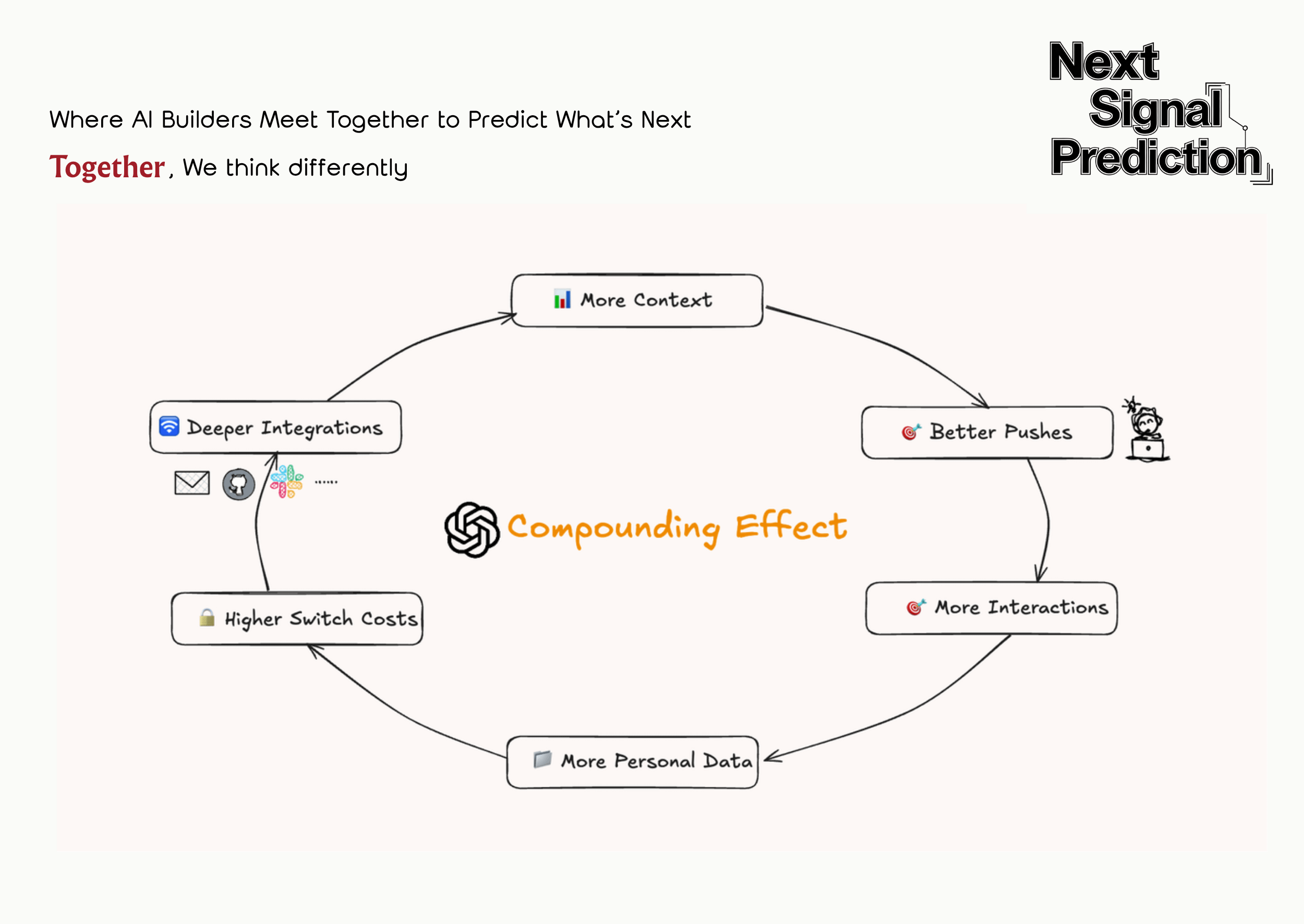
This is the clearest route to a super-app: Pulse lowers the skill barrier (no prompt-crafting), broadens the daily use cases, and can pull DAU/MAU toward 1:1, closer to a messaging app than a search tab.
It’s personalized-model-level advantage—a flywheel that accelerates with use and becomes harder to replicate over time.
4. Why Pulse will beat Google’s Playbook
Search organizes the web,Pulse organizes the user.
It lets OpenAI lower the usage barrier, compound preference data, and raise switching costs—all while building a recommendation system aimed at outcomes instead of CTR.
It also sets up a compute profile that only a model owner can stomach and optimize. In combination, those choices create a race Google can run technically but must re‑architect culturally and economically.
If Pulse evolves from restrained pushes into a truly agentic surface—cards you can accept, decline, or advance; memory that feels like continuity; actions that close loops—ChatGPT becomes everyday, all‑day assistance.
That’s not a better search engine. That’s a different internet interface. And that is how OpenAI starts to outrun Google.
5. Compute cost as moat
Pulse is expensive. Background analysis, passive triggers, and context-heavy prompts inflate inference costs by orders of magnitude. This is likely why Pulse remains gated behind the $200/month tier instead of rolling out widely.
So for those potential fast-followers, think about the scary UE, unless you own and optimize the model yourself.
The strategic read is different:
- Shifting heavy analysis into off-peak windows (like nightly deep research) smooths GPU utilization and cuts costs
- “Inference cost in new workflows” becomes the growth KPI: more proactive use cases, more learning signals, deeper product lock‑in.
- If you don’t own the model or can’t optimize inference paths, a Pulse clone will bleed. If you do, cost becomes a weapon—raising replication difficulty and strengthening infra leverage.
There’s a pragmatic counterpoint: nightly “deep research” doesn’t have to precompute everything. A sane architecture will push heavy work into cheap windows and reserve real‑time search+compose for when a user taps a card, keeping perceived latency under 10–20 seconds.
The point isn’t to waste compute; it’s to align compute with value and to own paths where tokens compound learning. In that framing, Pulse’s appetite is not a bug—it’s an investment in a more defensible loop.
Cost remains the constraint. Big‑model passes over the entire memory for every push won’t fly. The solution is memory architecture:
- Layered memory: a hot cache for recent, high‑utility items; warm stores for mid‑term habits; cold stores for long‑term facts.
- Bounded retrieval: candidate generation via lightweight retrieval and heuristics; hand off a small, relevant set for model ranking and composition.
- Budgeted reasoning: explicit token budgets per step; escalate only when the expected value of better reasoning exceeds cost.
- Feedback loops: treat card accept/dismiss and outcome completion as training signals to update both retrieval policies and language generation.
This approach preserves the intelligence where it matters—ranking a narrow candidate set, composing the final language, choosing the next best action—and keeps the rest cheap.
The strategic implication: compute cost becomes a barrier to entry. Competitors without their own models face a margin squeeze. Even if they license foundation models, they can’t optimize inference paths the way OpenAI can. That asymmetry turns Pulse’s appetite for tokens into a competitive advantage—not despite the cost, but because of it.
6. From News feed to Agent Feed
Apparently, Pulse will be misread as “Toutiao in AI-era”. It isn’t.
In the classic way, news feeds are supply‑limited (publishers can only create so much) and cohort‑optimized (CTR targets across audience segments).
An agent feed is demand‑native: it composes for one person against their own corpus and tools, and the atomic unit isn’t a post—it’s a task card. “Draft reply in my tone.” “Propose three meeting options that avoid Fridays.” “Reconcile recurring invoices and flag anomalies.” “Summarize this thread and propose next steps.” Each card is scoped to the user’s constraints and style captured in Memory.
That difference matters because every word can be tuned to the individual.
A feed optimized for CTR learns what you click; an agent feed learns how you work, what you finish, and where you stall. Early Pulse appears intentionally conservative on cadence, likely driven by compute budgets and trust calibration. That’s fine. The winning UX isn’t minimalism; it’s calibrated redundancy—enough cards to invite quick swipes and “not this” signals without overwhelming the user. The real risk isn’t “too many cards.” It’s thin personalization that collapses into generic headlines. Memory continuity plus tool access is the separation. Without both, Pulse degrades into Today’s Headlines with extra steps.
7. Proactive agent will beat prompt‑only chatbot
Chatting with great answers still requires the user to know what to ask. Most people don’t live in prompts; they live in tasks and feelings—unfinished replies, reschedules, deferred decisions, half-formed interests.
Pulse’s promise is to mine the un-asked: unresolved threads, repeated patterns, latent preferences, even the emotional tone that drives engagement.
When AI hits emotion, adoption can accelerate with near-zero paid marketing. The Ghibli-style AI art filter added an estimated 100 million users to ChatGPT in weeks; Google’s Nano Banana drove similar viral growth for Gemini.
If Pulse consistently lands helpful, personally resonant suggestions, it has that upside.
8. Preference data is the moat
Model capability is commoditizing; preference trails are not.
As frontier models converge in benchmark performance, the durable competitive edge shifts from “can the model answer this?” to “does the model know how I want this answered?” That difference, between capability and personalization, is where Pulse builds its moat.
Capability data improves models. Preference data makes products irreplaceable.
Capability data is what powers benchmarks: massive pre-training corpora, synthetic reasoning chains, evaluation sets. It’s expensive but accessible. Labs share techniques, models leak, distillation improves. Over time, capability converges—every major lab reaches “good enough” on most tasks.
Preference data is different. It’s the record of your decisions: which emails you defer, which meetings you decline, which phrasing you accept, which reminders you dismiss. It’s interaction trails that reveal not just what you asked for, but what you actually did.
This data is:
- User-specific. It can’t be scraped or licensed. It only accumulates through granted access and sustained use.
- Behavioral, not declarative. Users rarely articulate their full workflow logic. Pulse learns it by watching.
- Compounding over time. The longer you use Pulse, the more it learns your edge cases, your exceptions, your context-dependent rules. Six months of interaction history is an asset a competitor can’t replicate overnight.
This creates asymmetric lock-in. Much of your raw information—emails, calendar events, documents—can be imported with consent. Your interaction trail usually can’t be exported. There’s no “download my preference graph” button. That asymmetry raises switching costs and deepens the moat.
As users wire in email, calendars, subscriptions, bills, and health logs, the product gets better and the switching cost climbs. Pulse strengthens Memory’s lock-in and turns “who owns the user’s interaction history” into the core competitive question.
Pulse tilts toward preference data accumulation, and that’s the right tilt if the goal is durable consumer grip. The winners won’t be the labs with the best benchmarks. They’ll be the products with the longest, richest trails of “this is how I work.
9. Who can follow
Google: Can copy, but can it commit?
Technically, Google can assemble a Pulse variant fast. It already sits on Gmail, Calendar, Android, and Chrome exhaust, and it can unify identity across them.
But copying the architecture is not the same as rewiring the business. Google’s culture and economics are optimized for retrieval and ad‑centric evaluation.
Pulse optimizes for outcomes and per‑user goals. It blurs search, recommendation, and productivity into one surface where the click isn’t the target metric.
That creates friction:
- Incentives: Moving from CTR to outcome‑oriented evaluation complicates ad systems and prioritization. The best Pulse card may reduce pageviews.
- Trust contracts: Pulse needs deeper permissions and a different privacy posture than a search page. Users will scrutinize proactive pushes more than passive results.
- Cannibalization: A successful agent could route around search, threatening revenue centers.
Other incumbents
Other incumbents each have a piece:
- Behavior‑driven feed platforms excel at recommendation but lack deep dialog context and work graph access. Pulse closes that gap by unifying both intent and behavior.
- Super‑apps with dense life/work rails are natural substrates for a Pulse‑like surface. They sit atop payments, chat, and mini‑apps, and can capture interaction trails at scale.
- Productivity suites can bolt an agent onto mail, calendar, docs, and chat, but must avoid collapsing into shallow “smart suggestions” that don’t cross the chasm into daily habit.
The lesson is simple: whoever controls the default surface and the data pipes wins distribution. Pulse is OpenAI’s bid to become that surface, starting as cloud software and moving closer to the device over time.
10. What this means for startups
If Pulse becomes the default way people manage their digital lives, many existing SaaS tools will lose their reason to exist.
Tools that sit between apps and automate simple workflows are most at risk. Especially on reminders or discovery: Calendar schedulers, email triage apps, task reminders, bill-pay trackers—if Pulse can handle these natively, users won’t pay for standalone versions.
Pulse won’t replace everything. Three types of startups can survive:
- Regulated domains. Healthcare scheduling, tax filing, legal document prep. Pulse can surface the task, but execution requires compliance infrastructure it doesn’t own. If you control the licensed rails (HIPAA booking, IRS e-file API), you keep distribution even if Pulse handles discovery.
- Deep vertical expertise. A recruiting tool that ranks candidates using years of proprietary hire/fire data. Pulse might remind you to review applicants, but the ranking logic is your moat.
- High-trust transactions. Investing, insurance, major purchases. Users want brand trust and regulatory protection. Pulse might nudge you to rebalance your portfolio, but you’ll still open Vanguard to execute.
The strategy: don’t compete on reminders or discovery, compete on execution depth Pulse can’t replicate.Then integrate with Pulse so users can trigger your core action without leaving ChatGPT.
Another way is become Pulse infrastructure.If you can’t beat Pulse, plug into it:
- Offer your data. If you own valuable proprietary information—shipment tracking, customer support queues, inventory alerts—build an API that lets Pulse surface it. You lose the interface but keep backend leverage.
- Enable direct actions. Build OAuth endpoints that let Pulse execute your core workflows. Users schedule rides, approve expenses, or deploy code from a Pulse card. You lose screen time but gain passive distribution.
- Sell agent building blocks. If Pulse succeeds, hundreds of companies will want their own proactive agents. Build the infrastructure: memory systems, action orchestration, notification engines. Sell tools to companies building agents, not agents themselves.
Pulse: How OpenAI Starts Outrunning Google
Back to All
TL;DR
Over the past month, OpenAI has looked more like a consumer tech company than ever before.
Starting with Pulse, the AI lab rolled out the Sora app and an AI-native browser in quick succession, all in service of Sam Altman’s audacious goal: 1 billion WAUs .Given OpenAI’s recent pace, that target suddenly feels within reach.
Among these launches, Pulse looked unremarkable. Paywalled (Pulse is a premium feature gated behind the $200 USD/Month subscription). No viral potential like Sora. Easy to dismiss.
That’s a mistake. In Sam Altman’s “1 billion WAU super‑app” roadmap for ChatGPT, Pulse is not a side quest, it is one of OpenAI’s bids to shift the internet’s center of gravity from retrieval to anticipation.
1. What is the internet’s next center of gravity?
For twenty years, the web’s dominant posture was retrieval. You formulate intent, type a query, and a search engine distributes answers. Google perfected that posture and captured distribution, monetizing the moment of articulated need.
By launching Pulse, ChatGPT may change its posture. Based on chat history, durable Memory, and user-authorized data sources—calendars, email, messages, bills, documents—ChatGPT moves from waiting to be asked to proposing what to do next.
This is OpenAI’s credible path to outrun Google. Not by building a better search page, but by installing an agent that lives alongside work and life, learns preferences, and pushes help before you frame a question.
The pattern echoes ByteDance’s playbook: recommendation beats retrieval when you control what people see first.
2. A Distribution play, not a feature drop
Pulse is not just a feature, it’s a bid to own the default surface where decisions happen.
In a world where users are drowning in apps, the interface that curates what matters and lets you act in one click will win attention, and control distribution.
Memory was OpenAI’s wedge into continuity. Pulse is the wedge into daily habit.
Source:OpenAI
The mechanics are straightforward and powerful:
- Proactive cards convert fragments of context into preference signals—accept, dismiss, ignore, act.
- Every micro‑interaction tightens personalization; task outcomes feed back into the model’s understanding of what “success” looks like for you.
- This creates a data flywheel rival platforms can’t easily replicate, unless they also have your memory and your interaction trail.
This is also why Pulse can pull ChatGPT toward daily usage parity. Currently, ChatGPT’s DAU/MAU likely sits around 30–40%. With Pulse, that ratio could approach 1:1, iMessage-level stickiness.
Without the prompt tax, the addressable audience grows beyond power users. If the pushes remain useful and restrained, ChatGPT graduates from “tool you open” to “assistant that shows up.”
3. Pulse is OpenAI’s new data fly wheel
OpenAI is not the first to explore proactive agents, but it’s the first to ship at scale with integrated memory and cross-app context. That reflects both execution speed and data advantage: OpenAI sees what works across millions of users and can move decisively.
OpenAI’s first data flywheel was Memory.
Persistent memory keeps context across sessions, improves answer quality, and nudges users to share more about themselves.
That’s flywheel one: context → better responses → more context. It’s quiet but foundational—without continuity of memory, all proactive efforts drift toward generic content.
Pulse is flywheel No. 2. Proactive touchpoints multiply interactions even when the user isn’t prompting. Every accept, dismiss, and card-level action yields preference and outcome data. Connect Gmail, calendars, subscriptions, and accounts, and the personalization slope steepens.
But the real advantage builds at the model level. Unlike recommendation systems that optimize for clicks, Pulse learns how you work—what you prioritize, what you defer, and where you need help.
This will create three compounding advantages:
- Cross-domain synthesis
Most SaaS tools see one slice: email or calendar or documents. Pulse sees across them.It can learn you habit:
- rescheduling meetings when stressed (calendar + chat tone),
- responding faster to certain senders (email patterns),
- and document preference (document interaction ).
- Continuous fine-tuning through outcomes
Each card interaction is a training signal. When you accept a suggested reply, defer a meeting proposal, or dismiss a reminder, the model updates not just what to show you, but how success is defined for you. Over months, Pulse evolves from generic assistant to personal chief of staff who knows your quirks, your priorities, and your edge cases. This is model-level personalization that compounds with use.
- The cold-start problem becomes a moat
New entrants face brutal disadvantage: they start with zero context. Even if Google launches a competing agent, it won’t know that you always ignore LinkedIn notifications, need 15-minute buffers between calls, or that “following up” means different urgency depending on sender.
Building that understanding takes months of granted permission and quiet observation—time OpenAI already has with active users, and from which it has already benefited through compounding effects.
This is the clearest route to a super-app: Pulse lowers the skill barrier (no prompt-crafting), broadens the daily use cases, and can pull DAU/MAU toward 1:1, closer to a messaging app than a search tab.
It’s personalized-model-level advantage—a flywheel that accelerates with use and becomes harder to replicate over time.
4. Why Pulse will beat Google’s Playbook
Search organizes the web,Pulse organizes the user.
It lets OpenAI lower the usage barrier, compound preference data, and raise switching costs—all while building a recommendation system aimed at outcomes instead of CTR.
It also sets up a compute profile that only a model owner can stomach and optimize. In combination, those choices create a race Google can run technically but must re‑architect culturally and economically.
If Pulse evolves from restrained pushes into a truly agentic surface—cards you can accept, decline, or advance; memory that feels like continuity; actions that close loops—ChatGPT becomes everyday, all‑day assistance.
That’s not a better search engine. That’s a different internet interface. And that is how OpenAI starts to outrun Google.
5. Compute cost as moat
Pulse is expensive. Background analysis, passive triggers, and context-heavy prompts inflate inference costs by orders of magnitude. This is likely why Pulse remains gated behind the $200/month tier instead of rolling out widely.
So for those potential fast-followers, think about the scary UE, unless you own and optimize the model yourself.
The strategic read is different:
- Shifting heavy analysis into off-peak windows (like nightly deep research) smooths GPU utilization and cuts costs
- “Inference cost in new workflows” becomes the growth KPI: more proactive use cases, more learning signals, deeper product lock‑in.
- If you don’t own the model or can’t optimize inference paths, a Pulse clone will bleed. If you do, cost becomes a weapon—raising replication difficulty and strengthening infra leverage.
There’s a pragmatic counterpoint: nightly “deep research” doesn’t have to precompute everything. A sane architecture will push heavy work into cheap windows and reserve real‑time search+compose for when a user taps a card, keeping perceived latency under 10–20 seconds.
The point isn’t to waste compute; it’s to align compute with value and to own paths where tokens compound learning. In that framing, Pulse’s appetite is not a bug—it’s an investment in a more defensible loop.
Cost remains the constraint. Big‑model passes over the entire memory for every push won’t fly. The solution is memory architecture:
- Layered memory: a hot cache for recent, high‑utility items; warm stores for mid‑term habits; cold stores for long‑term facts.
- Bounded retrieval: candidate generation via lightweight retrieval and heuristics; hand off a small, relevant set for model ranking and composition.
- Budgeted reasoning: explicit token budgets per step; escalate only when the expected value of better reasoning exceeds cost.
- Feedback loops: treat card accept/dismiss and outcome completion as training signals to update both retrieval policies and language generation.
This approach preserves the intelligence where it matters—ranking a narrow candidate set, composing the final language, choosing the next best action—and keeps the rest cheap.
The strategic implication: compute cost becomes a barrier to entry. Competitors without their own models face a margin squeeze. Even if they license foundation models, they can’t optimize inference paths the way OpenAI can. That asymmetry turns Pulse’s appetite for tokens into a competitive advantage—not despite the cost, but because of it.
6. From News feed to Agent Feed
Apparently, Pulse will be misread as “Toutiao in AI-era”. It isn’t.
In the classic way, news feeds are supply‑limited (publishers can only create so much) and cohort‑optimized (CTR targets across audience segments).
An agent feed is demand‑native: it composes for one person against their own corpus and tools, and the atomic unit isn’t a post—it’s a task card. “Draft reply in my tone.” “Propose three meeting options that avoid Fridays.” “Reconcile recurring invoices and flag anomalies.” “Summarize this thread and propose next steps.” Each card is scoped to the user’s constraints and style captured in Memory.
That difference matters because every word can be tuned to the individual.
A feed optimized for CTR learns what you click; an agent feed learns how you work, what you finish, and where you stall. Early Pulse appears intentionally conservative on cadence, likely driven by compute budgets and trust calibration. That’s fine. The winning UX isn’t minimalism; it’s calibrated redundancy—enough cards to invite quick swipes and “not this” signals without overwhelming the user. The real risk isn’t “too many cards.” It’s thin personalization that collapses into generic headlines. Memory continuity plus tool access is the separation. Without both, Pulse degrades into Today’s Headlines with extra steps.
7. Proactive agent will beat prompt‑only chatbot
Chatting with great answers still requires the user to know what to ask. Most people don’t live in prompts; they live in tasks and feelings—unfinished replies, reschedules, deferred decisions, half-formed interests.
Pulse’s promise is to mine the un-asked: unresolved threads, repeated patterns, latent preferences, even the emotional tone that drives engagement.
When AI hits emotion, adoption can accelerate with near-zero paid marketing. The Ghibli-style AI art filter added an estimated 100 million users to ChatGPT in weeks; Google’s Nano Banana drove similar viral growth for Gemini.
If Pulse consistently lands helpful, personally resonant suggestions, it has that upside.
8. Preference data is the moat
Model capability is commoditizing; preference trails are not.
As frontier models converge in benchmark performance, the durable competitive edge shifts from “can the model answer this?” to “does the model know how I want this answered?” That difference, between capability and personalization, is where Pulse builds its moat.
Capability data improves models. Preference data makes products irreplaceable.
Capability data is what powers benchmarks: massive pre-training corpora, synthetic reasoning chains, evaluation sets. It’s expensive but accessible. Labs share techniques, models leak, distillation improves. Over time, capability converges—every major lab reaches “good enough” on most tasks.
Preference data is different. It’s the record of your decisions: which emails you defer, which meetings you decline, which phrasing you accept, which reminders you dismiss. It’s interaction trails that reveal not just what you asked for, but what you actually did.
This data is:
- User-specific. It can’t be scraped or licensed. It only accumulates through granted access and sustained use.
- Behavioral, not declarative. Users rarely articulate their full workflow logic. Pulse learns it by watching.
- Compounding over time. The longer you use Pulse, the more it learns your edge cases, your exceptions, your context-dependent rules. Six months of interaction history is an asset a competitor can’t replicate overnight.
This creates asymmetric lock-in. Much of your raw information—emails, calendar events, documents—can be imported with consent. Your interaction trail usually can’t be exported. There’s no “download my preference graph” button. That asymmetry raises switching costs and deepens the moat.
As users wire in email, calendars, subscriptions, bills, and health logs, the product gets better and the switching cost climbs. Pulse strengthens Memory’s lock-in and turns “who owns the user’s interaction history” into the core competitive question.
Pulse tilts toward preference data accumulation, and that’s the right tilt if the goal is durable consumer grip. The winners won’t be the labs with the best benchmarks. They’ll be the products with the longest, richest trails of “this is how I work.
9. Who can follow
Google: Can copy, but can it commit?
Technically, Google can assemble a Pulse variant fast. It already sits on Gmail, Calendar, Android, and Chrome exhaust, and it can unify identity across them.
But copying the architecture is not the same as rewiring the business. Google’s culture and economics are optimized for retrieval and ad‑centric evaluation.
Pulse optimizes for outcomes and per‑user goals. It blurs search, recommendation, and productivity into one surface where the click isn’t the target metric.
That creates friction:
- Incentives: Moving from CTR to outcome‑oriented evaluation complicates ad systems and prioritization. The best Pulse card may reduce pageviews.
- Trust contracts: Pulse needs deeper permissions and a different privacy posture than a search page. Users will scrutinize proactive pushes more than passive results.
- Cannibalization: A successful agent could route around search, threatening revenue centers.
Other incumbents
Other incumbents each have a piece:
- Behavior‑driven feed platforms excel at recommendation but lack deep dialog context and work graph access. Pulse closes that gap by unifying both intent and behavior.
- Super‑apps with dense life/work rails are natural substrates for a Pulse‑like surface. They sit atop payments, chat, and mini‑apps, and can capture interaction trails at scale.
- Productivity suites can bolt an agent onto mail, calendar, docs, and chat, but must avoid collapsing into shallow “smart suggestions” that don’t cross the chasm into daily habit.
The lesson is simple: whoever controls the default surface and the data pipes wins distribution. Pulse is OpenAI’s bid to become that surface, starting as cloud software and moving closer to the device over time.
10. What this means for startups
If Pulse becomes the default way people manage their digital lives, many existing SaaS tools will lose their reason to exist.
Tools that sit between apps and automate simple workflows are most at risk. Especially on reminders or discovery: Calendar schedulers, email triage apps, task reminders, bill-pay trackers—if Pulse can handle these natively, users won’t pay for standalone versions.
Pulse won’t replace everything. Three types of startups can survive:
- Regulated domains. Healthcare scheduling, tax filing, legal document prep. Pulse can surface the task, but execution requires compliance infrastructure it doesn’t own. If you control the licensed rails (HIPAA booking, IRS e-file API), you keep distribution even if Pulse handles discovery.
- Deep vertical expertise. A recruiting tool that ranks candidates using years of proprietary hire/fire data. Pulse might remind you to review applicants, but the ranking logic is your moat.
- High-trust transactions. Investing, insurance, major purchases. Users want brand trust and regulatory protection. Pulse might nudge you to rebalance your portfolio, but you’ll still open Vanguard to execute.
The strategy: don’t compete on reminders or discovery, compete on execution depth Pulse can’t replicate.Then integrate with Pulse so users can trigger your core action without leaving ChatGPT.
Another way is become Pulse infrastructure.If you can’t beat Pulse, plug into it:
- Offer your data. If you own valuable proprietary information—shipment tracking, customer support queues, inventory alerts—build an API that lets Pulse surface it. You lose the interface but keep backend leverage.
- Enable direct actions. Build OAuth endpoints that let Pulse execute your core workflows. Users schedule rides, approve expenses, or deploy code from a Pulse card. You lose screen time but gain passive distribution.
- Sell agent building blocks. If Pulse succeeds, hundreds of companies will want their own proactive agents. Build the infrastructure: memory systems, action orchestration, notification engines. Sell tools to companies building agents, not agents themselves.