
Building Robot Bodies: Not a Supply Chain. A Learning Loop.
back to All
TL;DR
- China's robotics advantage is not any single robot or factory. It is the speed of the hardware learning loop around them.
- Much of that capability was inherited from automotive, industrial automation, machine tools, and consumer electronics. Talent, suppliers, and accumulated process knowledge shape where the loop starts.
- For US teams, the practical question is which components can accelerate development, which modules must come under tighter control before scale, and whether each deployment improves the next machine.
Read and download the full 36-page report here.
How China compresses the robotics hardware learning loop, and what US teams can learn from it.
China's robotics advantage is easy to misread.
The obvious evidence is cheaper humanoids, more units, and a deeper component base. Those signals are real. They do not prove that humanoids have found broad, repeatable customer demand.
The more consequential advantage is the speed at which imperfect hardware can become better.
Lower component costs support more builds. Production exposes failures that prototypes hide. Deployments create task, service, reliability, and economic evidence. That evidence shapes the next model and the next hardware revision.
China has built the industry's fastest learning environment for the robot body. Commercial proof is still catching up.
The Body Problem Is Now a Market-Access Problem
For years, a US robotics company could make a reasonable choice: own the intelligence, buy much of the body, and postpone the supply-chain question until the product worked.
That strategy is now harder to postpone.
A recent FCC decision has made the origin of advanced robotic hardware a market-access question for US teams. The policy details will vary by product. The strategic implication is simpler: the body can no longer be treated as a sourcing issue to solve after the product works.
Compliance is the immediate task. The harder problem is industrial.
In one benchmark humanoid bill of materials, integrated joints and actuators account for roughly 60% of component cost. Dexterous hands add roughly 15%. The visible chassis is only a small part of the machine. For many robots, the joint will determine whether the body can become meaningfully domestic.
At the same time, China is opening a public-capital channel for the robot body. Unitree disclosed 5,215 humanoid sales and RMB 867.8 million in humanoid revenue for 2025. Its Shanghai listing raised roughly RMB 6.1 billion. An IPO does not establish broad end demand, but it gives the next hardware cycle another source of capital.
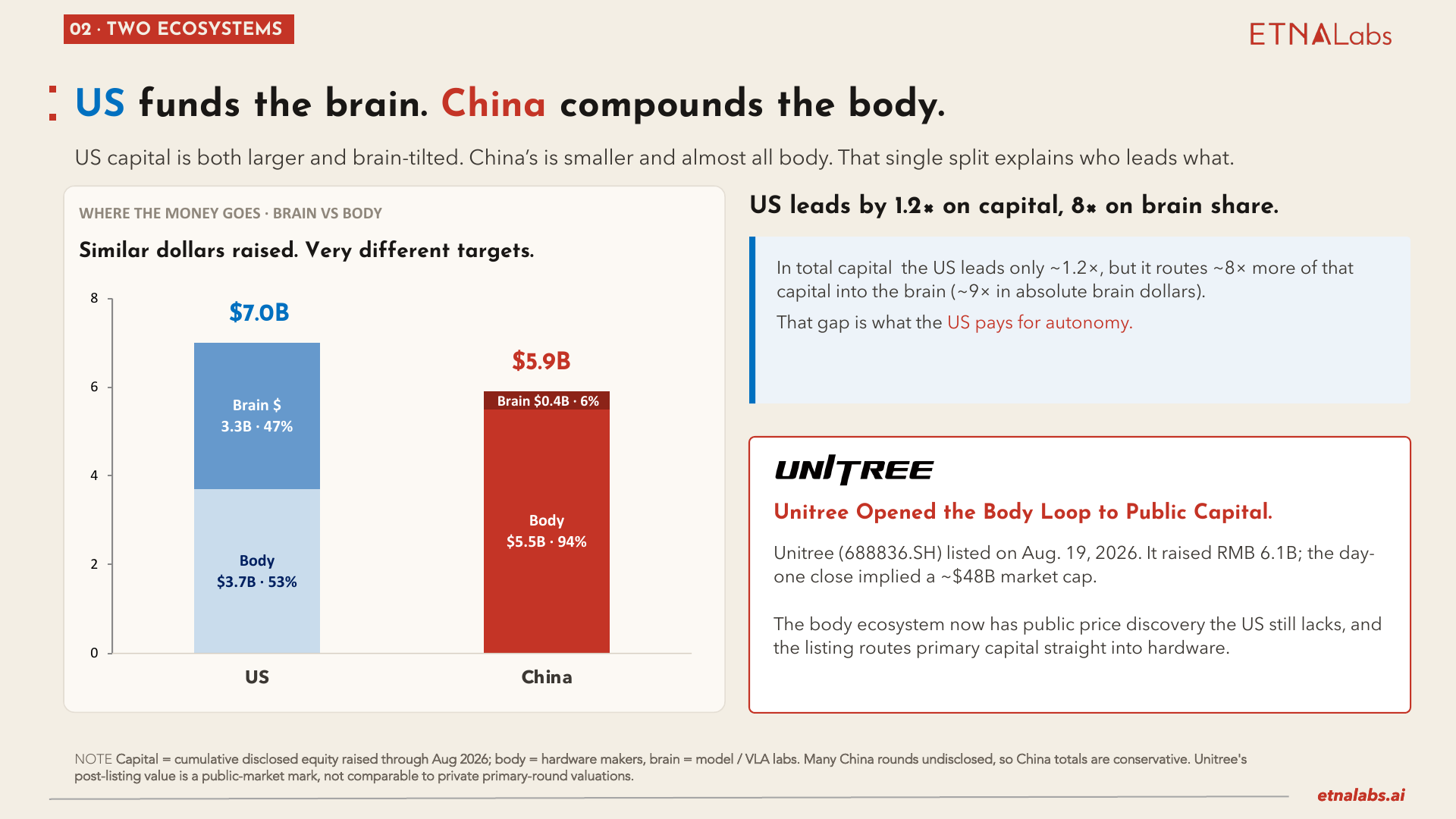
These are different developments, not two sides of the same policy story. Together, however, they sharpen one question: where will the capability to revise, qualify, and improve the robot body compound next?
Two Ecosystems, Two Starting Points
Hardware ecosystems do not begin with a blank sheet. Founders carry the capabilities of the systems that trained them.
Our founding-team lineage analysis shows a clear difference.
US teams are more entrepreneurial and AI-led. Chinese teams draw more heavily from academia, automotive, industrial automation, consumer electronics, and hardware engineering.
Those backgrounds influence what each ecosystem builds first. US lineages skew toward intelligence and full-stack systems. Chinese lineages put more weight on the body and its components.
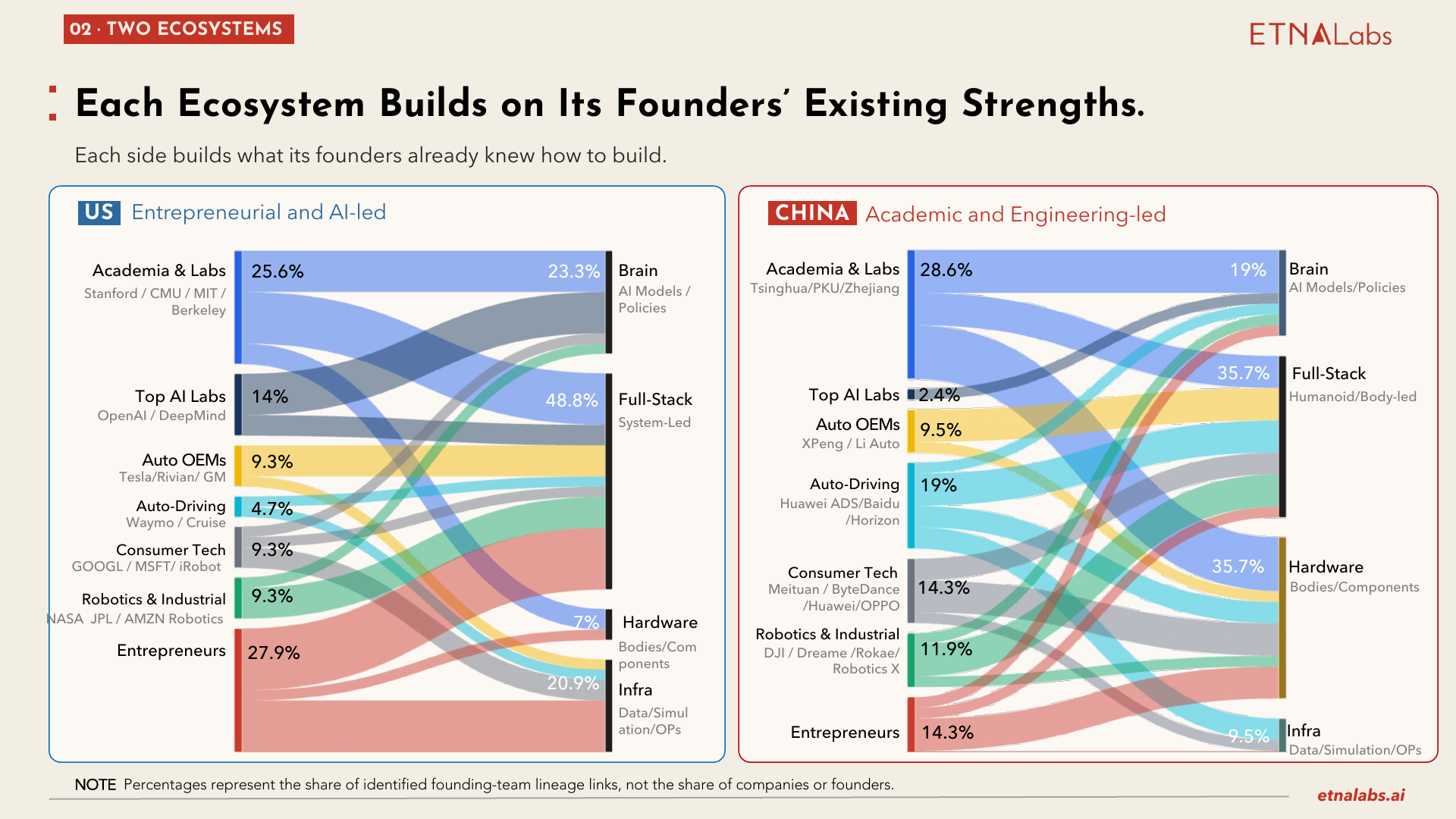
This is not a claim about nationality or innate advantage. It is a map of inherited capability. Teams tend to internalize the bottlenecks they already know how to solve. Those starting capabilities then determine which learning loops can turn fastest.
Volume Teaches Before It Validates
Three disclosed Chinese leaders sold or shipped roughly 11,500 robots in 2025, an indicative 10 to 20 times the US total in our analysis. Unitree alone disclosed 5,215 humanoid sales, while entry prices fell as low as roughly $4,100.
The numbers show access and production volume. They do not yet show broad commercial validation.
Most disclosed Chinese humanoid units in 2025 remained in demos, research shipments, or pilots. No Chinese humanoid has yet demonstrated broad, paid, repeatable deployment across independent customers. The strongest scaled-fleet evidence in the report still comes from the United States, where Agility Robotics says Digit robots at GXO have moved more than 100,000 totes.
Volume still creates value before the business model is proven. At hundreds or thousands of units, assembly sequence, yield, burn-in, thermal limits, quality control, repairability, and supplier consistency become design problems. The factory reveals what the lab cannot.
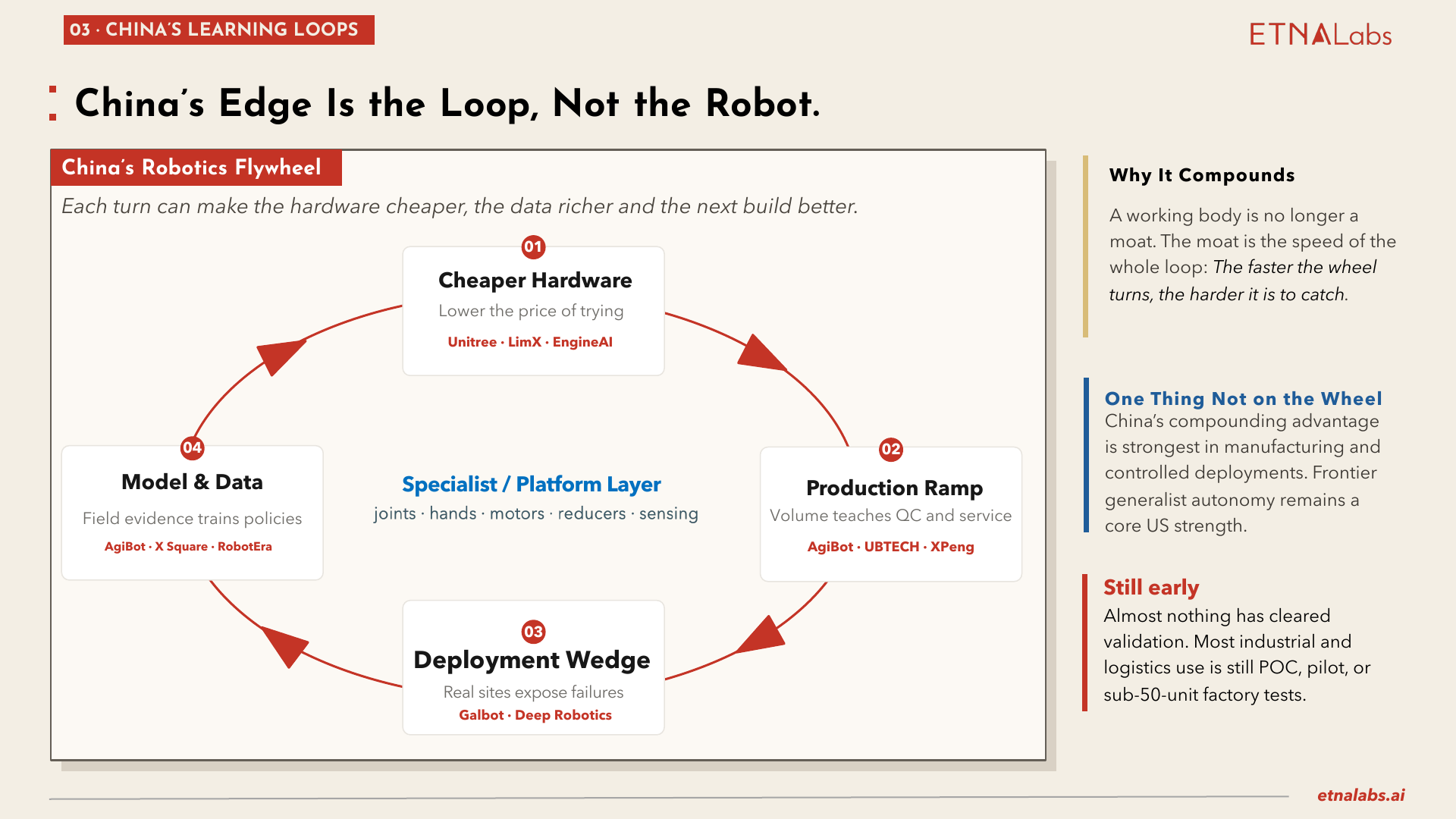
This is the central distinction in our report: shipment volume is evidence of production learning. Paid, repeatable operation is evidence of commercial learning. Robotics companies need both, and they should not be confused.
The Hardware Loop Was Inherited
The common picture is that humanoid companies are now creating a new supply chain around a new product. In China, much of the relevant hardware capacity arrived already paid for by larger industries.
Industrial automation paid for reducers, servos, and drives. Machine tools paid for precision screws. Electric vehicles paid for lidar, batteries, automotive electronics, and Tier 1 integration. Smartphones paid for miniature motors, sensors, gearboxes, and high-volume electronics assembly.
Robotics moved into capacity that larger industries had already financed.
This inheritance changes the cost and speed of iteration. Tooling, metrology, qualification routines, inspection lines, and yield learning already exist. Multiple suppliers can enter the same layer. Competition pushes prices down. Lower prices support more attempts, and those attempts create feedback for robot-specific components.
The loop is not equally mature everywhere. Motion components benefit from established industries. Tactile sensing, force sensing, tendon materials, and service-life evidence remain much less developed. These gaps are where a new supplier can still create meaningful leverage.
Hardware Strategy Comes Down to Control
Once a credible body can be assembled from available components, differentiation moves inward: torque density, heat, backlash, lifetime, sensing, firmware, repairability, and service.
In practice, teams have three paths.
- A company can build the joint, owning the cost floor, packaging, thermals, and reliability work,
- It can partner with an automotive or electronics manufacturer, gaining production speed while giving up some control of the critical module.
- Or it can buy an integrated joint to reach task validation quickly, placing its long-term bet on models, data, and customer workflow.
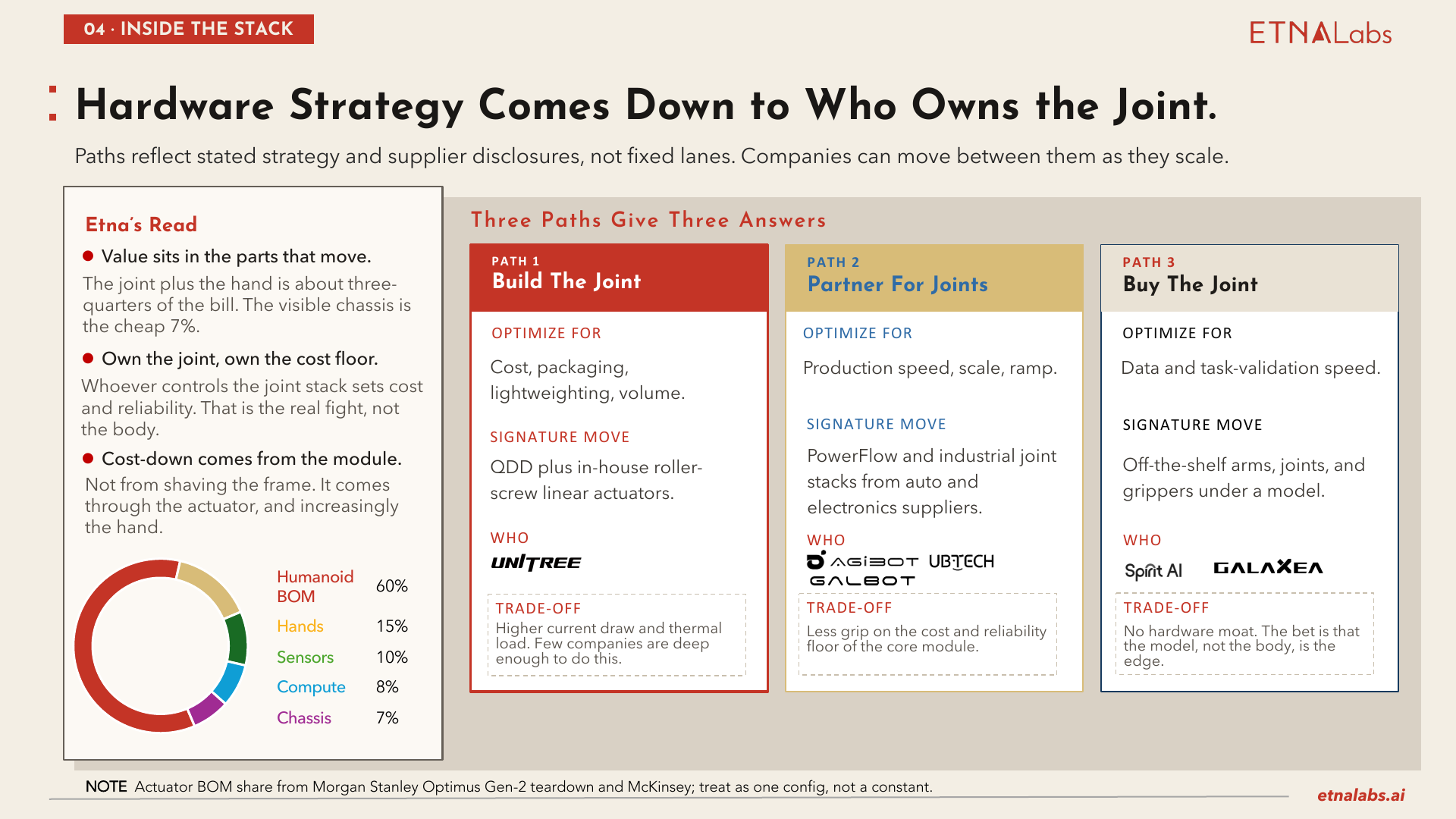
All three paths can be credible. Trouble begins when a prototype sourcing decision quietly becomes the scale architecture. A black-box joint bought for speed can later become the reliability ceiling.
The FCC makes that architectural choice more urgent for products intended for the US market. Drawings, tooling, firmware access, change control, quality data, failure analysis, and repair rights matter far more after design lock than they do during a demo.
Our framework suggests three practical plays for US teams:
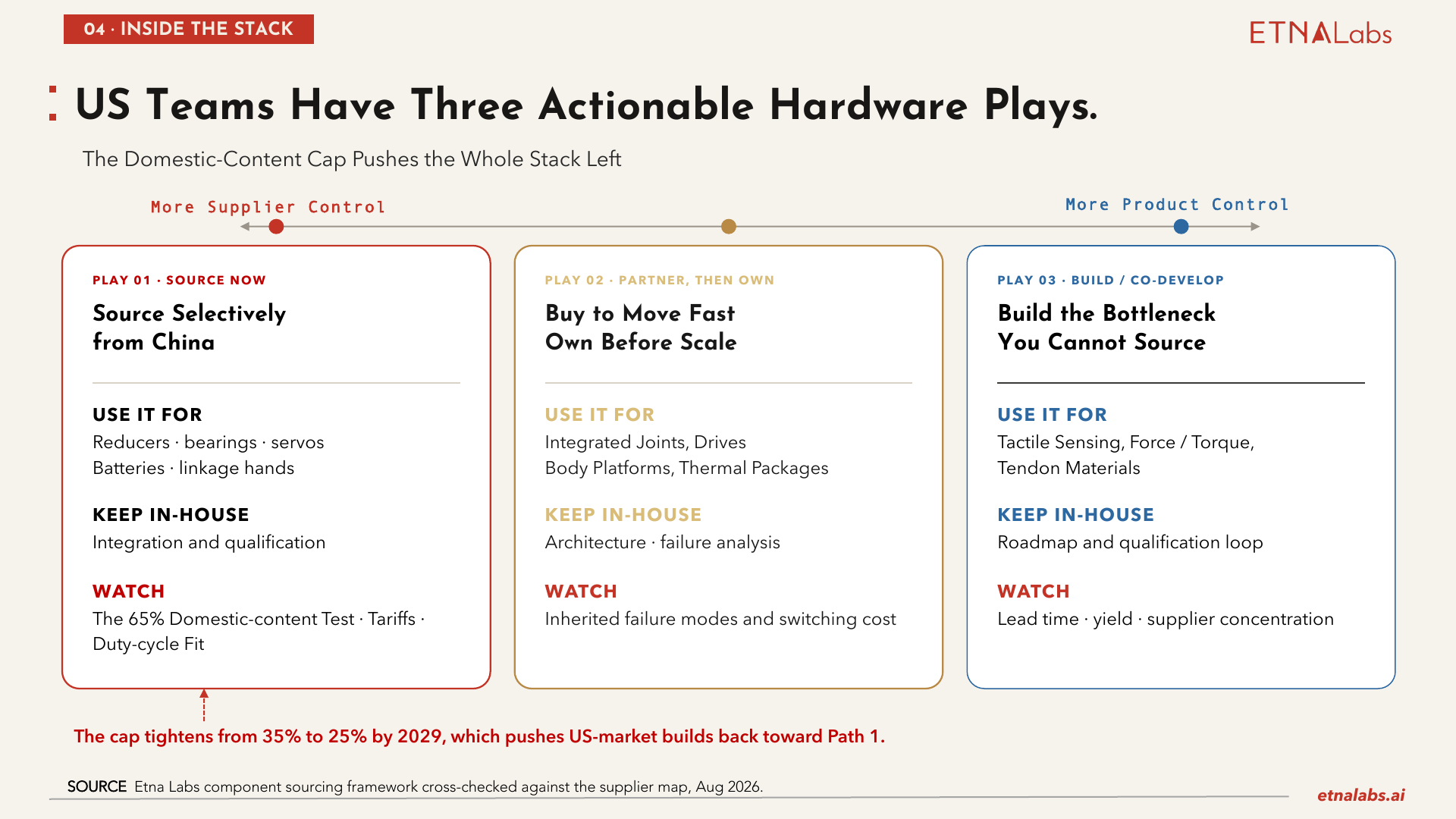
- Source mature, multi-vendor components selectively to move faster now.
- Partner for integrated modules, with a plan to own or co-own the bottleneck before scale.
- Build or co-develop the layers that cannot yet be sourced with credible lifetime, yield, or supplier depth.
A Deployment Is Only as Valuable as What It Teaches
Robotics companies often count sites. They should count learning.
A demo proves motion. A research shipment proves access and support. A customer pilot proves willingness to experiment. A repeatable small-batch trial begins to establish reliability. Paid deployment tests customer economics. Repeated operation at scale creates operational learning.
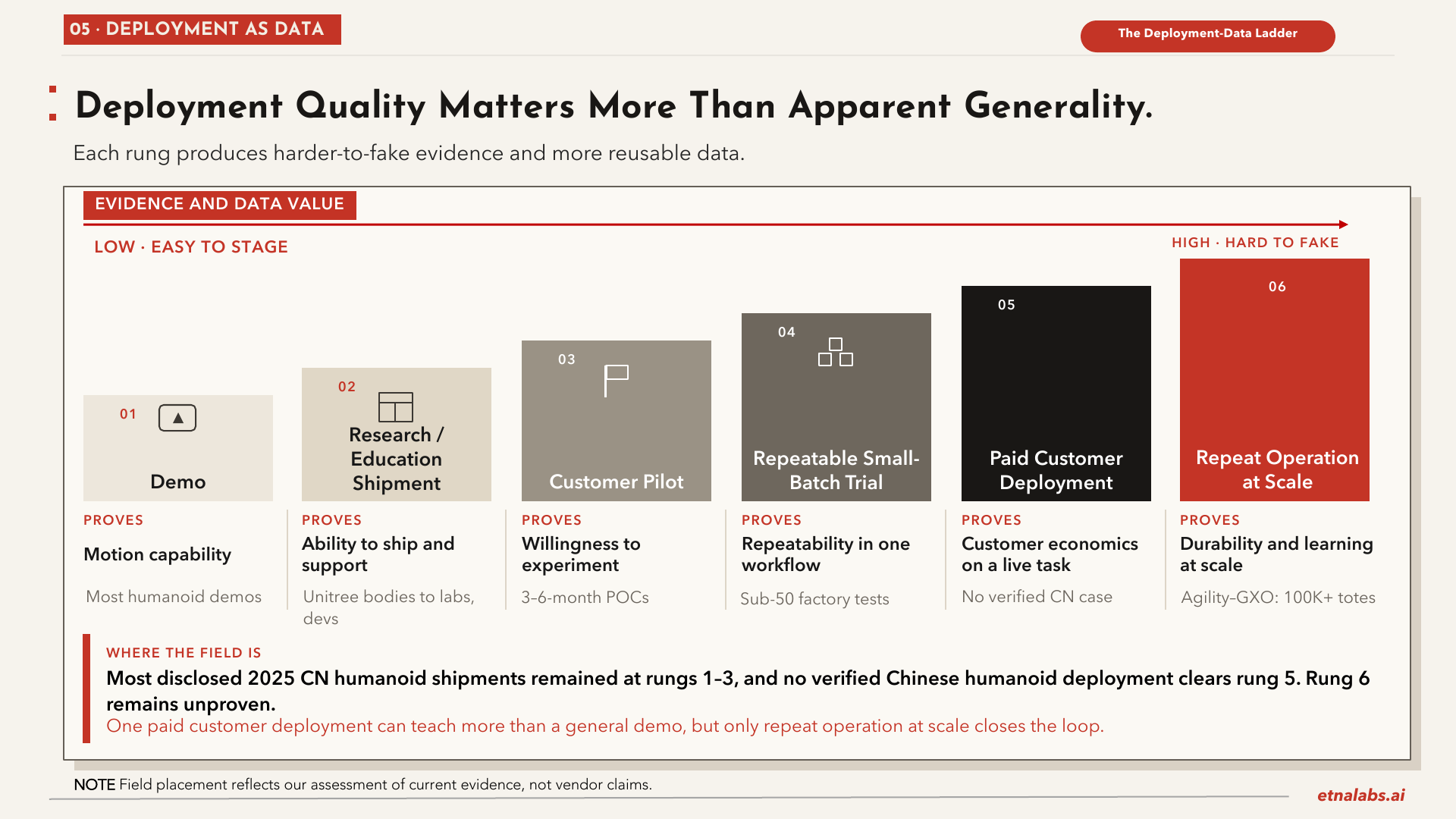
The rare valuable site produces four kinds of evidence: task data, failure data, service data, and ROI data. Most deployments produce only one or two and still get called deployments.
This also changes how teams should think about generality. A fixed arm, wheeled manipulator, quadruped, or constrained cell may create more useful evidence than a humanoid performing a less measurable task. Early deployments often benefit from a narrower machine. Generality adds engineering cost before it adds customer value.
Build the Loop, Not Just the Body
The United States retains a stronger concentration of frontier model talent and capital. China has the denser hardware ecosystem and faster physical iteration cycle. The opportunity lies in combining those strengths without giving up control of the layers that determine market access, cost, reliability, and learning speed.
US teams should preserve ownership of intelligence, system architecture, controls, safety, data, and customer integration. Mature components can come from the fastest available hardware loop. Each team still needs a clear view of which layers are safe to source, which modules belong only in a prototype, and which bottlenecks deserve internal development or a close partnership.
The strongest teams will turn hardware, production, deployment, data, and models into one working loop, then keep it moving after the demo ends.
Explore the full 36-page slide report and download the PDF here.
Policy references are current to August 2026. This article is research, not legal advice. Company figures and assessments reflect the report's evidence cutoff in June to August 2026. The full report distinguishes disclosed figures, reported figures, estimates, and Etna Labs' interpretations.
Building Robot Bodies: Not a Supply Chain. A Learning Loop.
Back to All
TL;DR
- China's robotics advantage is not any single robot or factory. It is the speed of the hardware learning loop around them.
- Much of that capability was inherited from automotive, industrial automation, machine tools, and consumer electronics. Talent, suppliers, and accumulated process knowledge shape where the loop starts.
- For US teams, the practical question is which components can accelerate development, which modules must come under tighter control before scale, and whether each deployment improves the next machine.
Read and download the full 36-page report here.
How China compresses the robotics hardware learning loop, and what US teams can learn from it.
China's robotics advantage is easy to misread.
The obvious evidence is cheaper humanoids, more units, and a deeper component base. Those signals are real. They do not prove that humanoids have found broad, repeatable customer demand.
The more consequential advantage is the speed at which imperfect hardware can become better.
Lower component costs support more builds. Production exposes failures that prototypes hide. Deployments create task, service, reliability, and economic evidence. That evidence shapes the next model and the next hardware revision.
China has built the industry's fastest learning environment for the robot body. Commercial proof is still catching up.
The Body Problem Is Now a Market-Access Problem
For years, a US robotics company could make a reasonable choice: own the intelligence, buy much of the body, and postpone the supply-chain question until the product worked.
That strategy is now harder to postpone.
A recent FCC decision has made the origin of advanced robotic hardware a market-access question for US teams. The policy details will vary by product. The strategic implication is simpler: the body can no longer be treated as a sourcing issue to solve after the product works.
Compliance is the immediate task. The harder problem is industrial.
In one benchmark humanoid bill of materials, integrated joints and actuators account for roughly 60% of component cost. Dexterous hands add roughly 15%. The visible chassis is only a small part of the machine. For many robots, the joint will determine whether the body can become meaningfully domestic.
At the same time, China is opening a public-capital channel for the robot body. Unitree disclosed 5,215 humanoid sales and RMB 867.8 million in humanoid revenue for 2025. Its Shanghai listing raised roughly RMB 6.1 billion. An IPO does not establish broad end demand, but it gives the next hardware cycle another source of capital.
These are different developments, not two sides of the same policy story. Together, however, they sharpen one question: where will the capability to revise, qualify, and improve the robot body compound next?
Two Ecosystems, Two Starting Points
Hardware ecosystems do not begin with a blank sheet. Founders carry the capabilities of the systems that trained them.
Our founding-team lineage analysis shows a clear difference.
US teams are more entrepreneurial and AI-led. Chinese teams draw more heavily from academia, automotive, industrial automation, consumer electronics, and hardware engineering.
Those backgrounds influence what each ecosystem builds first. US lineages skew toward intelligence and full-stack systems. Chinese lineages put more weight on the body and its components.
This is not a claim about nationality or innate advantage. It is a map of inherited capability. Teams tend to internalize the bottlenecks they already know how to solve. Those starting capabilities then determine which learning loops can turn fastest.
Volume Teaches Before It Validates
Three disclosed Chinese leaders sold or shipped roughly 11,500 robots in 2025, an indicative 10 to 20 times the US total in our analysis. Unitree alone disclosed 5,215 humanoid sales, while entry prices fell as low as roughly $4,100.
The numbers show access and production volume. They do not yet show broad commercial validation.
Most disclosed Chinese humanoid units in 2025 remained in demos, research shipments, or pilots. No Chinese humanoid has yet demonstrated broad, paid, repeatable deployment across independent customers. The strongest scaled-fleet evidence in the report still comes from the United States, where Agility Robotics says Digit robots at GXO have moved more than 100,000 totes.
Volume still creates value before the business model is proven. At hundreds or thousands of units, assembly sequence, yield, burn-in, thermal limits, quality control, repairability, and supplier consistency become design problems. The factory reveals what the lab cannot.
This is the central distinction in our report: shipment volume is evidence of production learning. Paid, repeatable operation is evidence of commercial learning. Robotics companies need both, and they should not be confused.
The Hardware Loop Was Inherited
The common picture is that humanoid companies are now creating a new supply chain around a new product. In China, much of the relevant hardware capacity arrived already paid for by larger industries.
Industrial automation paid for reducers, servos, and drives. Machine tools paid for precision screws. Electric vehicles paid for lidar, batteries, automotive electronics, and Tier 1 integration. Smartphones paid for miniature motors, sensors, gearboxes, and high-volume electronics assembly.
Robotics moved into capacity that larger industries had already financed.
This inheritance changes the cost and speed of iteration. Tooling, metrology, qualification routines, inspection lines, and yield learning already exist. Multiple suppliers can enter the same layer. Competition pushes prices down. Lower prices support more attempts, and those attempts create feedback for robot-specific components.
The loop is not equally mature everywhere. Motion components benefit from established industries. Tactile sensing, force sensing, tendon materials, and service-life evidence remain much less developed. These gaps are where a new supplier can still create meaningful leverage.
Hardware Strategy Comes Down to Control
Once a credible body can be assembled from available components, differentiation moves inward: torque density, heat, backlash, lifetime, sensing, firmware, repairability, and service.
In practice, teams have three paths.
- A company can build the joint, owning the cost floor, packaging, thermals, and reliability work,
- It can partner with an automotive or electronics manufacturer, gaining production speed while giving up some control of the critical module.
- Or it can buy an integrated joint to reach task validation quickly, placing its long-term bet on models, data, and customer workflow.
All three paths can be credible. Trouble begins when a prototype sourcing decision quietly becomes the scale architecture. A black-box joint bought for speed can later become the reliability ceiling.
The FCC makes that architectural choice more urgent for products intended for the US market. Drawings, tooling, firmware access, change control, quality data, failure analysis, and repair rights matter far more after design lock than they do during a demo.
Our framework suggests three practical plays for US teams:
- Source mature, multi-vendor components selectively to move faster now.
- Partner for integrated modules, with a plan to own or co-own the bottleneck before scale.
- Build or co-develop the layers that cannot yet be sourced with credible lifetime, yield, or supplier depth.
A Deployment Is Only as Valuable as What It Teaches
Robotics companies often count sites. They should count learning.
A demo proves motion. A research shipment proves access and support. A customer pilot proves willingness to experiment. A repeatable small-batch trial begins to establish reliability. Paid deployment tests customer economics. Repeated operation at scale creates operational learning.
The rare valuable site produces four kinds of evidence: task data, failure data, service data, and ROI data. Most deployments produce only one or two and still get called deployments.
This also changes how teams should think about generality. A fixed arm, wheeled manipulator, quadruped, or constrained cell may create more useful evidence than a humanoid performing a less measurable task. Early deployments often benefit from a narrower machine. Generality adds engineering cost before it adds customer value.
Build the Loop, Not Just the Body
The United States retains a stronger concentration of frontier model talent and capital. China has the denser hardware ecosystem and faster physical iteration cycle. The opportunity lies in combining those strengths without giving up control of the layers that determine market access, cost, reliability, and learning speed.
US teams should preserve ownership of intelligence, system architecture, controls, safety, data, and customer integration. Mature components can come from the fastest available hardware loop. Each team still needs a clear view of which layers are safe to source, which modules belong only in a prototype, and which bottlenecks deserve internal development or a close partnership.
The strongest teams will turn hardware, production, deployment, data, and models into one working loop, then keep it moving after the demo ends.
Explore the full 36-page slide report and download the PDF here.
Policy references are current to August 2026. This article is research, not legal advice. Company figures and assessments reflect the report's evidence cutoff in June to August 2026. The full report distinguishes disclosed figures, reported figures, estimates, and Etna Labs' interpretations.
Building Robot Bodies: Not a Supply Chain. A Learning Loop.
Back to All
TL;DR
- China's robotics advantage is not any single robot or factory. It is the speed of the hardware learning loop around them.
- Much of that capability was inherited from automotive, industrial automation, machine tools, and consumer electronics. Talent, suppliers, and accumulated process knowledge shape where the loop starts.
- For US teams, the practical question is which components can accelerate development, which modules must come under tighter control before scale, and whether each deployment improves the next machine.
Read and download the full 36-page report here.
How China compresses the robotics hardware learning loop, and what US teams can learn from it.
China's robotics advantage is easy to misread.
The obvious evidence is cheaper humanoids, more units, and a deeper component base. Those signals are real. They do not prove that humanoids have found broad, repeatable customer demand.
The more consequential advantage is the speed at which imperfect hardware can become better.
Lower component costs support more builds. Production exposes failures that prototypes hide. Deployments create task, service, reliability, and economic evidence. That evidence shapes the next model and the next hardware revision.
China has built the industry's fastest learning environment for the robot body. Commercial proof is still catching up.
The Body Problem Is Now a Market-Access Problem
For years, a US robotics company could make a reasonable choice: own the intelligence, buy much of the body, and postpone the supply-chain question until the product worked.
That strategy is now harder to postpone.
A recent FCC decision has made the origin of advanced robotic hardware a market-access question for US teams. The policy details will vary by product. The strategic implication is simpler: the body can no longer be treated as a sourcing issue to solve after the product works.
Compliance is the immediate task. The harder problem is industrial.
In one benchmark humanoid bill of materials, integrated joints and actuators account for roughly 60% of component cost. Dexterous hands add roughly 15%. The visible chassis is only a small part of the machine. For many robots, the joint will determine whether the body can become meaningfully domestic.
At the same time, China is opening a public-capital channel for the robot body. Unitree disclosed 5,215 humanoid sales and RMB 867.8 million in humanoid revenue for 2025. Its Shanghai listing raised roughly RMB 6.1 billion. An IPO does not establish broad end demand, but it gives the next hardware cycle another source of capital.
These are different developments, not two sides of the same policy story. Together, however, they sharpen one question: where will the capability to revise, qualify, and improve the robot body compound next?
Two Ecosystems, Two Starting Points
Hardware ecosystems do not begin with a blank sheet. Founders carry the capabilities of the systems that trained them.
Our founding-team lineage analysis shows a clear difference.
US teams are more entrepreneurial and AI-led. Chinese teams draw more heavily from academia, automotive, industrial automation, consumer electronics, and hardware engineering.
Those backgrounds influence what each ecosystem builds first. US lineages skew toward intelligence and full-stack systems. Chinese lineages put more weight on the body and its components.
This is not a claim about nationality or innate advantage. It is a map of inherited capability. Teams tend to internalize the bottlenecks they already know how to solve. Those starting capabilities then determine which learning loops can turn fastest.
Volume Teaches Before It Validates
Three disclosed Chinese leaders sold or shipped roughly 11,500 robots in 2025, an indicative 10 to 20 times the US total in our analysis. Unitree alone disclosed 5,215 humanoid sales, while entry prices fell as low as roughly $4,100.
The numbers show access and production volume. They do not yet show broad commercial validation.
Most disclosed Chinese humanoid units in 2025 remained in demos, research shipments, or pilots. No Chinese humanoid has yet demonstrated broad, paid, repeatable deployment across independent customers. The strongest scaled-fleet evidence in the report still comes from the United States, where Agility Robotics says Digit robots at GXO have moved more than 100,000 totes.
Volume still creates value before the business model is proven. At hundreds or thousands of units, assembly sequence, yield, burn-in, thermal limits, quality control, repairability, and supplier consistency become design problems. The factory reveals what the lab cannot.
This is the central distinction in our report: shipment volume is evidence of production learning. Paid, repeatable operation is evidence of commercial learning. Robotics companies need both, and they should not be confused.
The Hardware Loop Was Inherited
The common picture is that humanoid companies are now creating a new supply chain around a new product. In China, much of the relevant hardware capacity arrived already paid for by larger industries.
Industrial automation paid for reducers, servos, and drives. Machine tools paid for precision screws. Electric vehicles paid for lidar, batteries, automotive electronics, and Tier 1 integration. Smartphones paid for miniature motors, sensors, gearboxes, and high-volume electronics assembly.
Robotics moved into capacity that larger industries had already financed.
This inheritance changes the cost and speed of iteration. Tooling, metrology, qualification routines, inspection lines, and yield learning already exist. Multiple suppliers can enter the same layer. Competition pushes prices down. Lower prices support more attempts, and those attempts create feedback for robot-specific components.
The loop is not equally mature everywhere. Motion components benefit from established industries. Tactile sensing, force sensing, tendon materials, and service-life evidence remain much less developed. These gaps are where a new supplier can still create meaningful leverage.
Hardware Strategy Comes Down to Control
Once a credible body can be assembled from available components, differentiation moves inward: torque density, heat, backlash, lifetime, sensing, firmware, repairability, and service.
In practice, teams have three paths.
- A company can build the joint, owning the cost floor, packaging, thermals, and reliability work,
- It can partner with an automotive or electronics manufacturer, gaining production speed while giving up some control of the critical module.
- Or it can buy an integrated joint to reach task validation quickly, placing its long-term bet on models, data, and customer workflow.
All three paths can be credible. Trouble begins when a prototype sourcing decision quietly becomes the scale architecture. A black-box joint bought for speed can later become the reliability ceiling.
The FCC makes that architectural choice more urgent for products intended for the US market. Drawings, tooling, firmware access, change control, quality data, failure analysis, and repair rights matter far more after design lock than they do during a demo.
Our framework suggests three practical plays for US teams:
- Source mature, multi-vendor components selectively to move faster now.
- Partner for integrated modules, with a plan to own or co-own the bottleneck before scale.
- Build or co-develop the layers that cannot yet be sourced with credible lifetime, yield, or supplier depth.
A Deployment Is Only as Valuable as What It Teaches
Robotics companies often count sites. They should count learning.
A demo proves motion. A research shipment proves access and support. A customer pilot proves willingness to experiment. A repeatable small-batch trial begins to establish reliability. Paid deployment tests customer economics. Repeated operation at scale creates operational learning.
The rare valuable site produces four kinds of evidence: task data, failure data, service data, and ROI data. Most deployments produce only one or two and still get called deployments.
This also changes how teams should think about generality. A fixed arm, wheeled manipulator, quadruped, or constrained cell may create more useful evidence than a humanoid performing a less measurable task. Early deployments often benefit from a narrower machine. Generality adds engineering cost before it adds customer value.
Build the Loop, Not Just the Body
The United States retains a stronger concentration of frontier model talent and capital. China has the denser hardware ecosystem and faster physical iteration cycle. The opportunity lies in combining those strengths without giving up control of the layers that determine market access, cost, reliability, and learning speed.
US teams should preserve ownership of intelligence, system architecture, controls, safety, data, and customer integration. Mature components can come from the fastest available hardware loop. Each team still needs a clear view of which layers are safe to source, which modules belong only in a prototype, and which bottlenecks deserve internal development or a close partnership.
The strongest teams will turn hardware, production, deployment, data, and models into one working loop, then keep it moving after the demo ends.
Explore the full 36-page slide report and download the PDF here.
Policy references are current to August 2026. This article is research, not legal advice. Company figures and assessments reflect the report's evidence cutoff in June to August 2026. The full report distinguishes disclosed figures, reported figures, estimates, and Etna Labs' interpretations.